
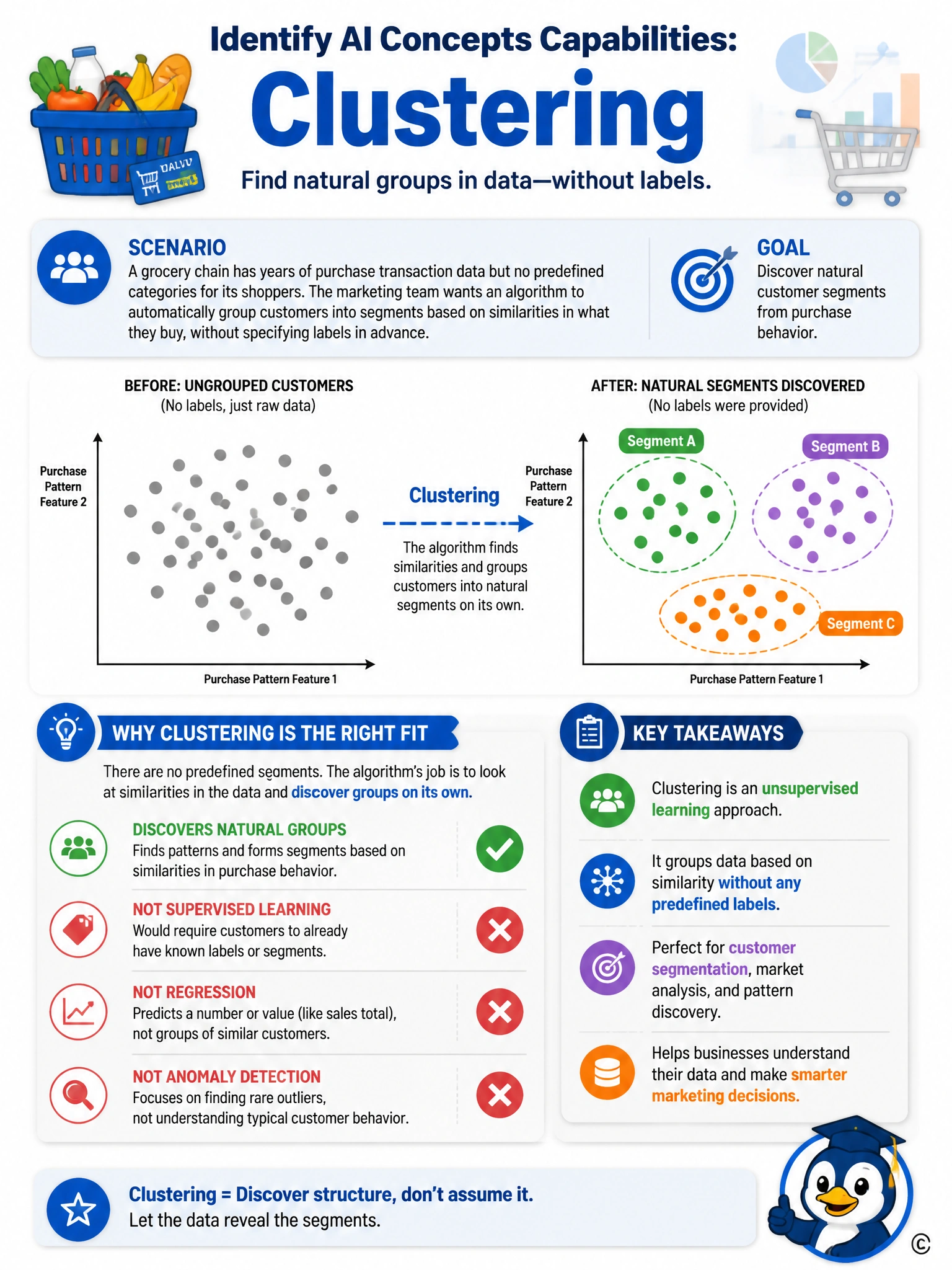
A grocery chain has years of purchase transaction data but no predefined categories for its shoppers. The marketing team wants an algorithm to automatically group customers into segments based on similarities in what they buy, without specifying labels in advance. Which machine learning approach fits this need?
Select an answer to reveal the explanation.
Short Explanation
The team has piles of purchase history but nobody has ever sat down and defined what a segment is supposed to look like. That's the giveaway: when you want an algorithm to look at similarities in the data and sort things into natural groups on its own, without anyone pre-labeling the answer, you're describing an approach that discovers structure rather than confirming it. That's different from a technique that needs each customer already tagged with a known label to learn from, since no such tags exist yet. It's also different from a method built to predict a single number, like a sales total, because the goal here is grouping, not forecasting a value. And it's not about hunting for the rare weird case that doesn't fit a pattern, since the goal is understanding the whole customer base's typical behavior, not flagging outliers.
Full Explanation
The correct answer is C. The marketing team has transaction data but no predefined customer categories, and wants an algorithm to discover natural groupings of shoppers based on purchasing similarity on its own — that is precisely what clustering does, organizing data points into groups without requiring labeled examples in advance. Option A is incorrect because classification requires a training dataset where each customer is already labeled with a known category, which the team does not have here since no categories exist yet. Option B is incorrect because regression predicts a continuous numeric value, such as forecasting a sales figure, rather than organizing customers into groups. Option D is incorrect because anomaly detection is built to flag unusual outliers that deviate from normal patterns, not to sort the broader customer base into meaningful, typical segments for marketing purposes.