
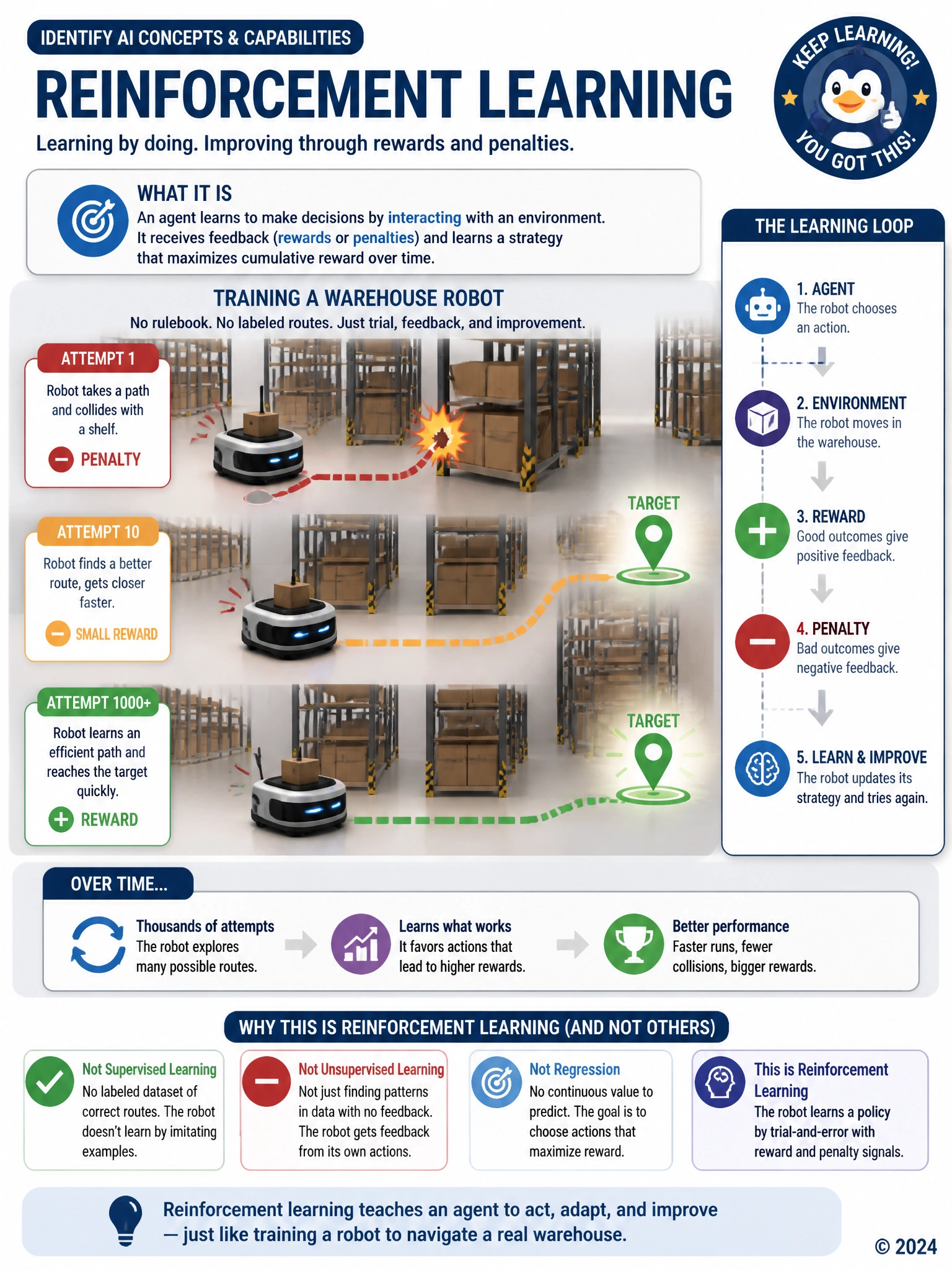
An engineering team is training a warehouse robot to navigate around shelving units. The robot has no labeled dataset of correct paths; instead it repeatedly attempts routes and receives a positive score when it reaches the target faster and a penalty when it collides with obstacles, gradually improving its behavior over thousands of attempts. Which type of machine learning does this describe?
Select an answer to reveal the explanation.
Short Explanation
Picture a robot bumping around a warehouse with nobody handing it a rulebook of correct routes. Instead, every time it gets closer to its target quickly, it gets a little reward signal, and every time it clips a shelf, it gets a penalty. Over thousands of attempts it starts favoring the moves that pay off and avoiding the ones that cost it. That trial-and-error, reward-driven loop is a distinctly different animal from learning off a labeled dataset, where you'd already have examples marked as right or wrong routes to imitate. It's also different from just spotting patterns in existing data with no feedback at all, since here the robot's own actions generate the signal it learns from. And it's not about crunching historical numbers to predict a continuous value either — there's no such prediction target, just behavior shaped by consequences over time.
Full Explanation
The correct answer is B. The robot has no dataset of correct paths to learn from; instead it takes actions, observes a reward when it reaches the target quickly and a penalty when it collides with obstacles, and adjusts its behavior over many trials based on that feedback — this trial-and-reward learning loop is the defining trait of reinforcement learning. Option A is incorrect because supervised learning requires a labeled dataset of input-output pairs, such as example paths marked correct or incorrect, which does not exist here. Option C is incorrect because unsupervised learning looks for structure or groupings within existing data without any feedback signal, whereas the robot is actively receiving rewards and penalties tied to its own actions. Option D is incorrect because regression is a supervised technique for predicting a continuous numeric value from labeled training examples, and the robot is not predicting a number from historical data, it is improving behavior through consequences of its own actions.