
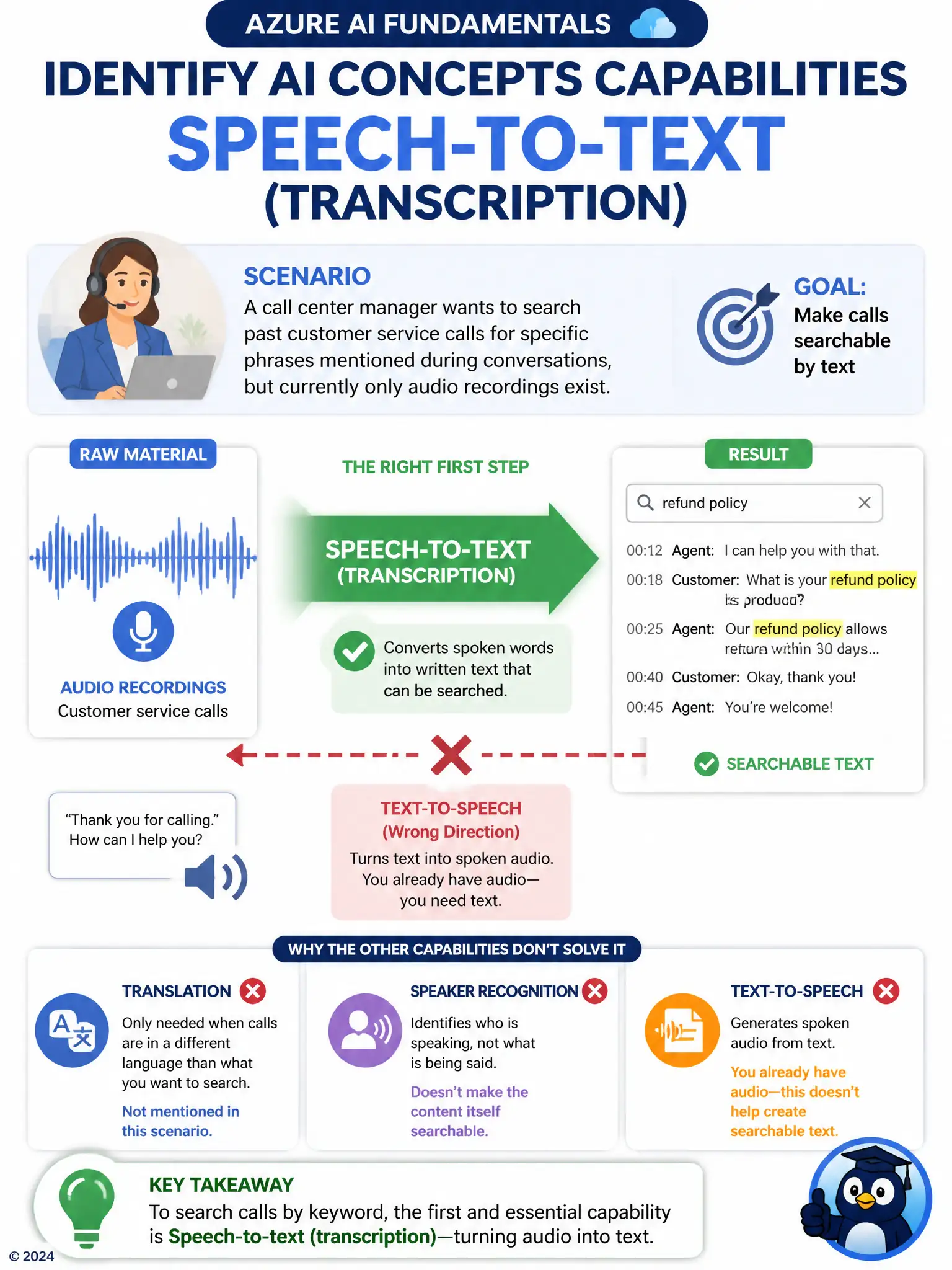
A call center manager wants to search past customer service calls for specific phrases mentioned during conversations, but currently only audio recordings exist. Which Azure AI capability should be used first to make the calls searchable by text?
Select an answer to reveal the explanation.
Short Explanation
You've got audio recordings, so you need to turn that speech into written words before you can search for phrases. That's what speech-to-text transcription does, giving you text you can index and search. The other capabilities either create audio, translate languages, or identify speakers, so they don't make the call content searchable.
Full Explanation
The correct capability is speech-to-text transcription. The manager already has audio recordings and wants to search their contents by phrase, which requires converting spoken audio into written text — exactly what a speech-to-text transcription service does, producing a text version of each call that can then be indexed and searched. Text-to-speech is incorrect because it runs in the opposite direction, turning written scripts into spoken audio for things like automated phone prompts, and does nothing to make existing audio searchable. Speech translation is incorrect because it converts spoken content from one language into another; the scenario never mentions a language barrier, so translation solves a different problem than the one described. Speaker recognition is incorrect because it identifies or verifies who is talking based on voice characteristics, which helps attribute a call to a person but does not produce any searchable text of what was said. Only transcription turns the audio archive into the kind of text-based, searchable resource the manager needs.