
A travel booking company wants to deploy an assistant through Azure AI Foundry that can answer general travel questions and also check a customer's real-time flight status by calling the airline's existing REST API. Which Foundry capability should the team use to let the model invoke that external API during a conversation?
Select an answer to reveal the explanation.
Short Explanation
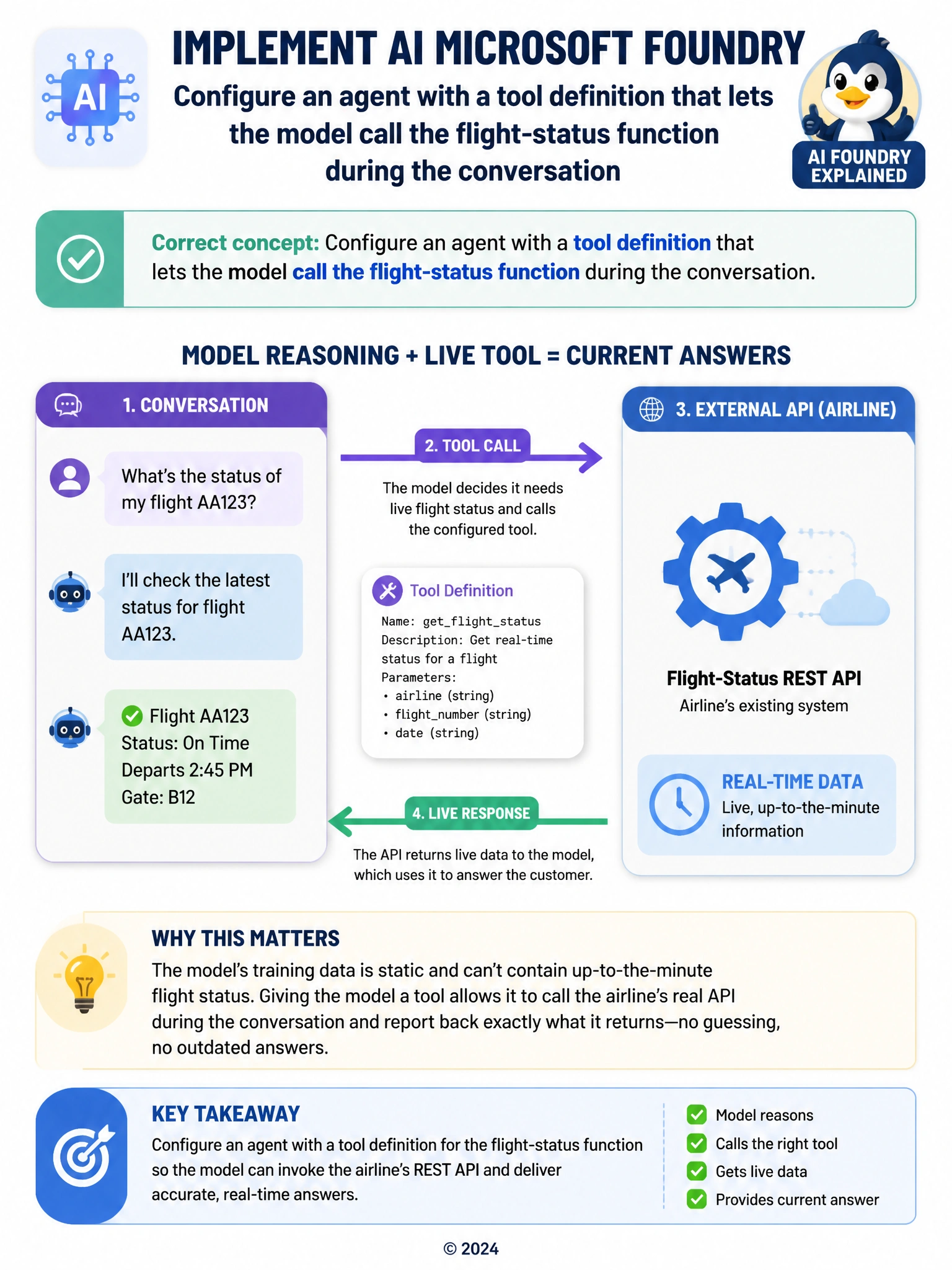
Think about what a model actually knows: whatever was in its training data, frozen at some point in the past. That's fine for explaining baggage policy, but a specific flight's status right now isn't something any amount of training data can capture, because it changes by the minute. Making the model write longer answers doesn't help, and neither does swapping in a bigger model, since neither gives it a live line to the airline's system. What actually solves this is wiring up a tool the model is allowed to call mid-conversation, so when someone asks about their flight, the model recognizes that need, reaches out to the airline's real API, and reports back what it actually returns, instead of inventing something that sounds reasonable. That handoff between reasoning and a live data source is the piece that closes the gap here.
Full Explanation
The correct answer is C. Configuring an agent with a tool (function) definition is what lets a Foundry-deployed model recognize when a request needs live data, hand off the relevant parameters, and receive the airline API's actual response before continuing the conversation. Option A is incorrect because a longer output limit only lets the model write more text; it does not give the model any way to reach an external system, so it would still be guessing at flight status. Option B is incorrect because a larger model has broader general knowledge from training but no access to real-time data feeds, so it cannot know a specific flight's current status regardless of size. Option D is incorrect because adding more example conversations to the system message can shape the model's tone or explain typical scenarios, but examples alone do not create a connection to a live API; the model would still be fabricating plausible-sounding answers instead of reporting fact. Only the tool-calling configuration bridges the model's language ability with the airline's authoritative, real-time source of truth, which is what this scenario requires.