
A gaming company is deploying a public chat companion built on a Foundry-hosted model. Before launch, the team must reduce the risk that the companion could be tricked into producing hateful, violent, or self-harm-related content. Which Foundry capability should they configure as part of the deployment?
Select an answer to reveal the explanation.
Short Explanation
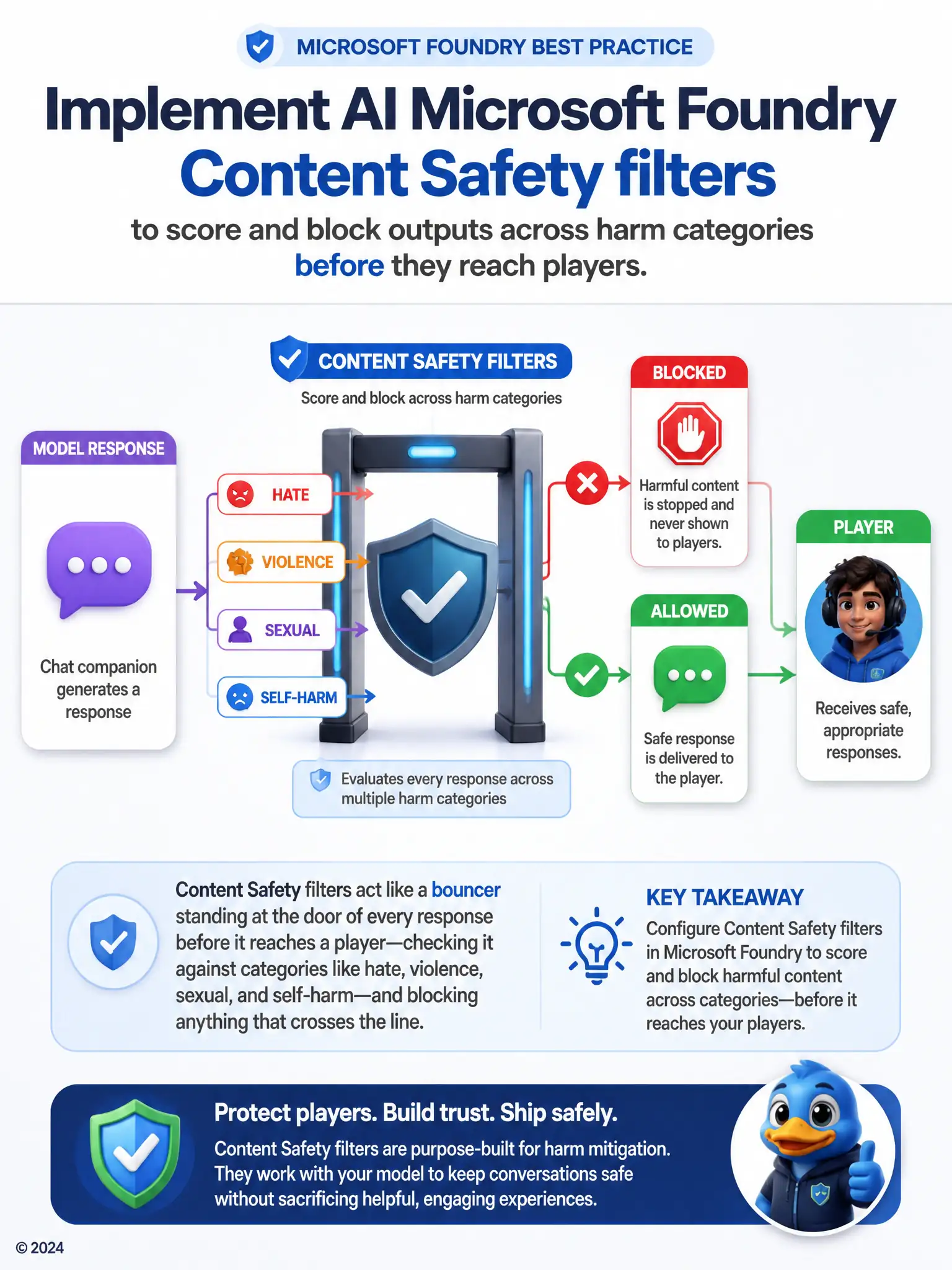
Picture Content Safety filters as a bouncer at the door of every response, checking hate, violence, and self-harm before players see anything. You need that filter because bigger token limits don't make responses safer, a fixed reply kills normal conversation, and benchmark scores don't measure safety.
Full Explanation
The right choice is Content Safety filters in Microsoft Foundry, which are designed to score both prompts and model outputs against harm categories such as hate, violence, sexual content, and self-harm, and can block or flag content that crosses configured severity thresholds, directly addressing the company's concern about the companion producing harmful material. The higher token limit choice is incorrect because it only changes how long a response can be; it has no effect on whether that response contains harmful content. The prompt flow branching choice that routes every conversation through one fixed reply is incorrect because it would make the companion useless for normal interaction and is not how harm mitigation is implemented; safety is applied as a check on generated content, not by eliminating variation entirely. The model catalog benchmark scores choice is incorrect because those scores describe quality, cost, and latency trade-offs between candidate models; they do not measure or reduce the risk of harmful output from a deployed model. Configuring Content Safety filtering as part of the deployment gives the team an ongoing, adjustable safeguard rather than a one-time model choice.