
A game studio is building a mobile app that lets players scan a physical trading card with their phone camera and see the exact card's name and rarity displayed on screen, even though the studio has thousands of unique card designs. Which Azure AI service is best suited to this task, and which characteristic of the training data matters most? (Select TWO.)
Select all correct answers, then click Submit.
Short Explanation
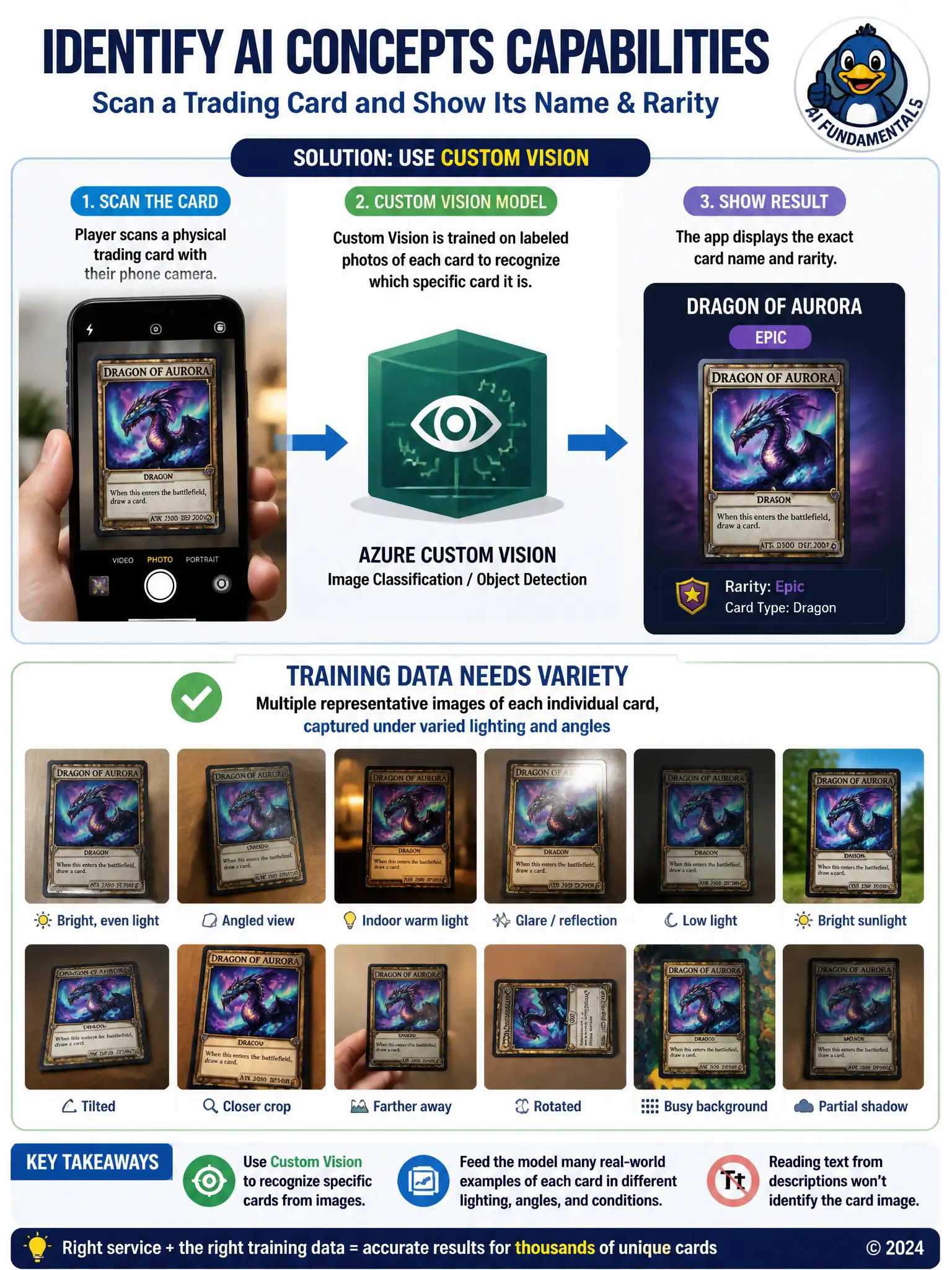
You need a vision service that learns each card from labeled photos, because off-the-shelf tagging would only say 'a card' instead of naming the exact one. You also need multiple representative images per card under varied lighting and angles, since one pristine shot won't handle glare, tilt, or dim rooms. Text extraction from descriptions won't recognize a physical card from a camera image.
Full Explanation
The best choices are Custom Vision, using image classification or object detection trained on labeled photos of each card, and multiple representative images of each individual card captured under varied lighting and angles. Custom Vision is designed to let a team upload labeled photos of specific visual categories, in this case individual trading cards, and train a model that recognizes each one from a live camera feed, which matches the studio's need to distinguish thousands of distinct card designs. Alongside choosing that service, the model needs multiple representative images per card captured under varied lighting and angles, because a single clean reference shot will not generalize to the range of real-world phone camera conditions players will actually use, such as glare, tilt, or dim rooms. The Azure AI Language option using key phrase extraction trained on card descriptions is incorrect because key phrase extraction works on text, not on identifying a physical object from a camera image, so it has no role in recognizing a scanned card. The single reference image per card option is incorrect because relying on one reference image per card ignores the real variability of lighting and angle that a phone camera introduces, which would make the trained model unreliable in practice.