
A subscription box company wants to predict which of its current customers are likely to cancel their subscription in the next 60 days, using each customer's order history, support ticket count, and login frequency, so the retention team can reach out first. Which machine learning approach fits this need?
Select an answer to reveal the explanation.
Short Explanation
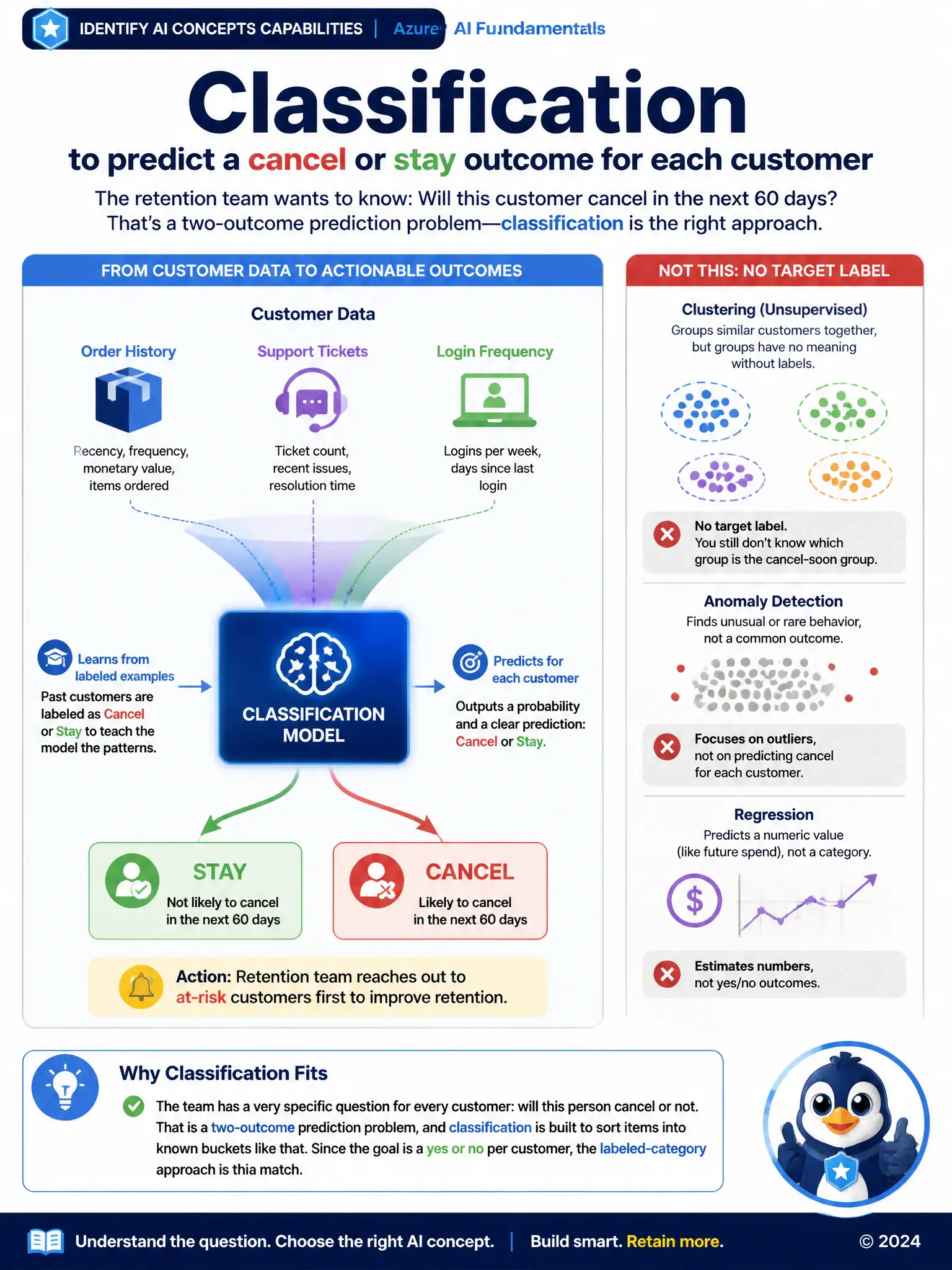
You need a yes-or-no answer for each customer: cancel or stay. That's a two-outcome prediction problem, so classification is the machine learning task built for sorting records into known categories. Clustering, anomaly detection, and regression each answer a different question, so they won't hand the retention team the churn call it needs.
Full Explanation
Classification is the right fit because the company needs to predict a discrete, labeled outcome for each customer, cancel or stay, based on input features like order history, support tickets, and login frequency, and classification models are trained specifically to assign records to known categories like this. Clustering to group customers into segments based on similarity is incorrect because it finds natural groupings in data without using a target label; it could reveal customer segments, but it would not directly predict whether a specific customer will cancel, and it would not tell you which group is the cancel-soon group. Flagging unusual account activity is incorrect because anomaly detection is aimed at spotting rare or unusual data points, such as fraudulent account access, rather than forecasting a common business outcome like churn across the whole customer base. Regression to estimate each customer's total lifetime spend is incorrect because it predicts a continuous numeric value, such as a dollar amount for lifetime spend, not a categorical yes or no outcome like cancellation.