
A manufacturing plant deploys an AI system on the factory floor that monitors a robotic arm's sensor readings in real time and immediately halts the arm if it detects a reading pattern consistent with an imminent mechanical failure, to prevent injury to nearby workers. Which two responsible AI considerations are most directly demonstrated by designing the system to prioritize an immediate safe shutdown over continuing operation when uncertainty is high? (Select TWO.)
Select all correct answers, then click Submit.
Short Explanation
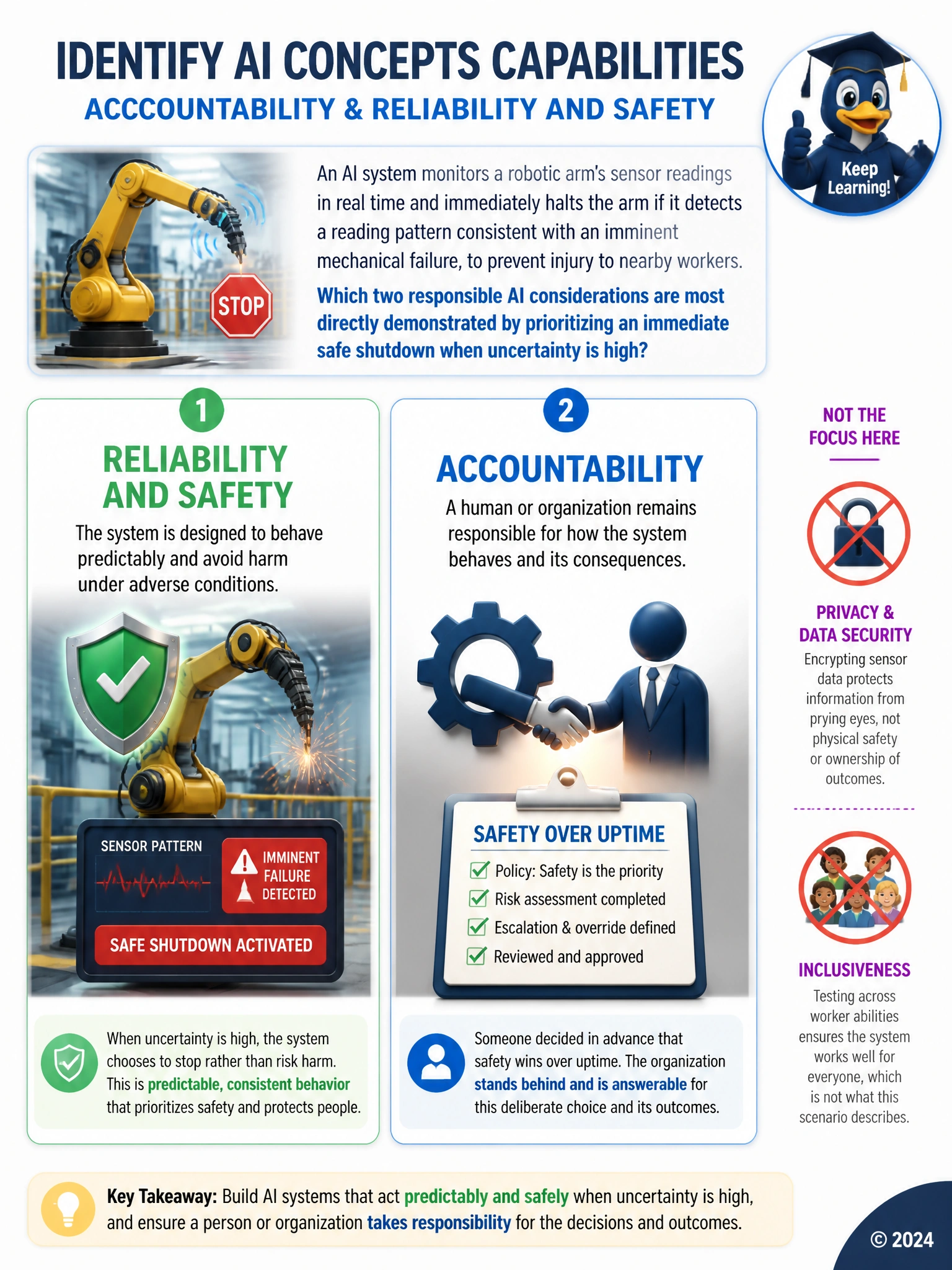
Picture the arm sensing something is off and choosing to stop rather than gamble on finishing the job, that instinct to play it safe when things are uncertain is exactly what it looks like to build a system that behaves predictably and avoids harm, which is one half of the answer. The other half is a little less obvious: someone had to decide, in advance, that safety wins over uptime, and that deliberate design choice is what it means for a person or organization to stand behind the consequences of how the system acts, rather than shrugging if something goes wrong. Testing across a range of worker abilities would be a different concern about who the system works well for, and that is not what is being described. Encrypting the sensor data would be about keeping information safe from prying eyes, which also is not the story here, since the scenario is entirely about physical safety and who owns that outcome, not data protection.
Full Explanation
The correct answers are A and C. Reliability and safety is demonstrated because the system is explicitly engineered to behave predictably and err on the side of preventing physical harm when its confidence in the sensor pattern is uncertain, which is the core of designing for safe operation under adverse or ambiguous conditions. Accountability is also demonstrated because building in a deliberate, predefined safe-shutdown behavior reflects the manufacturer's decision to remain answerable for the arm's real-world consequences rather than leaving harmful outcomes unaddressed, showing that a human or organization stands behind the system's design choices. Option D is incorrect because inclusiveness concerns whether the AI system's benefits and usability extend across people with different abilities, backgrounds, or circumstances, and nothing in this scenario describes testing across worker populations. Option B is incorrect because while encrypting sensor data is a legitimate privacy and security practice, it is not what is being described here; the scenario is about halting operation to prevent physical harm, not about protecting data from unauthorized access.