
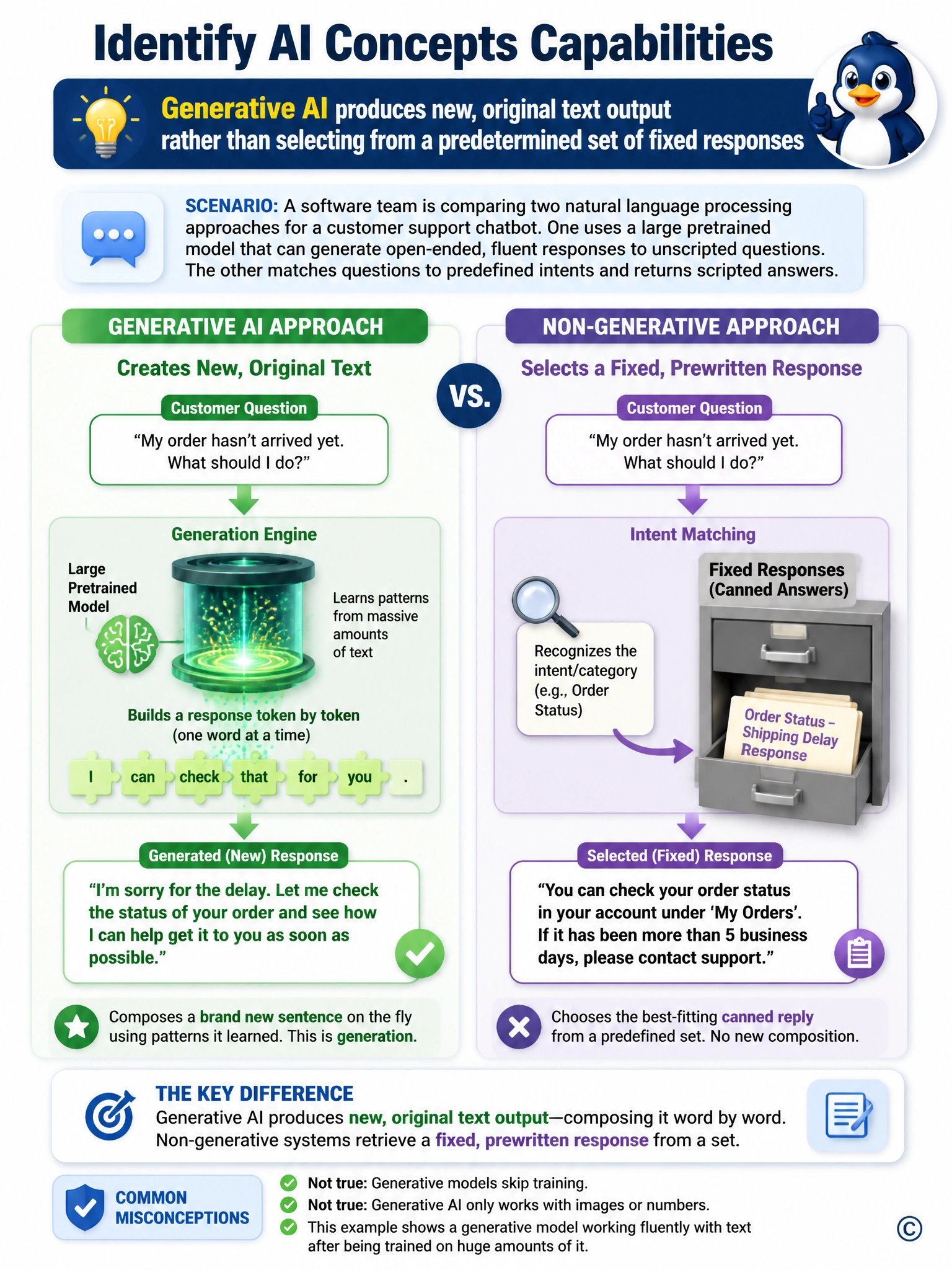
A software team is comparing two natural language processing approaches for a customer support chatbot. Approach one uses a large pretrained language model that can generate open-ended, fluent responses to a wide variety of unscripted questions. Approach two uses a smaller model trained only to match customer questions against a fixed set of predefined intents and reply with scripted answers. Which statement correctly distinguishes generative AI from this second, non-generative approach?
Select an answer to reveal the explanation.
Short Explanation
The real difference between these two chatbot designs comes down to whether the system is composing a brand new sentence on the fly or just picking the best-fitting canned reply off a shelf. The pretrained model that handles unscripted questions is doing the former, building fresh phrasing word by word from patterns it learned, which is the hallmark of generation. The intent-matching system, by contrast, is more like a lookup table: it recognizes which bucket a question falls into and returns whatever prewritten answer lives in that bucket, no new composition involved. It is tempting to think generative models skip training entirely or only work with images or numbers, but none of that holds up, since this very example shows a generative model working fluently with text after being trained on huge amounts of it. The defining trait is producing original output versus retrieving a fixed one.
Full Explanation
The correct answer is B. Generative AI models create new content, such as original sentences composed word by word based on learned patterns, which is why approach one can respond fluently to unscripted questions, whereas the intent-matching model in approach two simply selects the closest match from a fixed library of prewritten answers and cannot produce anything outside that set. Option A is incorrect because generative language models process and produce text directly, not just numeric data; numeric representations are an internal implementation detail, not a limitation on the model's input or output type. Option C is incorrect because generative models absolutely require large amounts of training data to learn language patterns before they can generate anything; the idea that they need no training data is false. Option D is incorrect because generative AI is not limited to images, as demonstrated in this very scenario by a generative text model handling customer support questions, and intent-matching systems are not defined by working only with text either.