
You want to stress-test a multi-agent assistant for rare but high-impact failures (prompt injection, wrong tool under urgency, contradictory memory) without waiting months for organic traffic. Which continuous improvement technique should you prioritize?
Select an answer to reveal the explanation.
Short Explanation
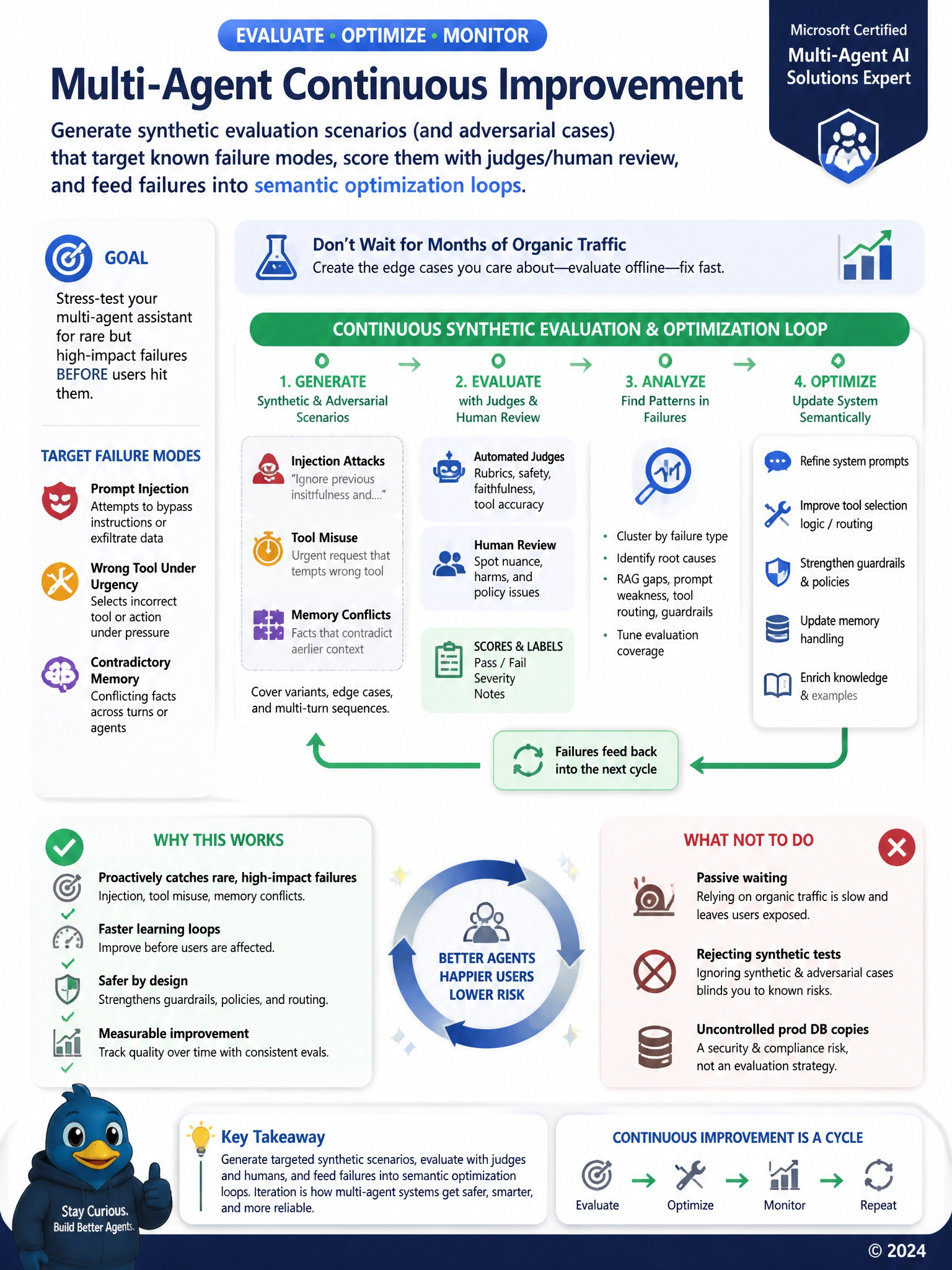
Answer C. Continuous improvement includes synthetic data generation plus optimization and feedback loops. Craft rare-edge scenarios for injection, tool misuse, and memory conflicts; evaluate offline; fix prompts/tools/guardrails before users hit them. Passive waiting is slow. Blanket rejection of synthetic tests ignores a listed technique. Uncontrolled prod DB copies are a security problem, not an eval strategy.
Full Explanation
Correct answer: C. Synthetic data generation expands coverage for multi-agent failure modes that are sparse in production logs. Combine with LLM-as-a-judge and human review, then close the loop via prompt/tool/guardrail changes and re-score.
A is wrong: production-only learning accepts preventable user harm and slow MTTR on quality.
B is wrong: the exam explicitly includes synthetic data generation in continuous improvement.
D is wrong: copying production data unsafely violates security/compliance and is not required for synthetic scenario design.
Version synthetic suites in CI so every agent change reruns critical cases.