
Platform engineers must alert when any multi-agent workflow exceeds a token budget or repeatedly fails a critical tool stage. Which Foundry-oriented tracing implementation details are essential?
Select an answer to reveal the explanation.
Short Explanation
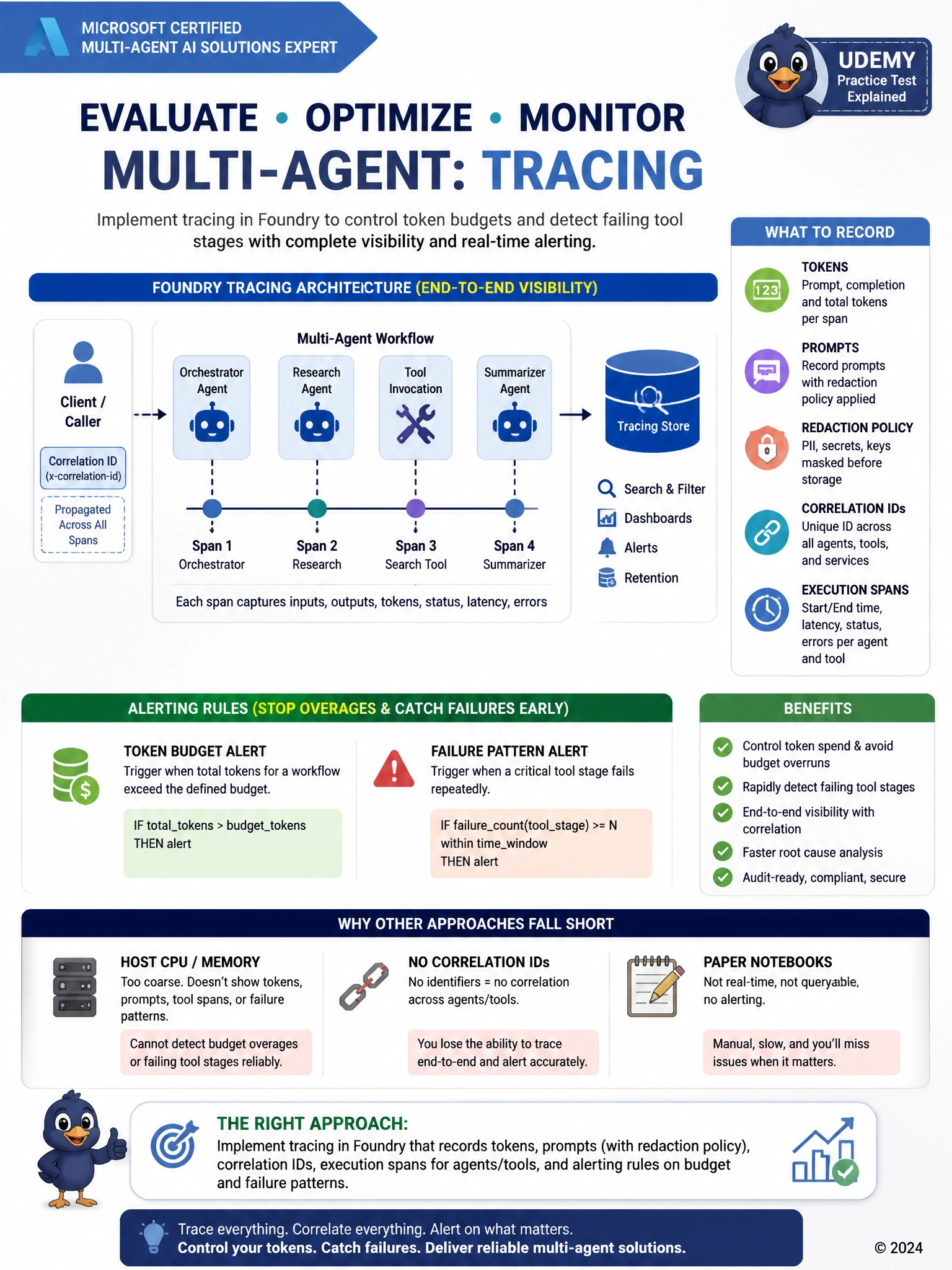
Answer B. Implementing tracing in Foundry includes tokens, prompts, correlation IDs, alerting, and execution tracking. That is how you budget tokens and catch failing tool stages. Host CPU alone is too coarse. Zero identifiers break correlation. Paper notebooks are not real-time alerting.
Full Explanation
Correct answer: B. Foundry tracing should capture model token usage, prompt/response artifacts under privacy redaction, end-to-end correlation IDs, and spans for orchestrator steps and tool calls. Alert on threshold breaches and repeated stage failures to drive remediation.
A is incorrect: host metrics do not reveal which agent or prompt burned tokens.
C is incorrect: without correlation IDs and workflow IDs, multi-agent debugging collapses.
D is incorrect: offline notebooks cannot meet operational alerting SLAs.
Apply data classification so prompt traces do not leak secrets or raw PII into general log stores.