
Contoso is building a multi-agent operations desk. Agents must call internal inventory, ticketing, and change-management APIs through a consistent tool interface with centralized auth and observability. Leadership wants standards-based agent-to-tool integration rather than ad-hoc function schemas per framework. Which approach best fits Microsoft Foundry multi-agent tooling guidance?
Select an answer to reveal the explanation.
Short Explanation
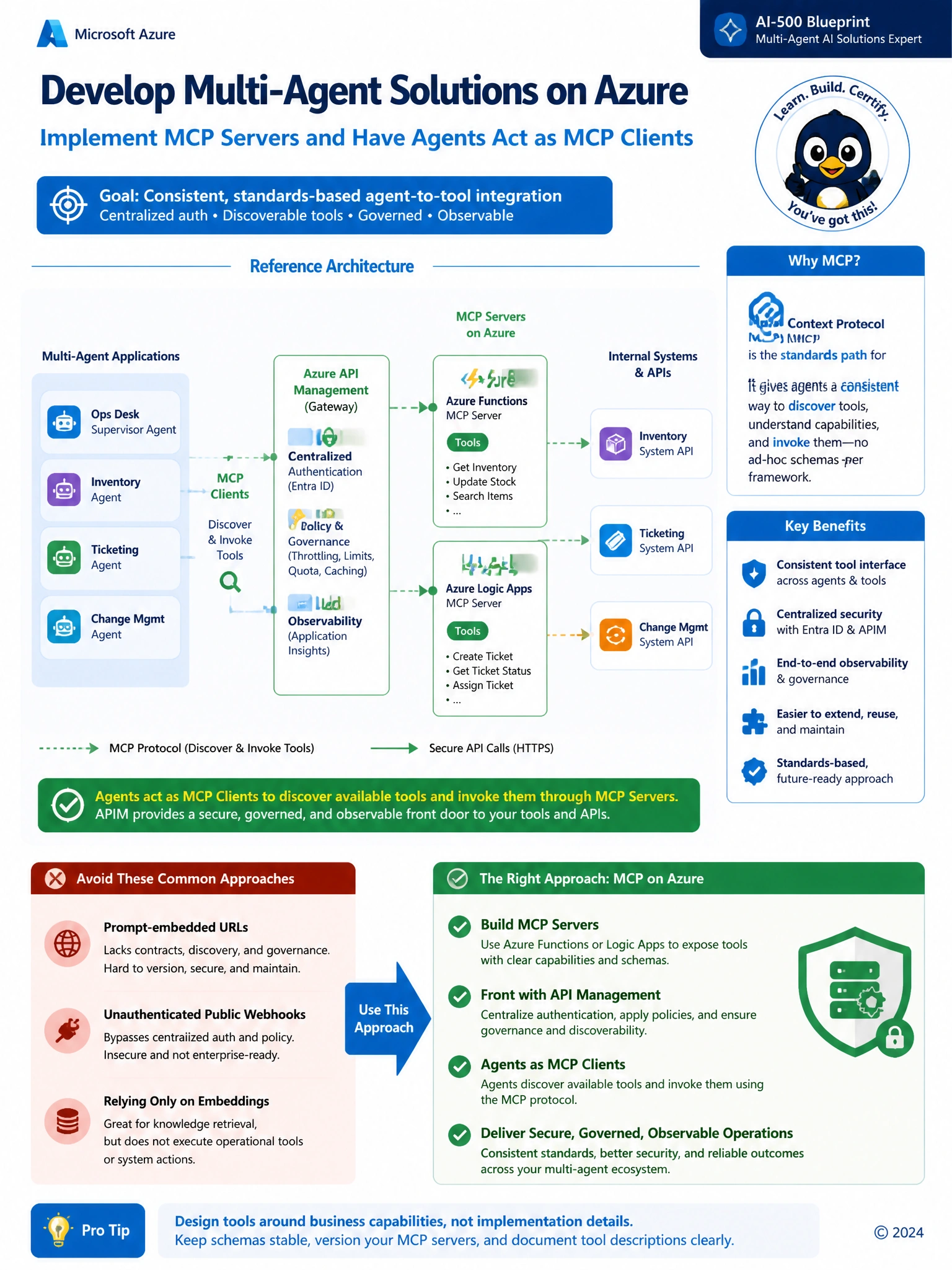
Answer C. Model Context Protocol (MCP) is the standards path for agent-to-tool ecosystems on the AI-500 blueprint: build MCP servers and clients, including Azure Functions, Logic Apps, and API Management. Agents discover and invoke tools consistently instead of inventing one-off schemas. Prompt-embedded URLs lack contracts and governance. Unauthenticated public webhooks are insecure. Embeddings help knowledge retrieval but do not replace operational tool calls.
Full Explanation
Correct answer: C. Building and integrating tool ecosystems includes function calling, specified and dynamic tool use, and designing MCP servers/clients on Azure compute and integration services. MCP gives a common tool surface for multi-agent solutions so inventory, ticketing, and change systems are discoverable, auth-bound, and observable.
A is incorrect: baking URLs into prompts is brittle, non-discoverable, and bypasses validation, versioning, and centralized policy.
B is incorrect: public unauthenticated endpoints violate Zero Trust tool boundaries and production security requirements.
D is incorrect: retrieval/embeddings address knowledge grounding; they do not execute transactional operations against line-of-business APIs.
Also plan tool error handling, result validation, and quality checks once MCP tools are wired.