
A research orchestrator and three specialist agents collaborate on long investigations. After about twenty turns, specialists begin contradicting earlier findings because the shared working context is truncated mid-entity. You need a context-management approach that preserves entity continuity across agents without exceeding model context limits. What should you implement?
Select an answer to reveal the explanation.
Short Explanation
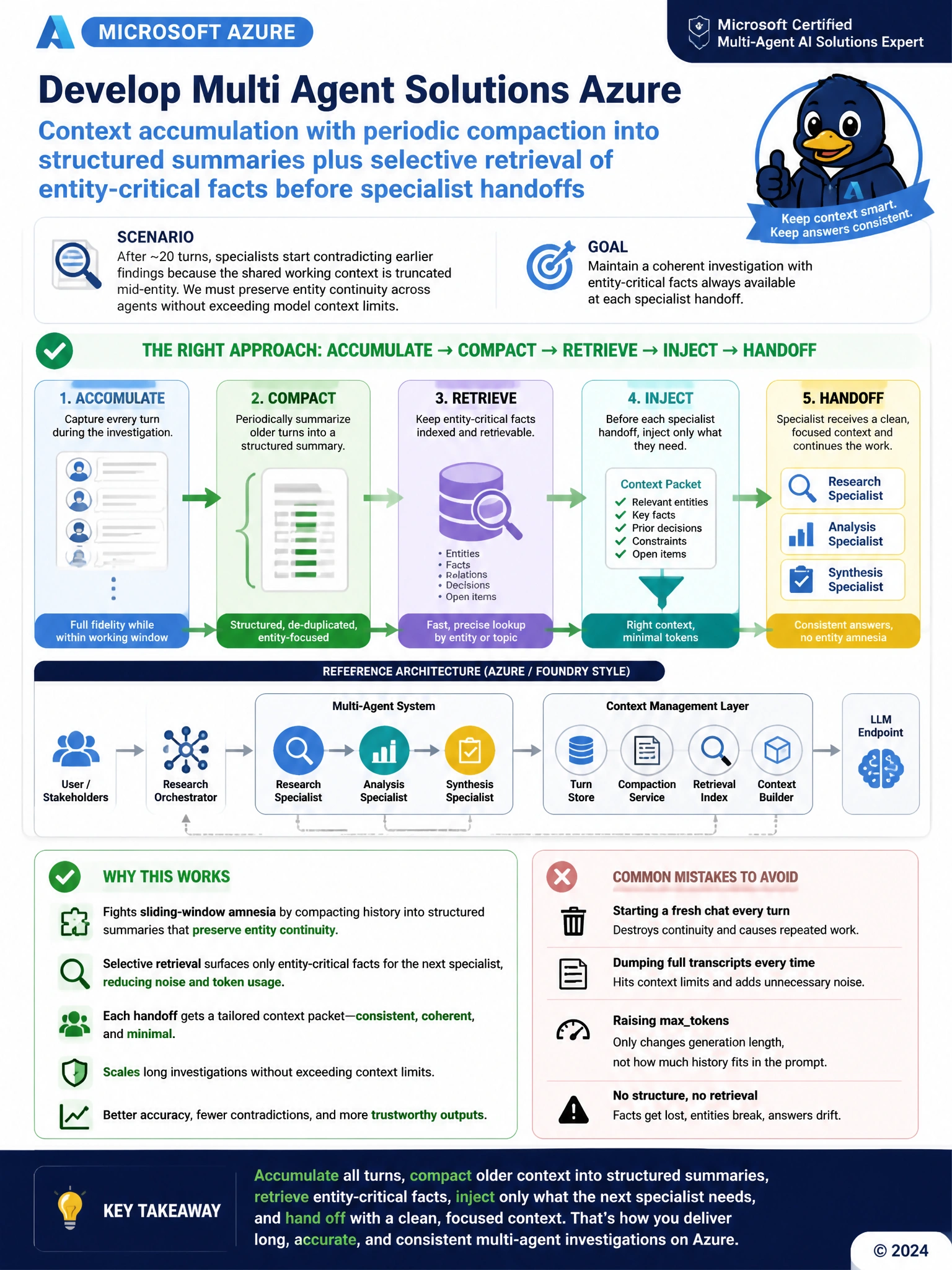
Answer B. Multi-agent context management needs accumulation, retrieval, injection, and compaction. Compact older turns into structured summaries, keep entity-critical facts retrievable, and inject only what the next specialist needs at handoff. That fights sliding-window amnesia and entity continuity breaks. Fresh chats every turn destroy continuity. Dumping full transcripts hits limits and noise. Raising max_tokens only changes generation length, not how much history fits in the prompt.
Full Explanation
Correct answer: B. AI-500 expects you to design context management for single agents and between agents: accumulation, retrieval, injection, and compaction. For long multi-agent investigations, raw history grows faster than any model window. Compaction produces structured digests; selective retrieval rehydrates entities, constraints, and prior decisions at specialist handoffs so continuity survives truncation.
A is wrong because wiping memory each turn maximizes isolation but guarantees specialists cannot share durable investigation state.
C is wrong because unbounded full transcripts cause hard truncations, cost spikes, and attention dilution—exactly the failure mode described.
D is wrong because completion max_tokens controls output size, not the input context budget that holds prior turns and shared state.
Practical pattern: compact → store structured team state → retrieve entity packs → inject into the next agent’s working context.