
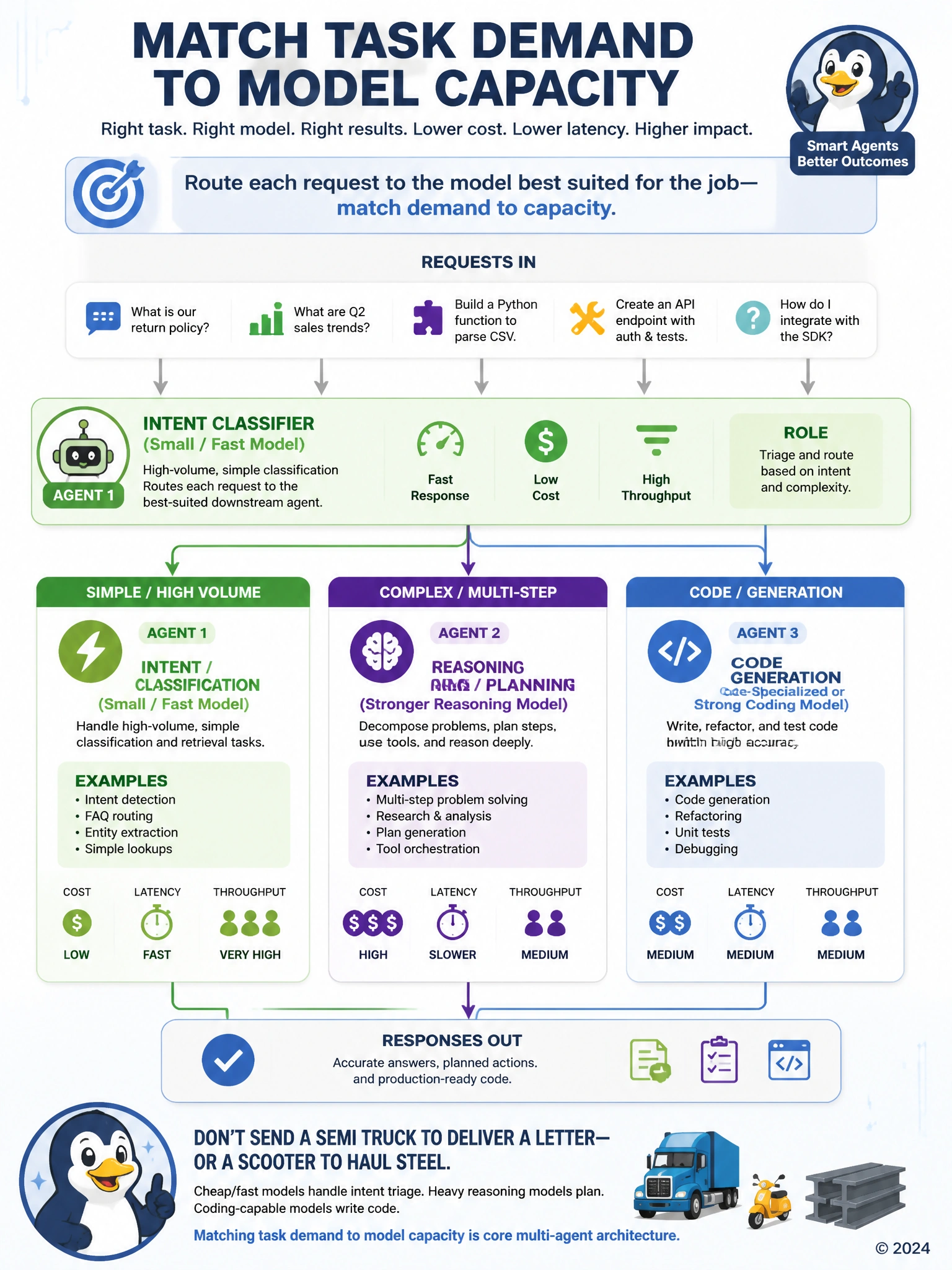
Your multi-agent design includes (1) a cheap high-volume intent classifier, (2) a reasoning-heavy planning orchestrator, and (3) a code-generation specialist. How should you match tasks to model family capacities?
Select an answer to reveal the explanation.
Short Explanation
Correct answer: C. Don’t send a semi truck to deliver a letter—or a scooter to haul steel. Cheap/fast models handle intent triage; heavy reasoning models plan; coding-capable models write code. Matching task demand to model capacity is core multi-agent architecture, not an afterthought.
Full Explanation
Architects must match task demands to model family capacities. Option C correctly differentiates routing: small/fast models for high-volume simple tasks, stronger reasoning models for orchestration/planning, and coding-capable models for code generation—balancing quality, latency, and cost.
Option A is incorrect: largest-model-everywhere wastes tokens and latency on trivial classification.
Option B is incorrect: undersizing planning and codegen destroys solution quality.
Option D is incorrect: one mid-size model ignores differentiated task demands called out in the scenario.
Exam tip: Heterogeneous model routing is a feature of good multi-agent design questions.