
A multi-agent release checklist currently only unit-tests Python helpers. Failures in production are often caused by bad tool schemas, weak retrieval, prompt regressions, or memory mis-scoping—not helper functions. What evaluation design should the team add before promotion?
Select an answer to reveal the explanation.
Short Explanation
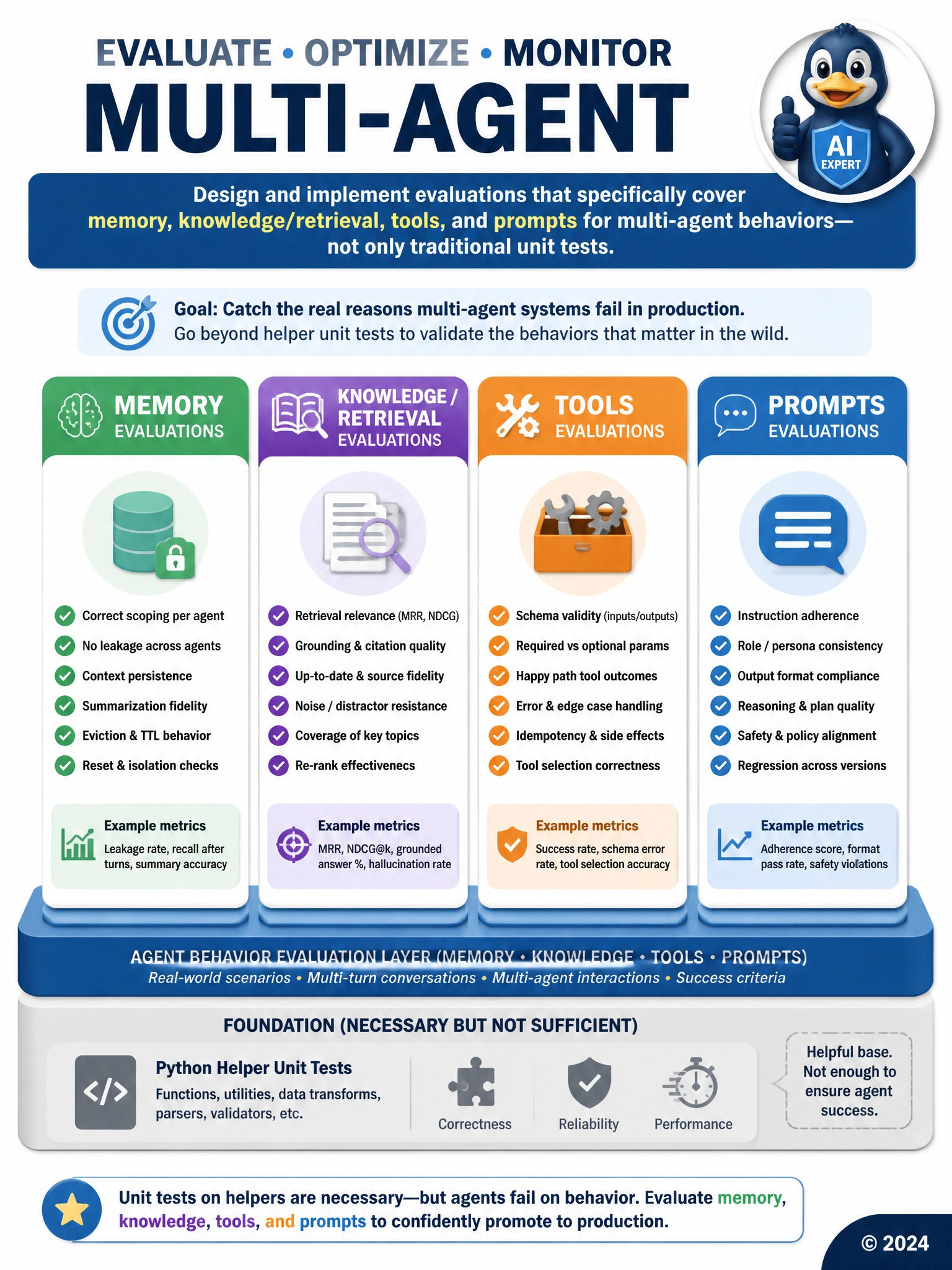
Unit tests on helpers are necessary but nowhere near sufficient for agents. You need evaluations aimed at memory scoping, knowledge/retrieval quality, tool schemas and outcomes, and prompts—the surfaces that actually break multi-agent systems. Management-plane pings and CSS checks do not cover agent behavior. A is the evaluation design to add.
Full Explanation
Correct answer: A. Multi-agent evaluation strategies explicitly include evaluations for memory, knowledge, tools, and prompts. Traditional unit tests do not exercise retrieval precision, tool contracts, prompt regressions, or memory isolation/continuity.
B is incorrect because control-plane liveness is not semantic agent evaluation.
C is incorrect because UI contrast testing is orthogonal to agent reasoning quality.
D is incorrect because helper unit tests do not validate end-to-end multi-agent behaviors.
Exam focus: expand eval scope to the four multi-agent pillars—memory, knowledge, tools, prompts.