
Platform ops needs a reliability strategy for a production multi-agent system: detect when individual agents are unhealthy, when workflows fail mid-orchestration, when traces cannot be correlated, and when automated remediation should page on-call or restart a failed step. Which monitoring strategy scope is most complete?
Select an answer to reveal the explanation.
Short Explanation
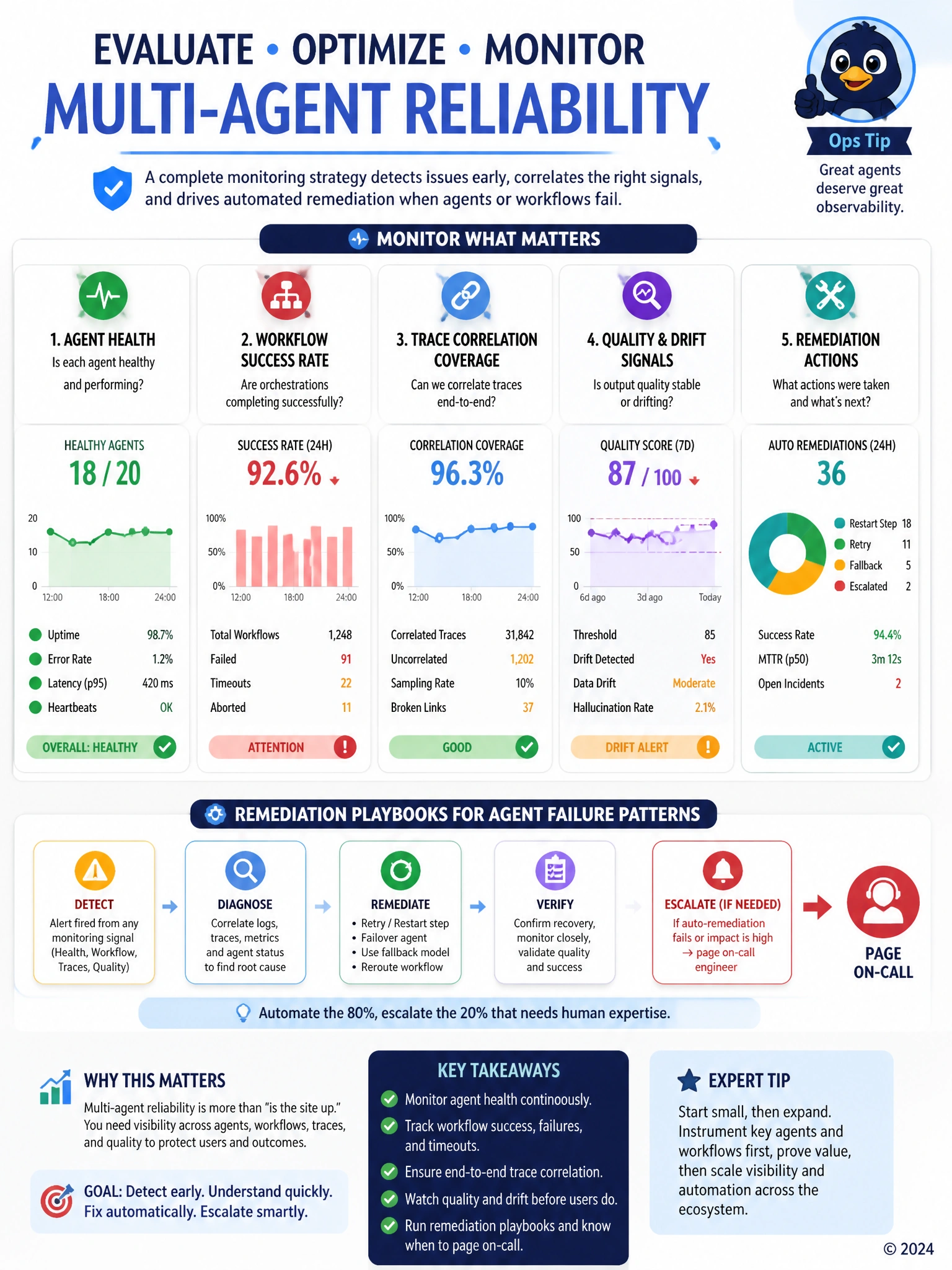
Multi-agent reliability is more than “is the site up.” You need agent health, workflow failure detection, trace correlation, quality/drift signals, and remediation paths. Marketing bounce rate, git pushes, and laptop batteries do not cover agentic production reliability. D is the complete strategy.
Full Explanation
Correct answer: D. Reliability monitoring for multi-agent solutions includes agent health, workflow failures, trace correlation, drift detection, quality regression, and remediation. That combination supports both detection and response for production agent systems.
A is incorrect because frontend bounce rate does not diagnose agent or orchestration failures.
B is incorrect because source control availability is not runtime multi-agent health.
C is incorrect because developer device metrics are unrelated to production agent reliability.
Exam focus: reliability monitoring must span agents, workflows, traces, quality, and remediation.