
A SaaS multi-agent assistant stores short-term session state and long-term semantic memory for thousands of customer tenants. During a red-team exercise, Tenant A’s agent retrieved Tenant B’s prior case summaries through a shared vector store namespace. Which memory design change best remediates the cross-tenant leak while preserving per-tenant long-term memory?
Select an answer to reveal the explanation.
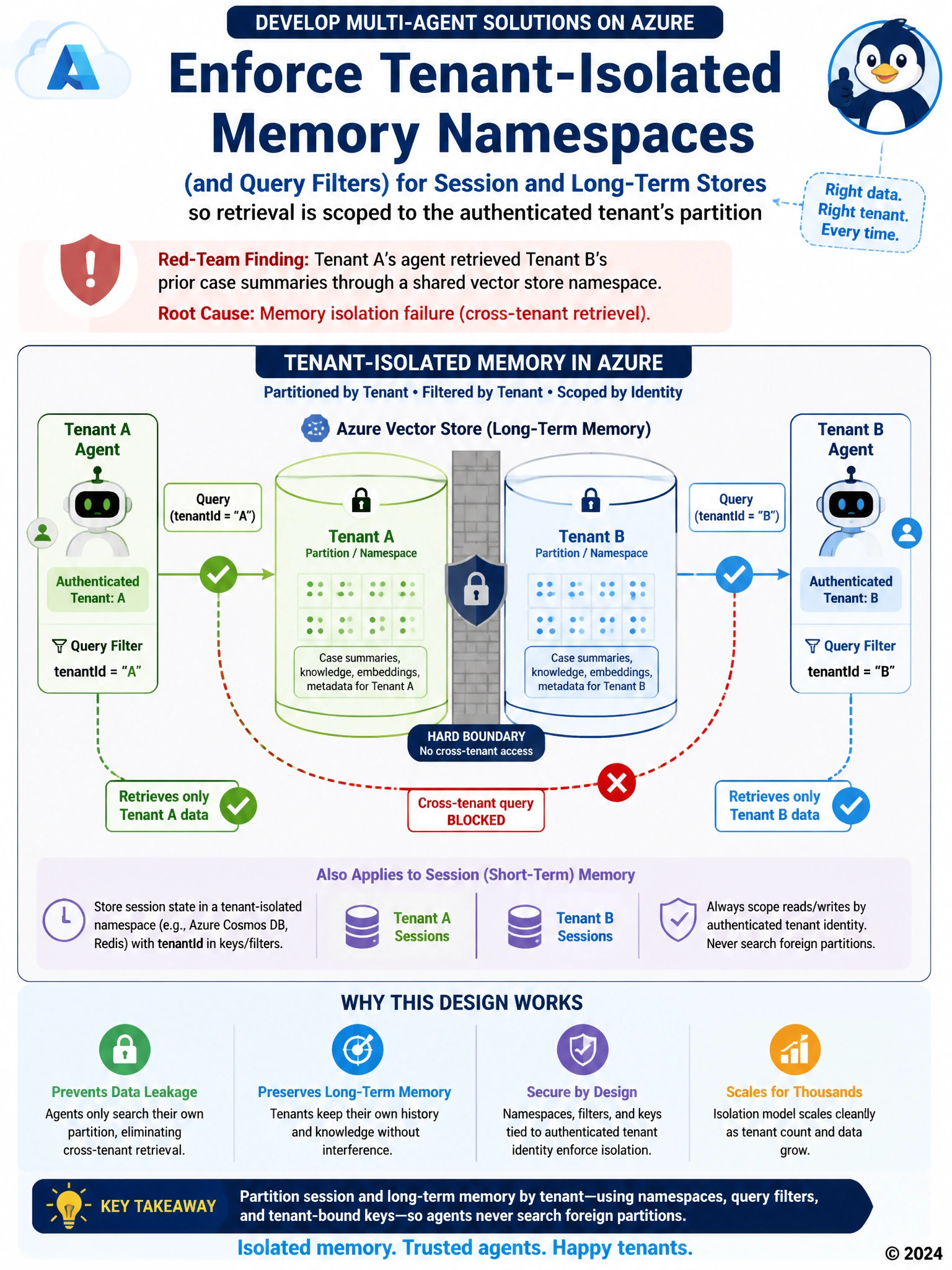
Short Explanation
Cross-tenant retrieval is a memory isolation failure, not a “need more recall” problem. Partition session and long-term memory by tenant—namespaces, filters, keys tied to authenticated tenant identity—so agents never search foreign partitions. Global shared memory makes the leak worse. Turning memory off avoids the leak but kills the product capability. Browser localStorage is not a secure multi-tenant server control. B is the correct multi-agent memory strategy.
Full Explanation
Correct answer: B. Multi-agent memory strategies must address security, compliance, lifecycle, storage, and session management—including tenant isolation for multi-tenant deployments. Isolated namespaces and mandatory tenant filters on vector/session stores prevent lateral retrieval of another tenant’s semantic memory.
A is incorrect because a single global partition maximizes cross-tenant leakage risk.
C is incorrect because disabling long-term memory avoids the symptom by removing a required capability rather than fixing isolation.
D is incorrect because client-only storage lacks centralized policy enforcement, multi-device consistency, and server-side isolation guarantees for SaaS agents.
Exam focus: multi-tier memory requires tenant isolation as a first-class design constraint.