
A multi-agent claims workflow in Microsoft Foundry keeps a shared working context that accumulates every agent’s intermediate reasoning, tool payloads, and retrieved passages. After several long-running cases, later agents begin truncating mid-sentence because the context window is full, and critical claim identifiers from early turns are dropped first. Which approach best restores usable shared context without losing high-value entities?
Select an answer to reveal the explanation.
Short Explanation
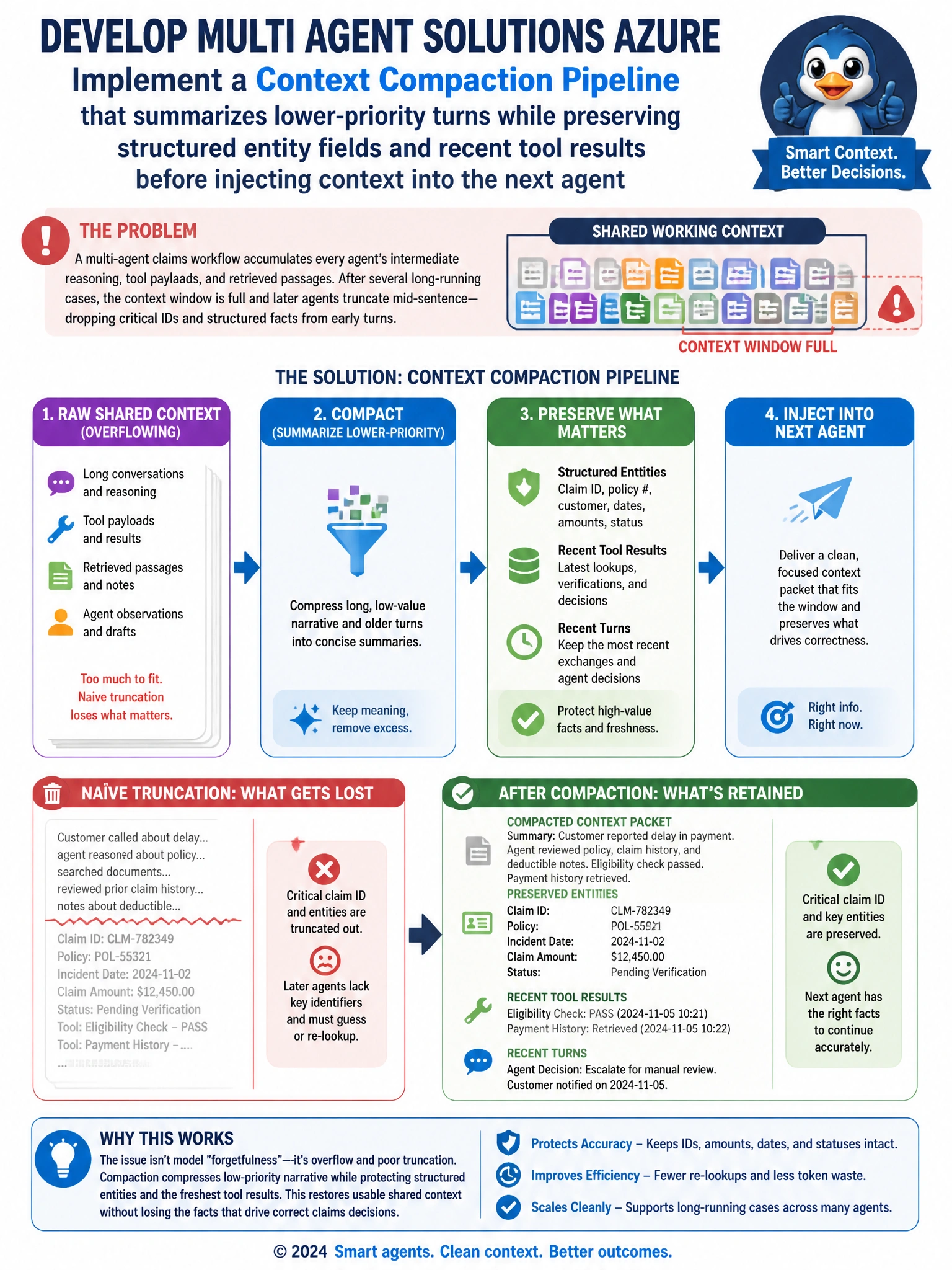
The problem is not that the models are “forgetful” in some mysterious way—the shared working memory is simply overflowing, and naïve truncation is chewing through the early turns that still hold claim IDs and other structured facts. Compaction is the right move: compress the long, low-value narrative while keeping the structured entities and the freshest tool results intact, then hand that cleaned packet to the next agent. Turning up temperature just encourages guessing when data is missing, which is the last thing you want in a claims flow. Killing tools removes useful evidence instead of managing size. Wiping context on every hop means specialists never see prior decisions. So A is the answer: compact intelligently, preserve entities, keep recent tools.
Full Explanation
Correct answer: A. In multi-agent solutions, context accumulation across hops frequently exhausts model context windows. A deliberate compaction strategy—summarizing verbose intermediate reasoning while retaining structured entity fields (claim IDs, policy numbers), critical decisions, and recent tool results—keeps shared context both within budget and operationally complete before the next agent is invoked.
B is incorrect because temperature only influences sampling randomness; it does not restore truncated identifiers and may increase hallucinated values when data is missing.
C is incorrect because tools often supply the authoritative evidence (policy lookups, claim status). Removing tools reduces noise but also removes grounding, and does not solve entity continuity across agents.
D is incorrect because restarting with an empty context on every hop discards prior agent decisions and shared state, breaking multi-agent continuity by design.
Exam focus: diagnose context overflow as a management problem (compaction, entity preservation, selective retention), not a model-temperature or “start clean every time” problem.