
An architect must design memory for a multi-agent consulting workspace. Agents need the last few turns for immediate coherence, a team-shared board of intermediate findings during a multi-hour engagement, and durable client preferences that survive across sessions for the same tenant. Which memory architecture best fits?
Select an answer to reveal the explanation.
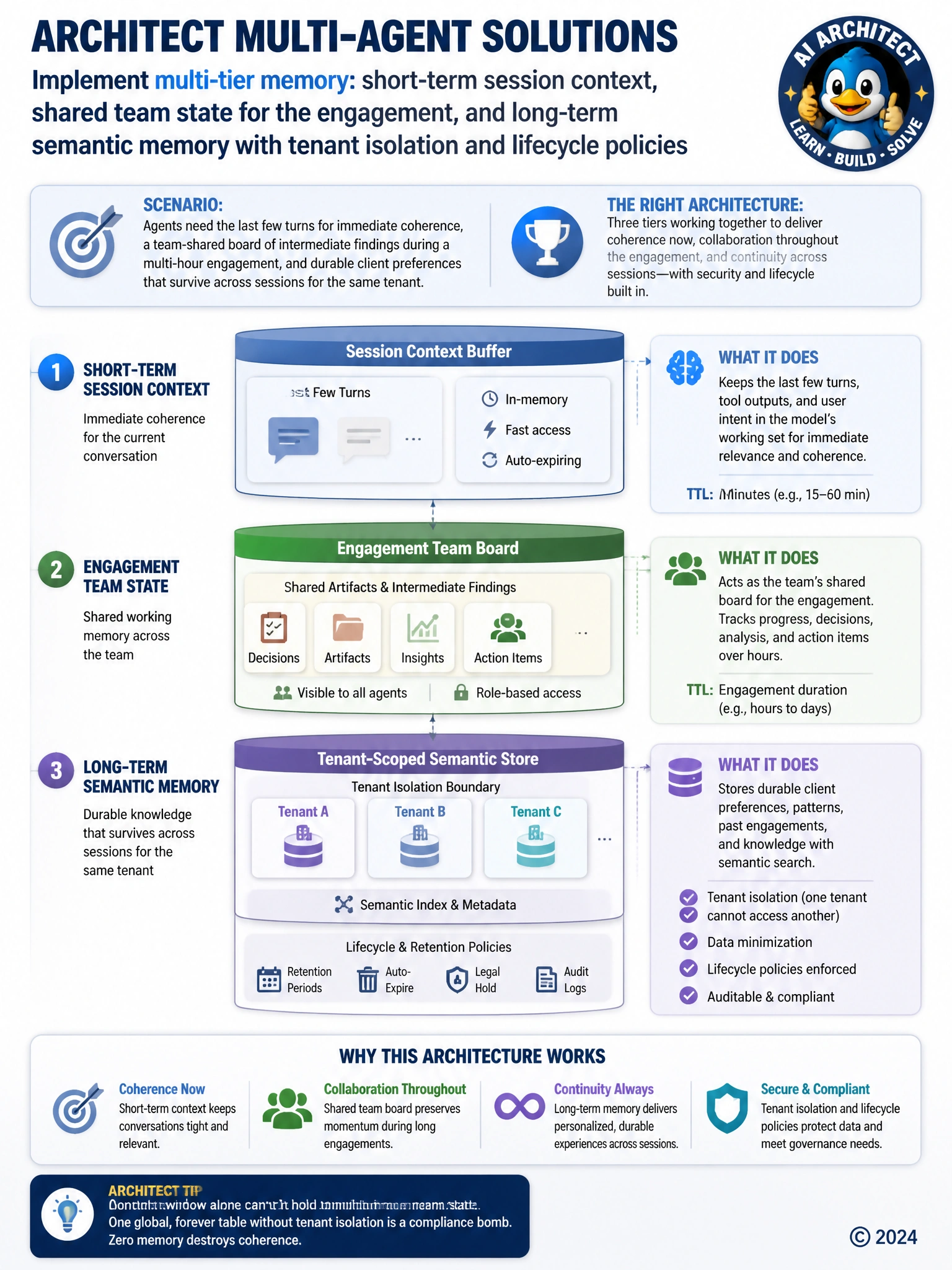
Short Explanation
The correct answer is C. You need three tiers: short-term turns, shared team board for the engagement, and long-term tenant-scoped preferences with lifecycle rules. Context window alone will not hold multi-hour team state. One global forever table without tenant isolation is a compliance bomb. Zero memory destroys coherence.
Full Explanation
Option C is correct. Architecture skills require short-term and long-term memory designs including context sharing, plus multi-tier persistence for session state, shared team state, and long-term semantic memory with lifecycle and tenant isolation. That mapping matches the three distinct needs in the stem.
Option A is incorrect because pure in-window context cannot reliably provide multi-hour shared boards or cross-session preferences.
Option B is incorrect because lacking tenant isolation and unbounded retention violates multi-tenant security and lifecycle governance.
Option D is incorrect because eliminating memory removes required coherence and personalization rather than solving the design problem.