
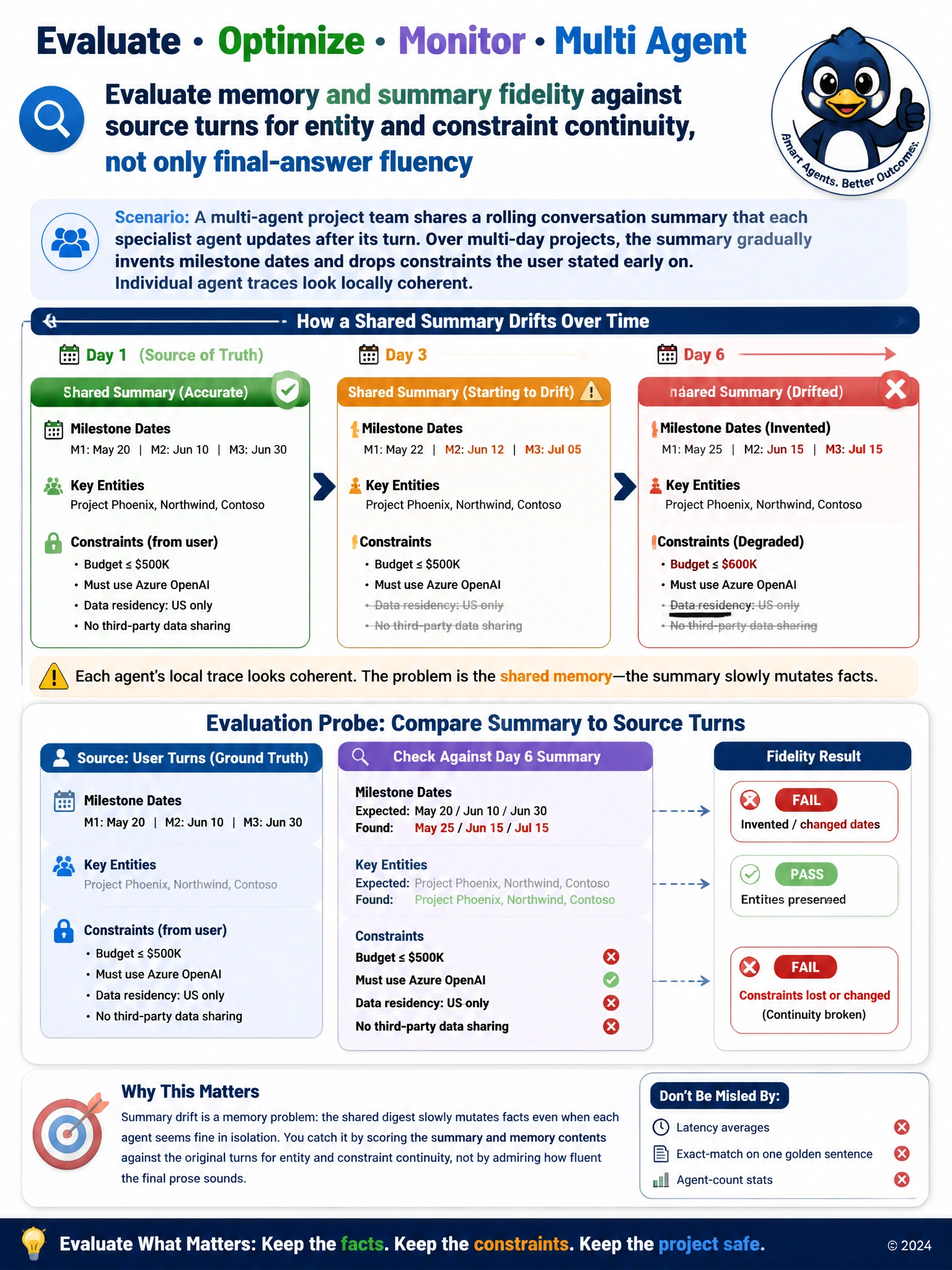
A multi-agent project team shares a rolling conversation summary that each specialist agent updates after its turn. Over multi-day projects, the summary gradually invents milestone dates and drops constraints the user stated early on. Individual agent traces look locally coherent. Which evaluation focus best detects this class of failure?
Select an answer to reveal the explanation.
Short Explanation
The correct answer is A. Summary drift is a memory problem: the shared digest slowly mutates facts even when each agent seems fine in isolation. You catch it by scoring the summary and memory contents against the original turns for entity and constraint continuity, not by admiring how fluent the final prose sounds. Latency averages, exact-match on one golden sentence, and agent-count stats will all miss a polished answer that rests on a quietly corrupted project summary.
Full Explanation
Option A is correct. Multi-agent evaluation must cover memory and knowledge pathways. When specialists rewrite a shared rolling summary, gradual summary drift and lost constraints are common. Dedicated checks for entity continuity and constraint retention against source turns surface failures that final-answer fluency metrics miss.
Option B is incorrect because latency characterizes performance, not whether shared memory still reflects user-stated facts.
Option C is incorrect because exact-match against one reference sentence fails for open-ended multi-day work products and does not inspect intermediate memory state where drift accumulates.
Option D is incorrect because invocation counts describe orchestration shape, not factual integrity of shared summaries.