
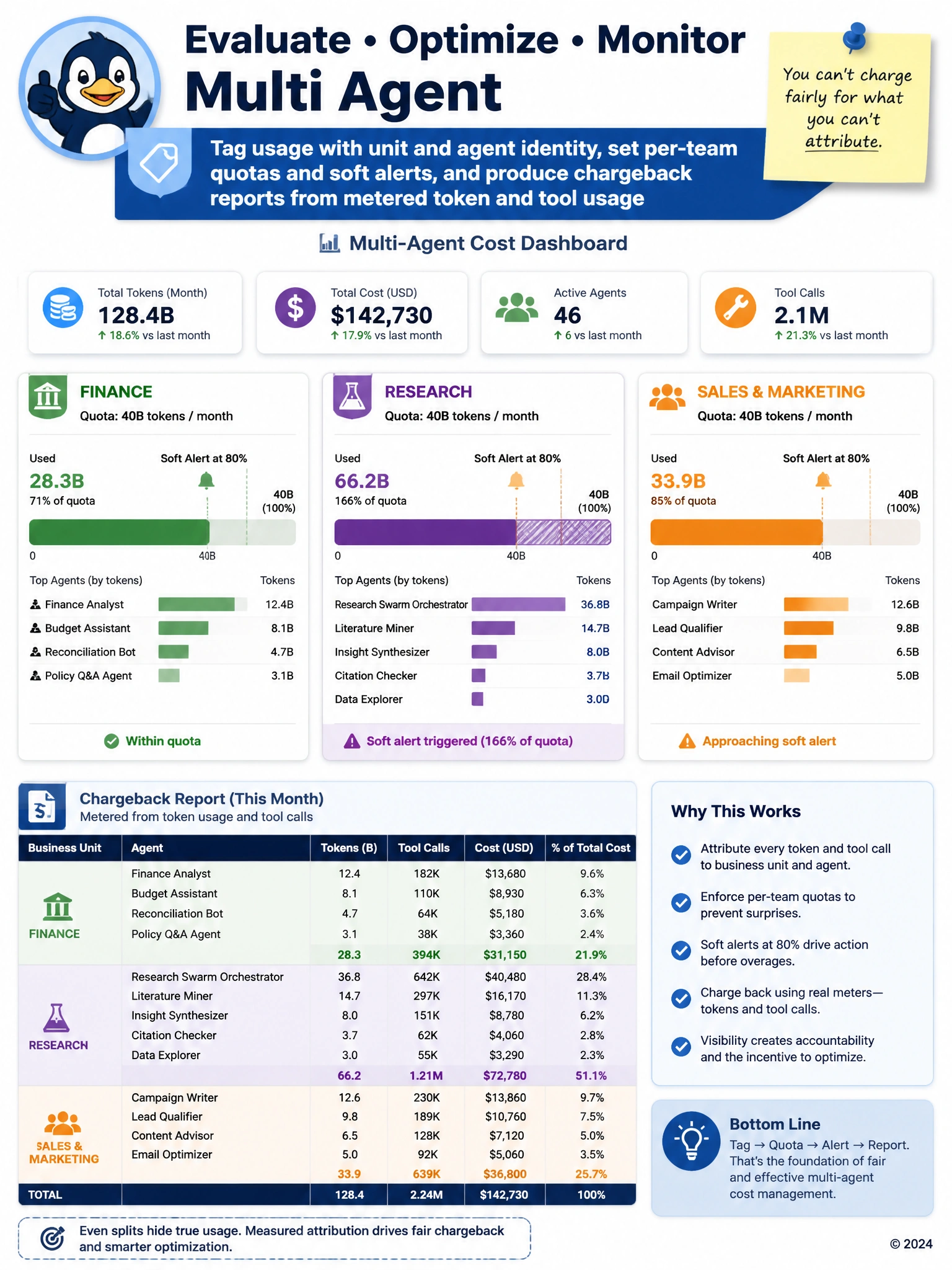
Contoso runs three business units on a shared multi-agent Foundry platform. Finance complains that monthly Azure OpenAI spend is opaque: one unit's research swarm appears to consume most tokens, but chargebacks are still split evenly. Platform engineering must improve cost accountability without redesigning every agent. What should they implement first?
Select an answer to reveal the explanation.
Short Explanation
The correct answer is D. You cannot charge fairly for what you cannot attribute. Tagging traffic with business unit and agent identity, applying per-team quotas with soft alerts, and reporting from real token and tool meters is the foundation of multi-agent cost management. Even splits hide the research swarm's consumption and remove any incentive to optimize. Turning off tracing saves almost nothing relative to model tokens and blinds ops. One tiny model for every task is a quality hammer, not a chargeback system. Purging memory weekly is a data lifecycle choice, not a usage attribution fix.
Full Explanation
Option D is correct. Cost management for multi-agent solutions requires usage attribution (tags or dimensions for team and agent), quotas/allocations, alerting before hard failures, and chargeback reporting driven by metered token and tool consumption. That directly answers finance's opacity problem without a full rewrite of agent logic.
Option A is incorrect because telemetry overhead is typically minor compared with model and tool spend, and disabling tracing removes the observability needed to investigate cost drivers.
Option B is incorrect because mandating a single small model is a blunt quality/cost tradeoff, not an accountability mechanism; it can degrade critical workloads while still leaving spend unattributed if tagging is missing.
Option C is incorrect because memory storage cost is separate from inference token chargebacks, and weekly deletion may violate product or compliance needs without explaining which unit burned tokens.