
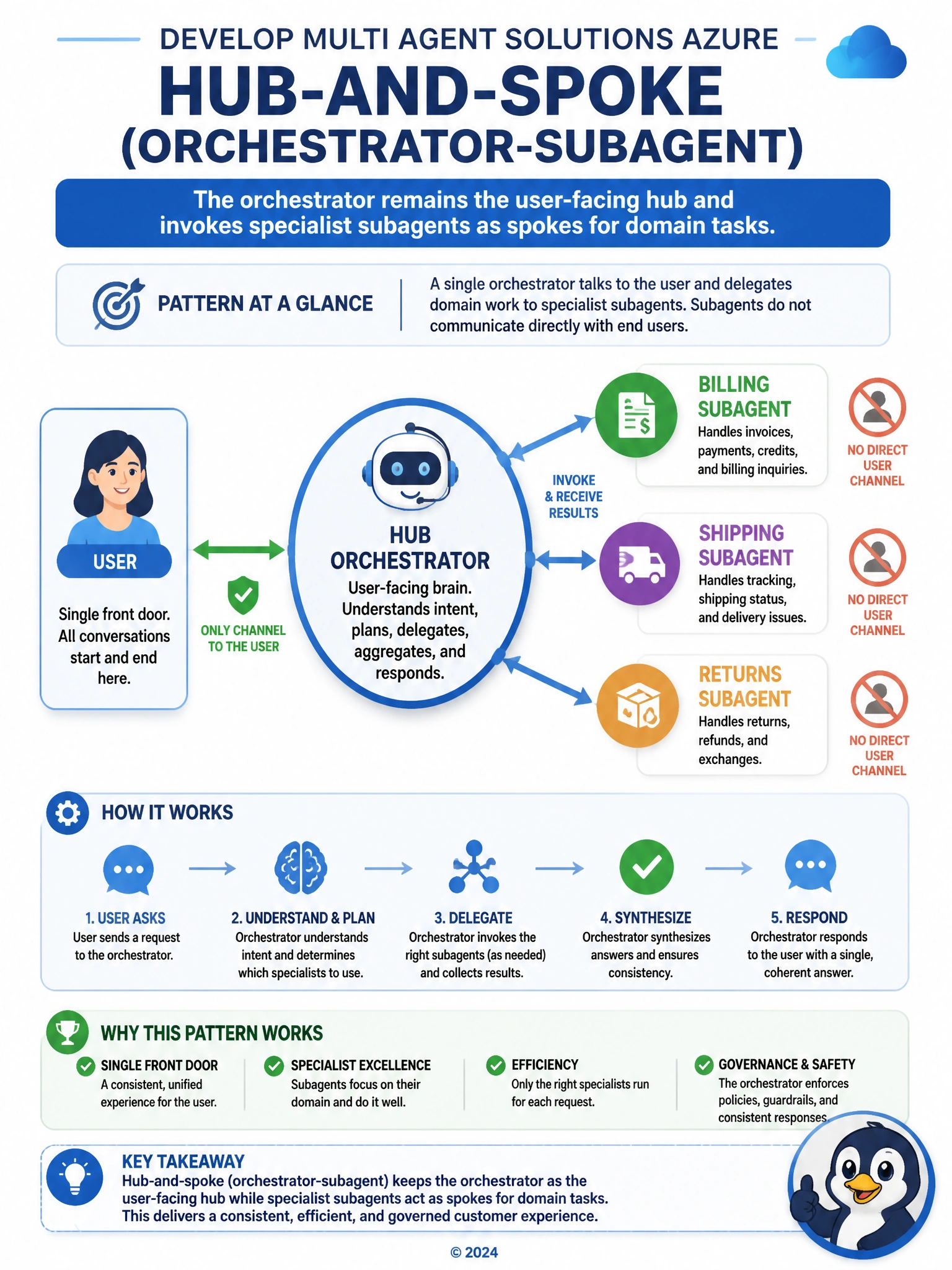
You are coding a customer-service multi-agent solution where a single user-facing orchestrator must delegate to billing, shipping, and returns specialists without those specialists talking directly to end users. Which pattern should you implement?
Select an answer to reveal the explanation.
Short Explanation
User-facing single front door plus specialist delegates is classic hub-and-spoke / orchestrator-subagent. Orchestrator talks to the user; billing/shipping/returns are spokes. Option B. Full mesh to the user (A) splinters UX. Always-on sequential triple run (C) wastes work. Ungoverned broadcast merge (D) creates conflicting answers without a hub.
Full Explanation
Orchestration patterns include hub-and-spoke and orchestrator-subagent. Option B matches a single conversational owner with delegated specialists.
Option A breaks channel consistency and complicates security/session state.
Option C imposes unnecessary steps for narrow intents.
Option D increases cost and contradiction risk without arbitration.
Implement specialist calls as tools/A2A invocations returning results to the hub for final user wording.
Exam tip: If only one agent should speak to the user, think hub-and-spoke.