
A support multi-agent system struggles with company-specific shorthand that few-shot prompting only partially fixes. Leadership asks about fine-tuning. What strategy should you design?
Select an answer to reveal the explanation.
Short Explanation
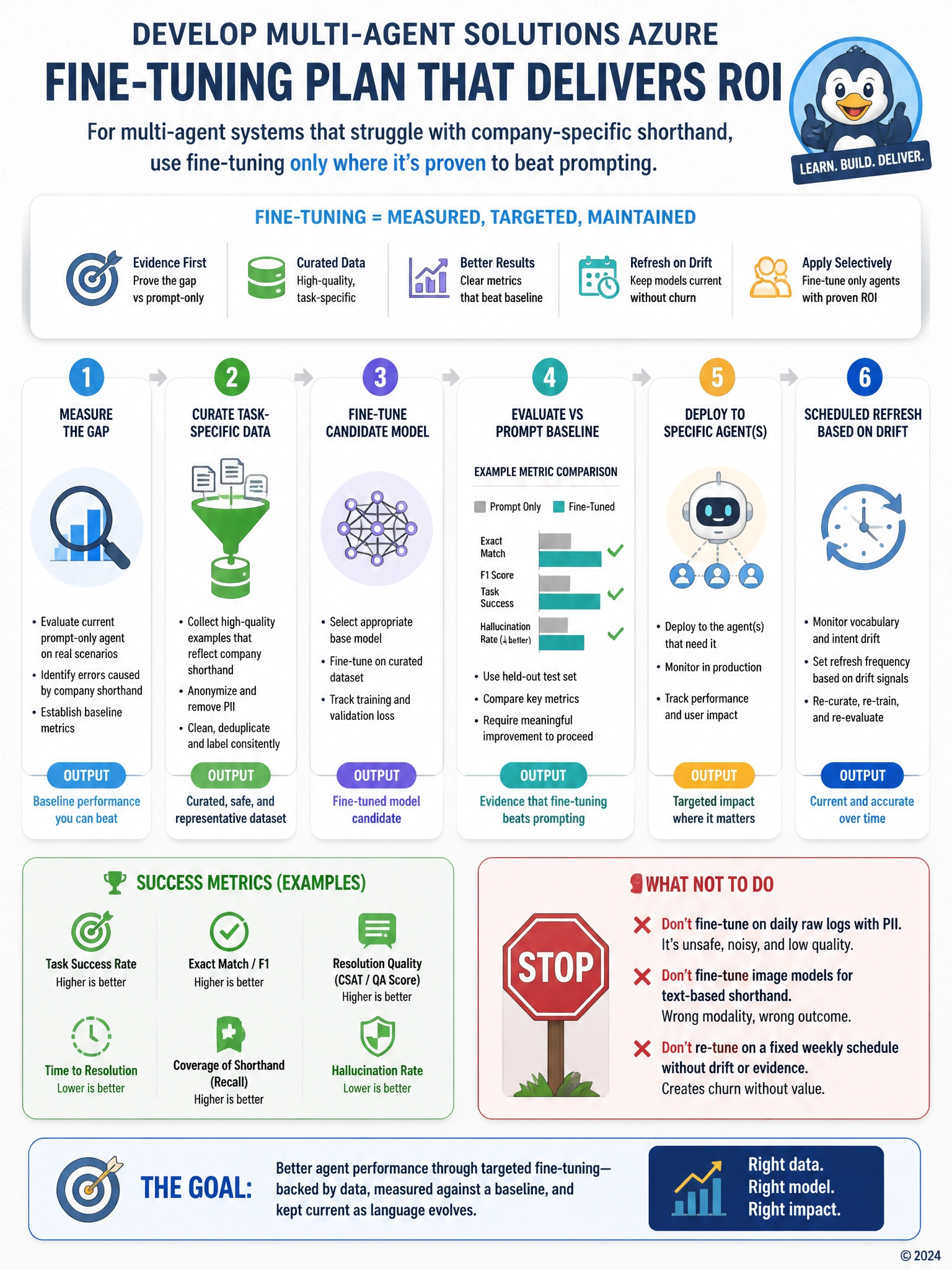
Fine-tuning is a measured strategy: curated data, baselines, metrics that beat prompting, and a refresh cadence when language drifts — only for agents that need it. Option A. Daily raw logs with PII (B) is unsafe and noisy. Image fine-tunes for text slang (C) mismatch modality. Blind weekly re-tunes (D) create churn without evidence.
Full Explanation
Designing fine-tuning strategy includes data and frequency decisions. Option A is controlled, evaluable, and selective.
Option B risks privacy violations and reward hacking on noisy logs.
Option C uses the wrong data modality for the failure mode.
Option D optimizes for change rate rather than quality.
Prefer prompt/RAG improvements first; fine-tune when stable stylistic or domain-token gaps remain after retrieval and prompting.
Exam tip: Fine-tuning plans always include evaluation gates and data governance.