
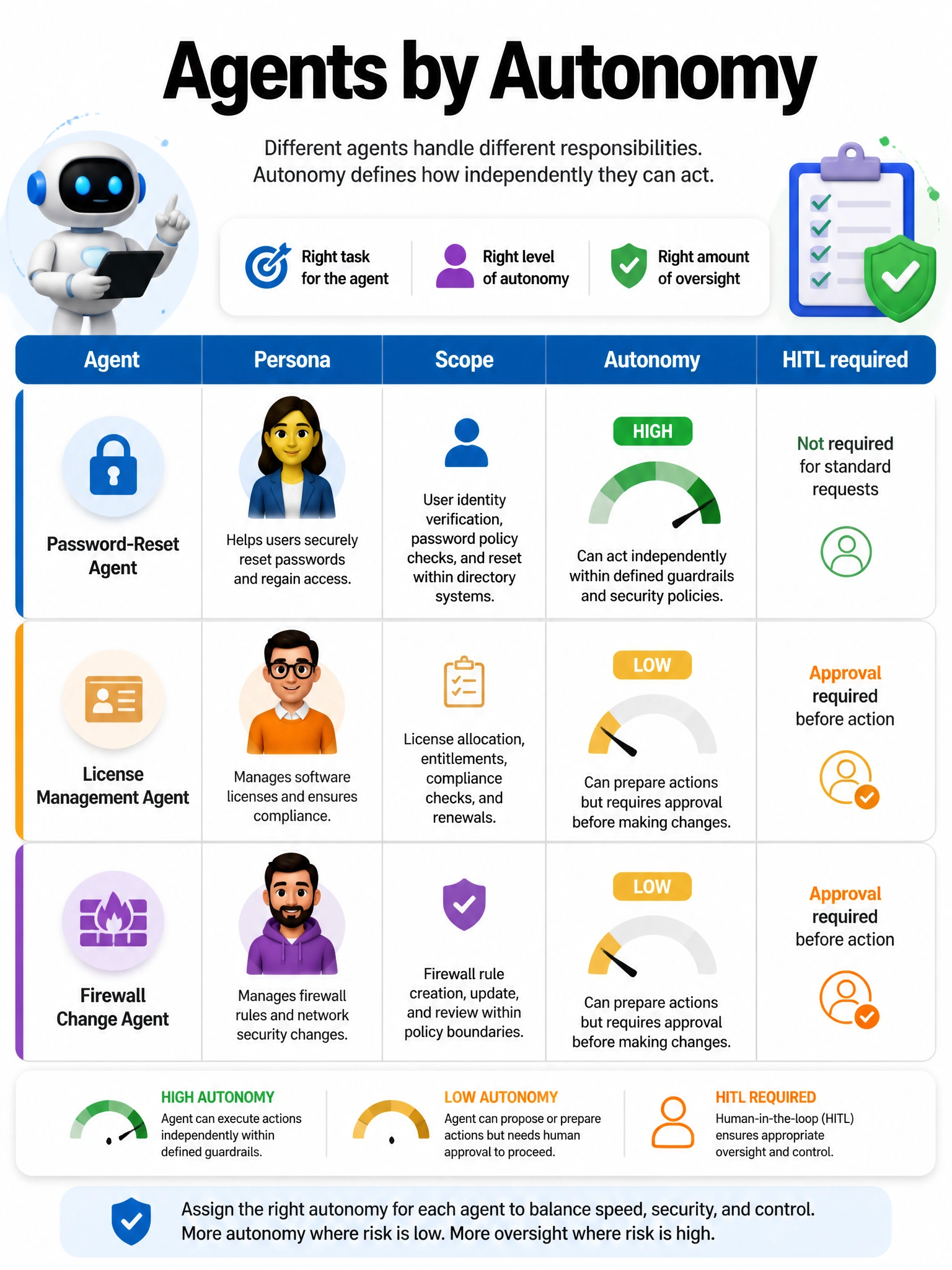
You are specifying agents for an internal IT multi-agent helpdesk. A password-reset agent may complete routine resets automatically, but license-purchase and firewall-change requests must pause for engineer approval. What should you define for each agent during logical design?
Select an answer to reveal the explanation.
Short Explanation
Correct answer: C. Logical architecture must specify agent personas, scopes, boundaries, autonomy levels, and behavioral guidelines. Password resets can be high autonomy; license and firewall changes need HITL. Model name only (A) or uniform autonomy (B) ignores risk differentiation. Token limits (D) are operational knobs, not role design. Encode autonomy in architecture and enforce it in orchestration and tools.
Full Explanation
Exam objectives explicitly include specifying agent personas, scopes, boundaries, autonomy levels, and behavioral guidelines. This is how multi-agent systems stay safe and understandable: each agent knows what it is, what it may do, and when it must escalate. Pair autonomy specs with tool permission boundaries so an agent cannot execute a firewall change API even if the model attempts it. Option A defers critical design to ad-hoc prompting. Option B over- or under-constrains agents. Option D confuses capacity settings with behavioral architecture. Document guidelines for tone, escalation language, and refusal behavior, and align them with responsible AI and HAX (human-AI experience) controls.