
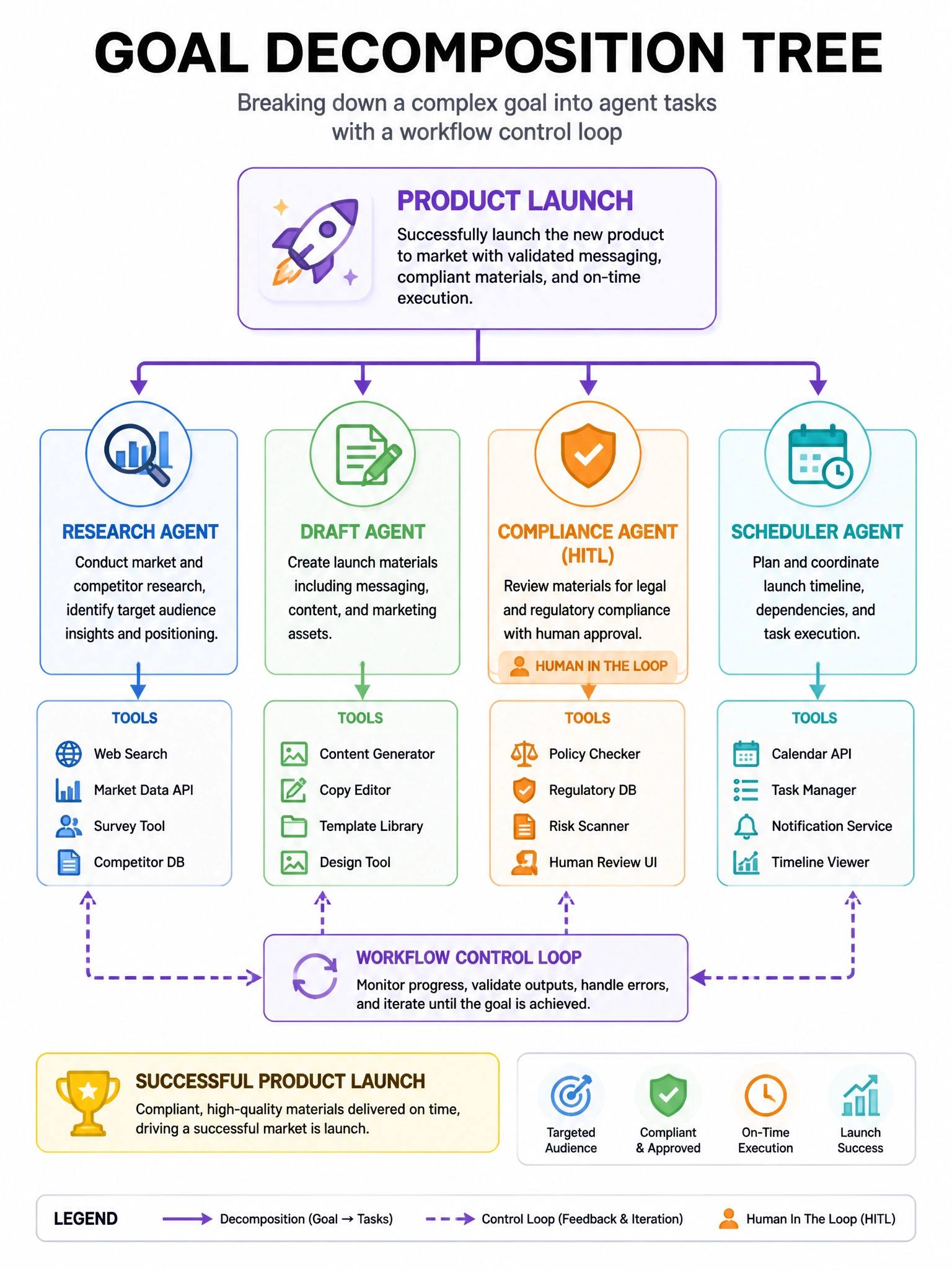
A retailer wants an autonomous system that, for each new product launch, researches competitors, drafts marketing copy, checks brand compliance, and schedules social posts. Stakeholders describe this as one mega-agent that “does everything.” As the solution architect, what is the most appropriate first logical-architecture step?
Select an answer to reveal the explanation.
Short Explanation
Correct answer: C. Architecting multi-agent solutions starts by decomposing goals into workflows, agents/subagents, tools, control loops, and HITL where risk is high. A is close but C fully reflects the skills list (subagents, control loops, HITL). Fine-tuning first (B) skips architecture. Manual uncoordinated bots (D) abandon orchestration. Design scopes and handoffs before implementation.
Full Explanation
AI-500 architect skills begin with decomposing goals and objectives into workflows, agents, and tools, including subagents, control loops, and human-in-the-loop. Product launch marketing is naturally multi-step with different skills, data sources, and risk levels—compliance and publish steps often need lower autonomy. Option A captures specialization but understates subagent/HITL/control-loop design called out in the exam. Option B optimizes a model without a workflow contract. Option D fails coordination, memory, and observability. Produce an architecture that names each agent’s persona, inputs/outputs, tools, autonomy level, and escalation path before selecting frameworks or models.