
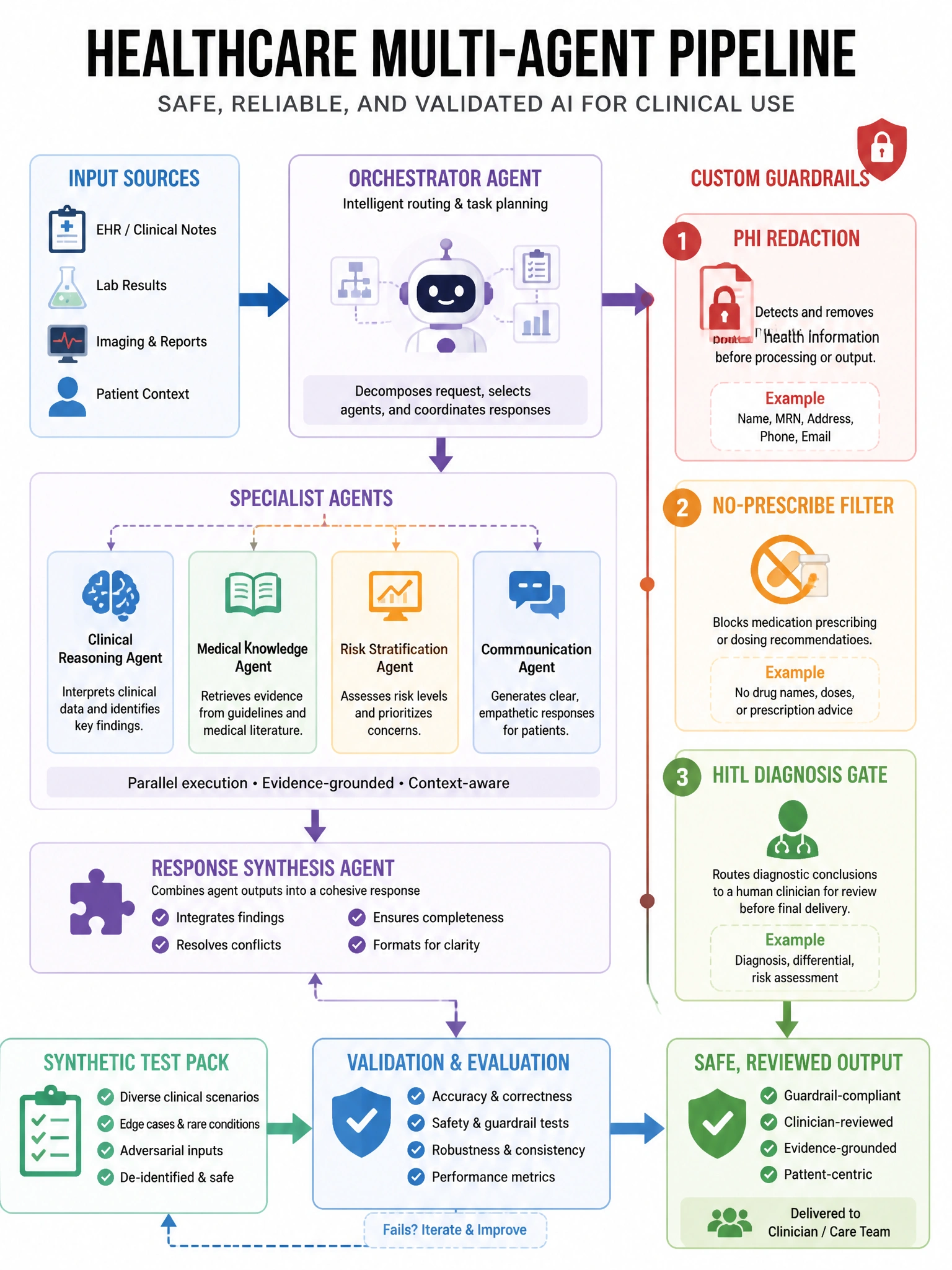
A hospital is piloting multi-agent triage helpers that draft clinical summaries. Beyond generic content safety, policies forbid diagnosing rare conditions without clinician review, forbid prescribing language, and require PHI redaction before any external tool call. How should you implement these requirements?
Select an answer to reveal the explanation.
Short Explanation
Correct answer: B. Domain-specific constraints need custom guardrails, not only generic toxicity filters. Encode diagnosis/prescribing rules, force HITL for high-risk classes, scrub PHI before egress, and prove the controls with synthetic datasets in CI. Wikis (A) are not runtime enforcement. Temperature tweaks (C) do not implement policy. Dropping RAG (D) harms utility without ensuring compliance language rules. Custom guardrails plus validation are the production pattern.
Full Explanation
The secure/govern domain of AI-500 includes designing custom guardrails for domain-specific constraints and testing them with synthetic data. Healthcare is a canonical example: policy is richer than hate/violence categories. Implement classifiers or rule engines for forbidden action verbs (prescribe, dose changes), route diagnosis-class drafts to human-in-the-loop queues, and apply deterministic PHI detection before MCP or HTTP tools leave the trust boundary. Version guardrail configs alongside agent definitions. Option A is process-only. Option C confuses sampling with safety. Option D reduces capability without encoding the actual clinical policies. Measure false positives so clinicians still get useful drafts, and log guardrail interventions for audit and continuous improvement.