
Your multi-agent batch job finishes too slowly. Profiling shows sequential specialist calls and frequent 429s from the model endpoint. What optimization should you apply first?
Select an answer to reveal the explanation.
Short Explanation
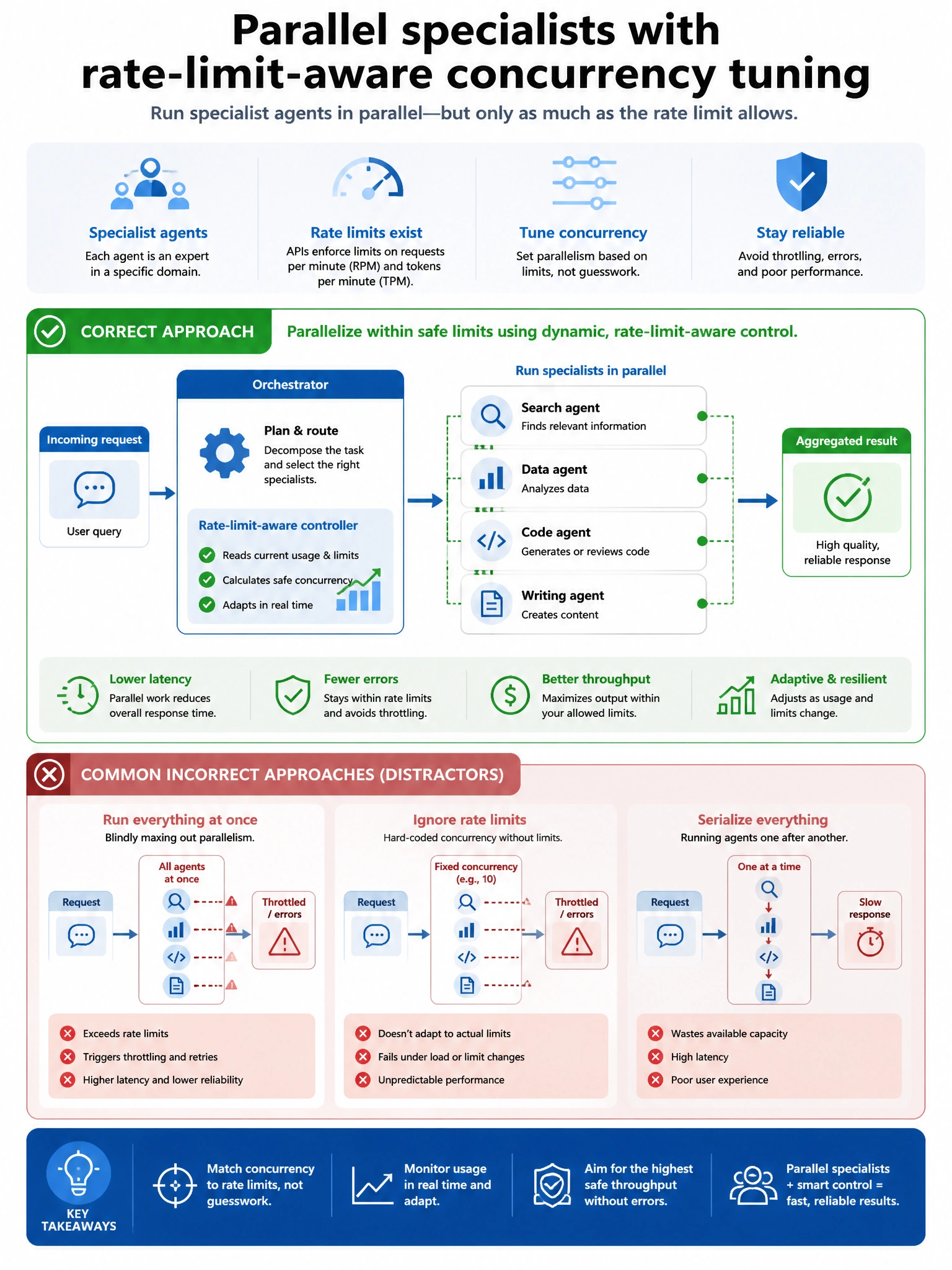
D is the optimize-task-duration playbook: parallelism where independent, plus respect for rate limits via batching and backoff. Sequential specialists and 429 storms are the twin villains in the stem. A more sequential agents worsens duration. B stampede makes 429s worse. C unbounded concurrency without measurement risks loops and cost blowups. AI-500 optimize skills call out task duration including parallelism and rate limits—do both together.
Full Explanation
Correct Answer — D
Optimizing task duration includes parallelism and rate-limit-aware concurrency control. Fan out independent work, batch where useful, and apply backoff so throughput rises without chronic 429 failures.
Why A is wrong: Lengthening the sequential critical path increases latency.
Why B is wrong: Ignoring rate limits increases throttling and retries.
Why C is wrong: Unmeasured concurrency can cause runaway loops and cost.
Exam tip: Parallelism without rate-limit design is incomplete optimization.