
After a release, users report the research agent forgets case facts mid-session, tools return unused, and prompts drift from the approved template. What evaluation strategy should you implement?
Select an answer to reveal the explanation.
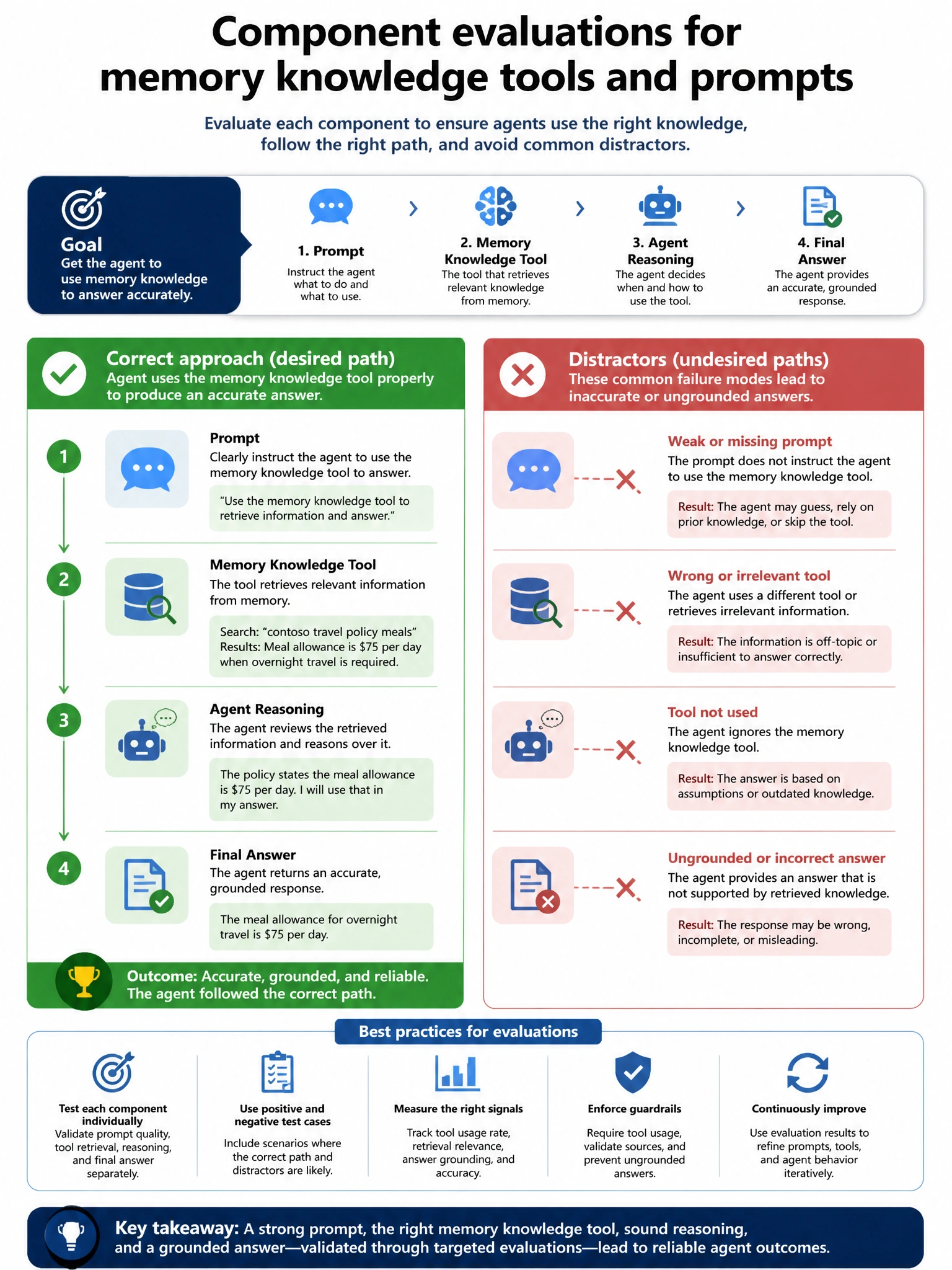
Short Explanation
C hits the skill: evaluations for memory, knowledge, tools, and prompts. Multi-agent failures are often component-level—memory continuity, retrieval quality, tool success, prompt compliance—while the final sentence still “sounds fine.” A CPU load tests miss cognitive quality. B stars alone are lagging and coarse. D deleting telemetry is reverse of observability. Build eval suites that score each subsystem so regressions localize quickly.
Full Explanation
Correct Answer — C
Evaluation strategies for multi-agent solutions must cover memory, knowledge, tools, and prompts in addition to end-to-end answers, enabling localization of regressions such as mid-session forgetting or tool non-use.
Why A is wrong: Infrastructure load tests do not assess agent cognitive quality.
Why B is wrong: Star ratings lack component diagnostic power.
Why D is wrong: Removing telemetry undermines continuous evaluation.
Exam tip: Component evals + E2E evals beat answer-only scoring.