
Your multi-agent FAQ solution repeatedly pays full inference cost for near-identical policy questions. You need a caching strategy that preserves correctness when policies change. Which design is best?
Select an answer to reveal the explanation.
Short Explanation
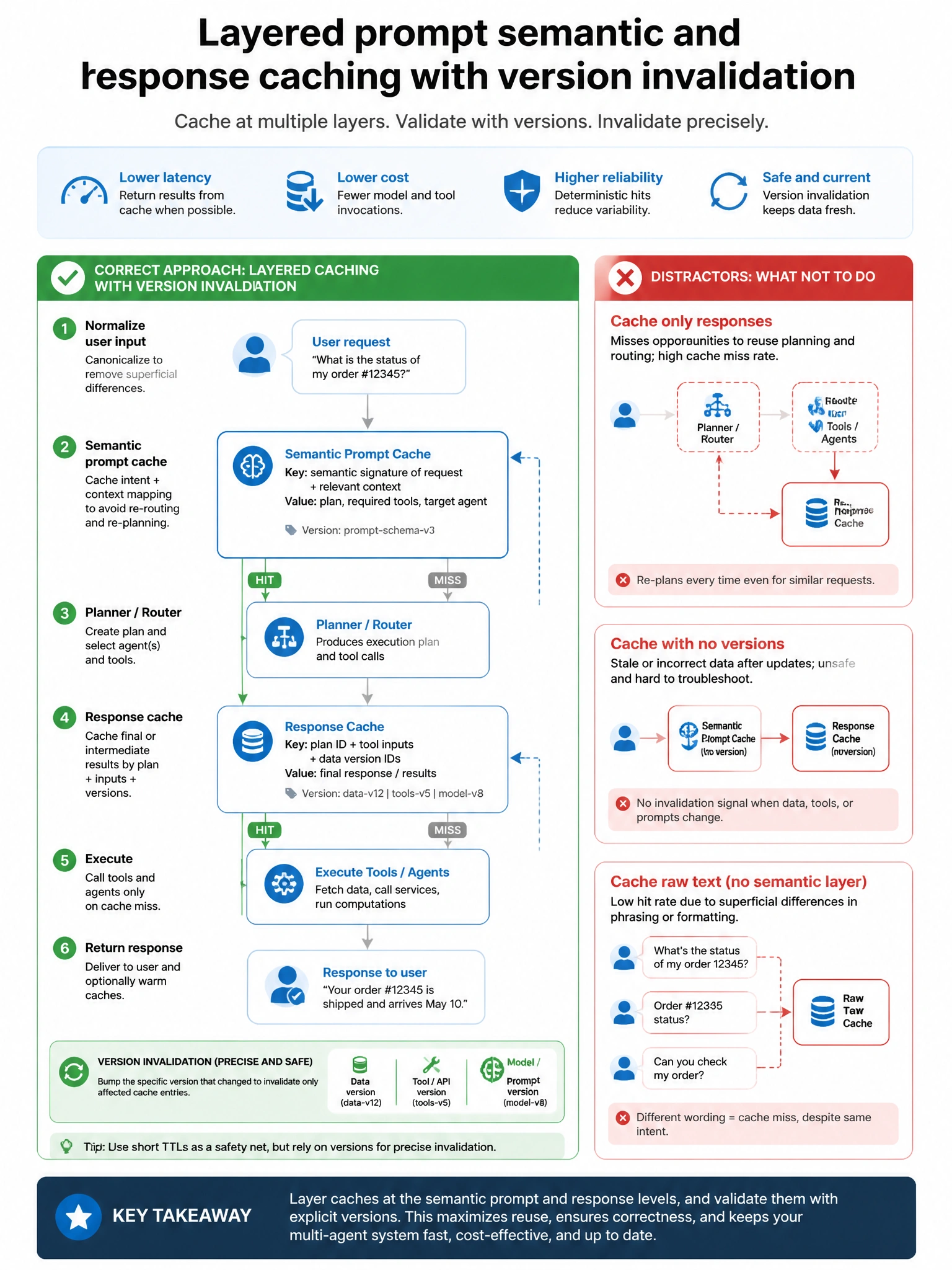
C is the complete answer. Multi-agent caching strategies include prompt caching, semantic caching, and response caching. Layer them, set similarity thresholds carefully, and bind invalidation to policy versions so answers do not outlive the source. A forever cache without invalidation is how you ship wrong policy. B GPU kernel cache is not the skill being tested. D is false—caching is an explicit orchestration skill. Cost and latency wins come from smart invalidation, not blind permanent stores.
Full Explanation
Correct Answer — C
Caching strategies for multi-agent solutions include prompt caching, semantic caching, and response caching. Production designs combine them with TTLs and source-version invalidation so near-duplicate FAQ traffic is cheap without serving stale policy.
Why A is wrong: Infinite retention without policy-version invalidation serves outdated answers.
Why B is wrong: Low-level kernel caching does not address LLM prompt/response reuse.
Why D is wrong: Caching is a first-class multi-agent optimization technique.
Exam tip: Always pair semantic cache hits with freshness/invalidation rules.