
Three agents share a knowledge base: policy lookup, exception handling, and customer explanation. Retrieval often returns irrelevant partial tables, so the exception agent applies the wrong rule. How should you improve the multi-agent RAG architecture?
Select an answer to reveal the explanation.
Short Explanation
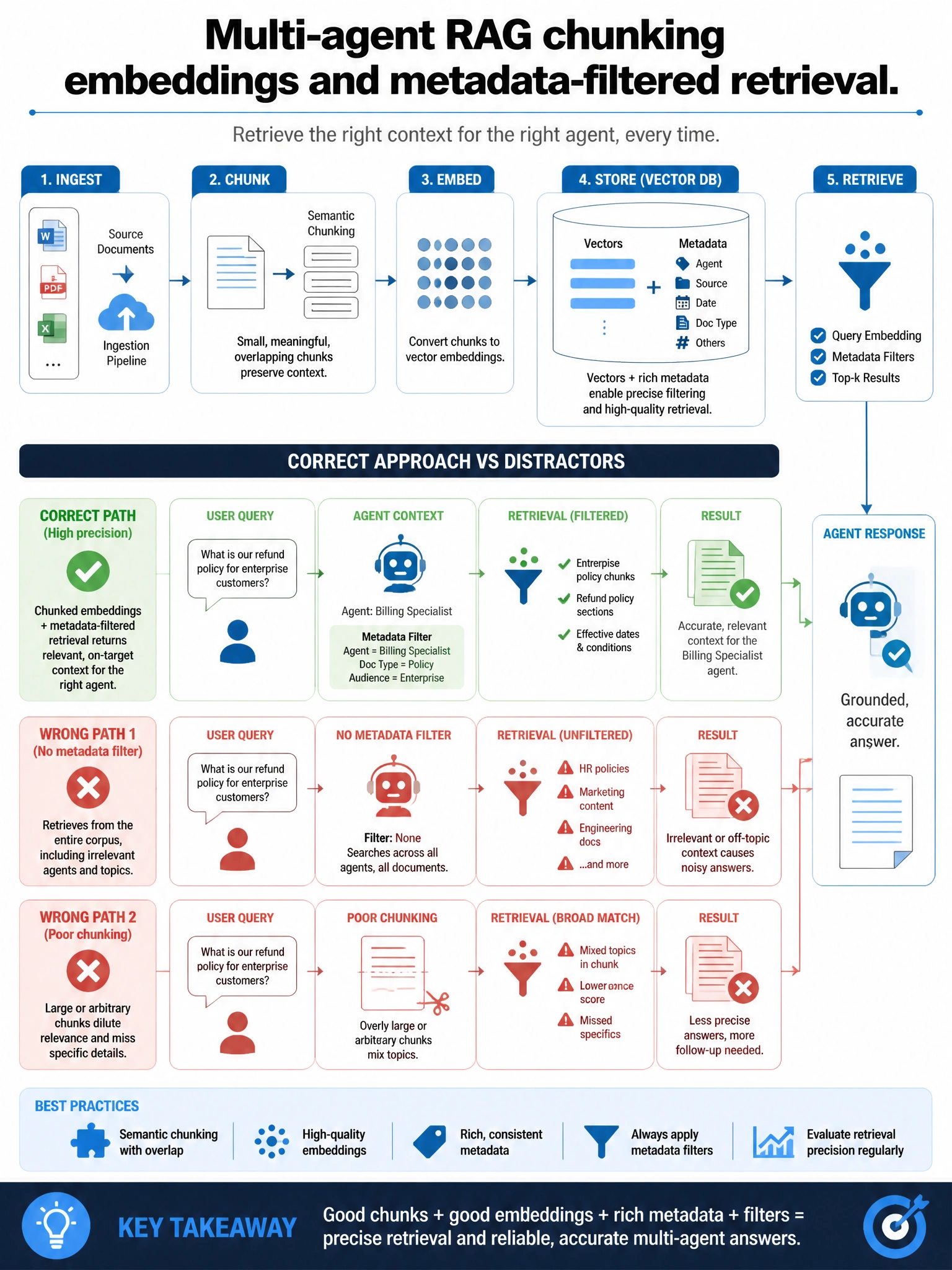
B is correct. Multi-agent RAG is not one-size retrieval. Bad table chunks and weak embeddings tank precision, and specialists then act on the wrong rule. Fix chunk boundaries for structured content, improve embeddings for domain vocabulary, and use metadata filters so the exception agent does not pull marketing fluff. A single-PDF-as-one-chunk blows embedding quality and retrieval. C stuffing the corpus every call is cost and latency suicide. D “ignore retrieval” abandons grounding. AI-500 wants you to connect multi-agent consumption to chunking, embedding quality, and retrieval precision—not bigger prompts alone.
Full Explanation
Correct Answer — B
Multi-agent RAG architecture requires chunking strategy, embedding quality, and retrieval precision. Role-scoped queries with metadata filters prevent specialists from consuming irrelevant passages; table-aware chunking reduces partial-table errors.
Why A is wrong: Oversized single-document chunks degrade embedding fidelity and ranking.
Why C is wrong: Full-corpus prompt injection is impractical and expensive at scale.
Why D is wrong: Parametric-only answers increase hallucination and skip enterprise knowledge.
Exam tip: Wrong-rule symptoms often mean retrieval precision, not only prompt tone.