
You design memory for a multi-tenant multi-agent assistant: short-term session scratchpads, shared team state for a case, and long-term semantic memory of resolved patterns. Compliance requires tenant isolation and retention limits. Which implementation choice is most appropriate?
Select an answer to reveal the explanation.
Short Explanation
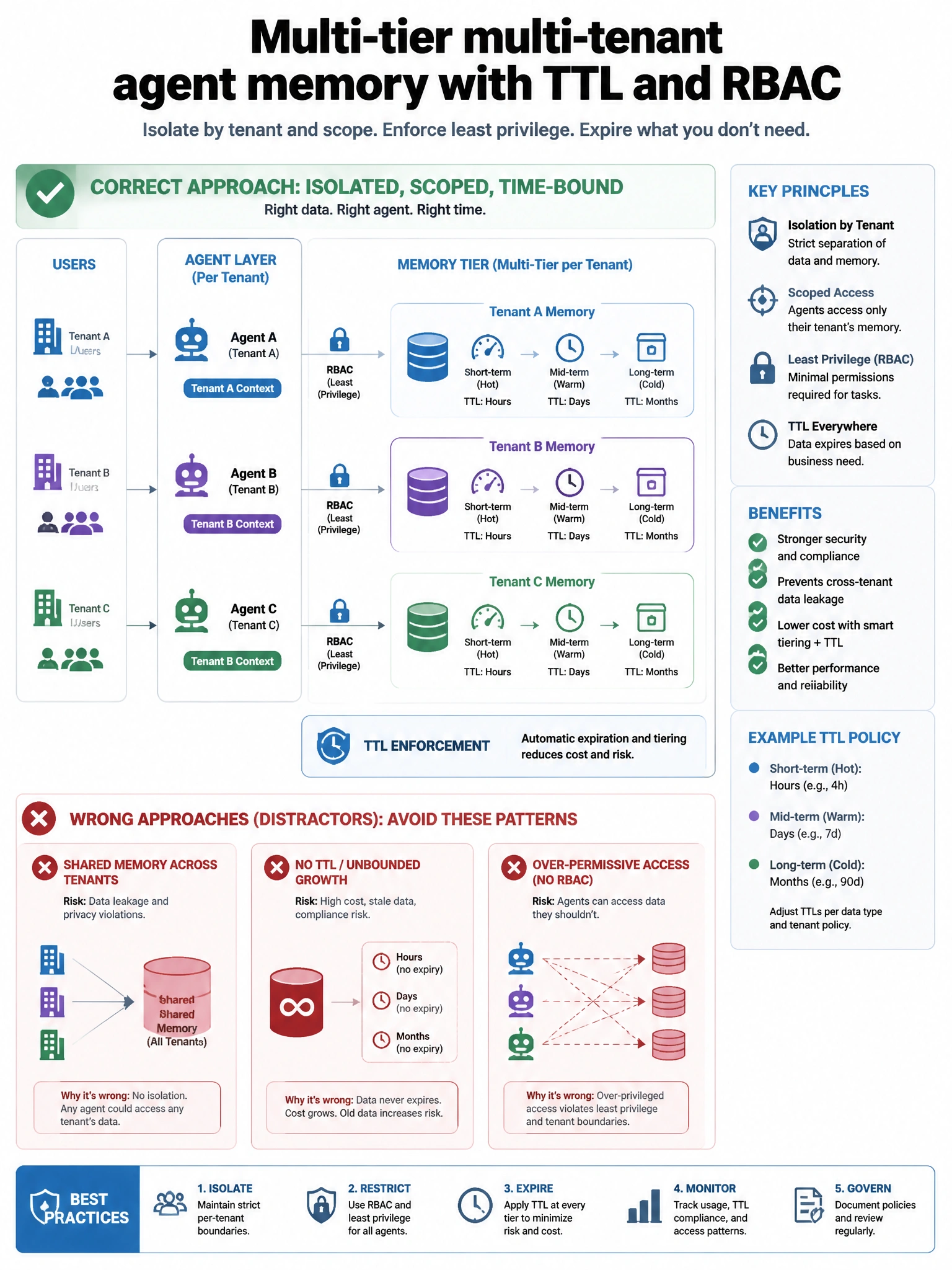
A is the production answer. Multi-agent memory is multi-tier: session scratch, team/case state, and long-term semantic memory—and each tier needs security, compliance, lifecycle, and session management. Tenant partitions, TTLs, purge jobs, and scoped retrieval tools keep isolation real. Shared team state should be case-scoped, not company-wide soup. B’s global store is a classic isolation failure. C cookies cannot hold multi-agent orchestration state reliably. D unrestricted writes invite pollution and lateral data access. When the stem mentions multi-tenant plus retention, map to partitioned stores plus lifecycle policies plus RBAC on memory tools.
Full Explanation
Correct Answer — A
Single- and multi-agent memory strategies must address security, compliance, lifecycle, storage, and session management. Multi-tier designs separate session, shared team/case, and long-term semantic memory with tenant isolation, TTL/purge policies, and controlled retrieval.
Why B is wrong: A global unfiltered store violates tenant isolation and compliance.
Why C is wrong: Browser cookies are inadequate for durable multi-agent memory tiers.
Why D is wrong: Unrestricted writes break least privilege and data integrity.
Exam tip: Memory architecture questions often hinge on tenant isolation + lifecycle, not model size.