
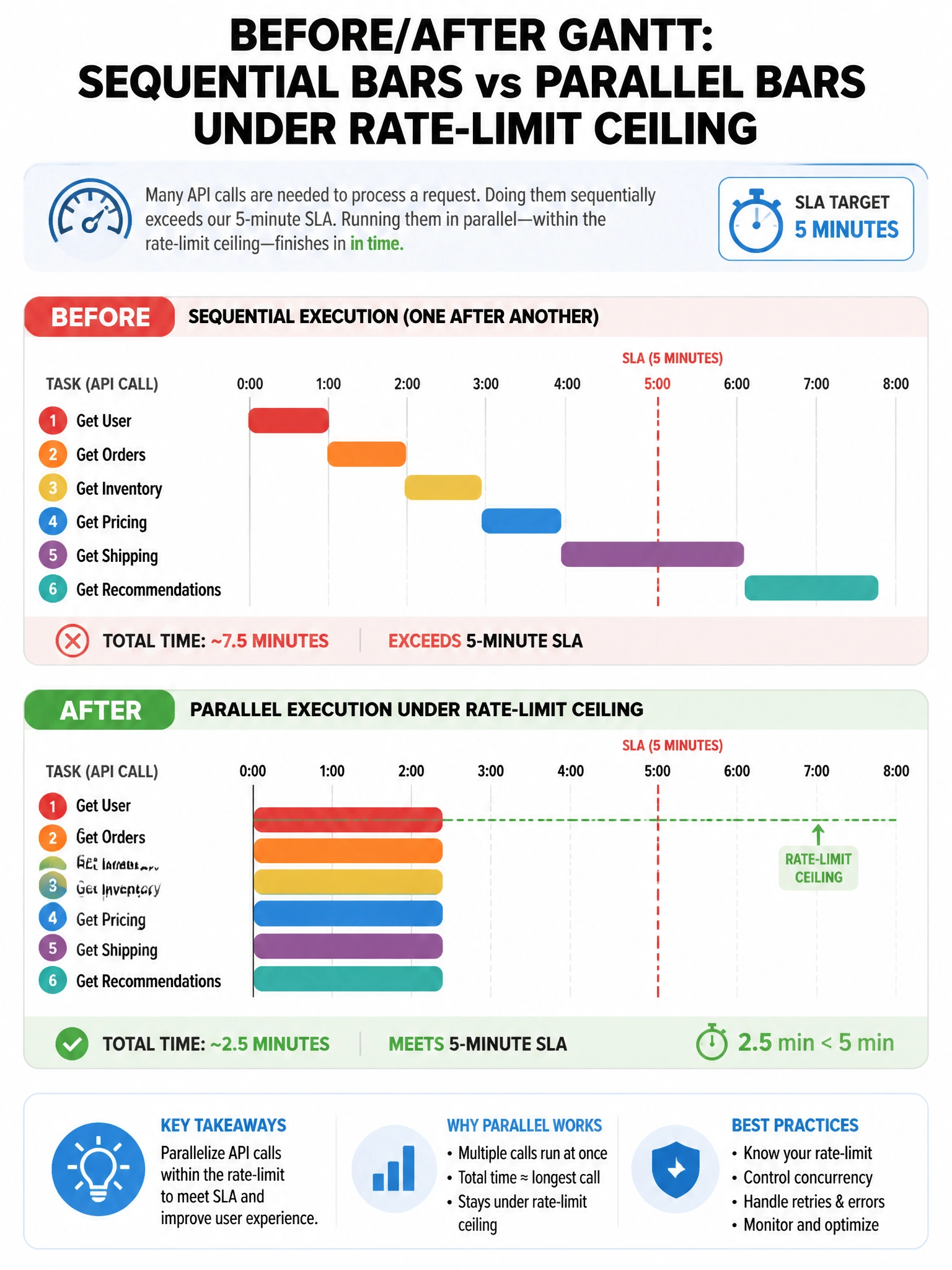
An orchestrator fans out ten research subagents sequentially even though their tasks are independent. End-to-end duration exceeds the five-minute SLA, while the model deployment still has headroom before rate limits. What should you do to optimize task duration?
Select an answer to reveal the explanation.
Short Explanation
Correct answer: D. Independent work should run in parallel. Fan out the ten research subagents concurrently, stay inside rate-limit budgets, batch when it helps, and serialize only true dependencies. Extra sleeps (A) make SLA worse. One mega-prompt without tools (B) drops tool quality and may still be slow or shallow. Disabling cache (C) increases latency and cost. Watch concurrency versus 429s and tune max parallel agents with backoff.
Full Explanation
Optimizing task duration for multi-agent solutions includes parallelism and respect for rate limits. The scenario states independence among research tasks and remaining deployment headroom, so sequential fan-out is the bottleneck. Option D applies parallel execution with rate-limit awareness and dependency-aware serialization. Option A increases duration. Option B sacrifices tool-based research quality and does not address orchestration structure. Option C removes performance optimizations. Implement concurrency controls, exponential backoff on throttling, and metrics for p95 end-to-end duration versus SLA.