
Users report that a long-running research multi-agent loses early constraints (budget cap and excluded vendors) after many tool turns, then invents conflicting recommendations. Token usage per session is near the model limit. Which diagnosis best explains the failure mode?
Select an answer to reveal the explanation.
Short Explanation
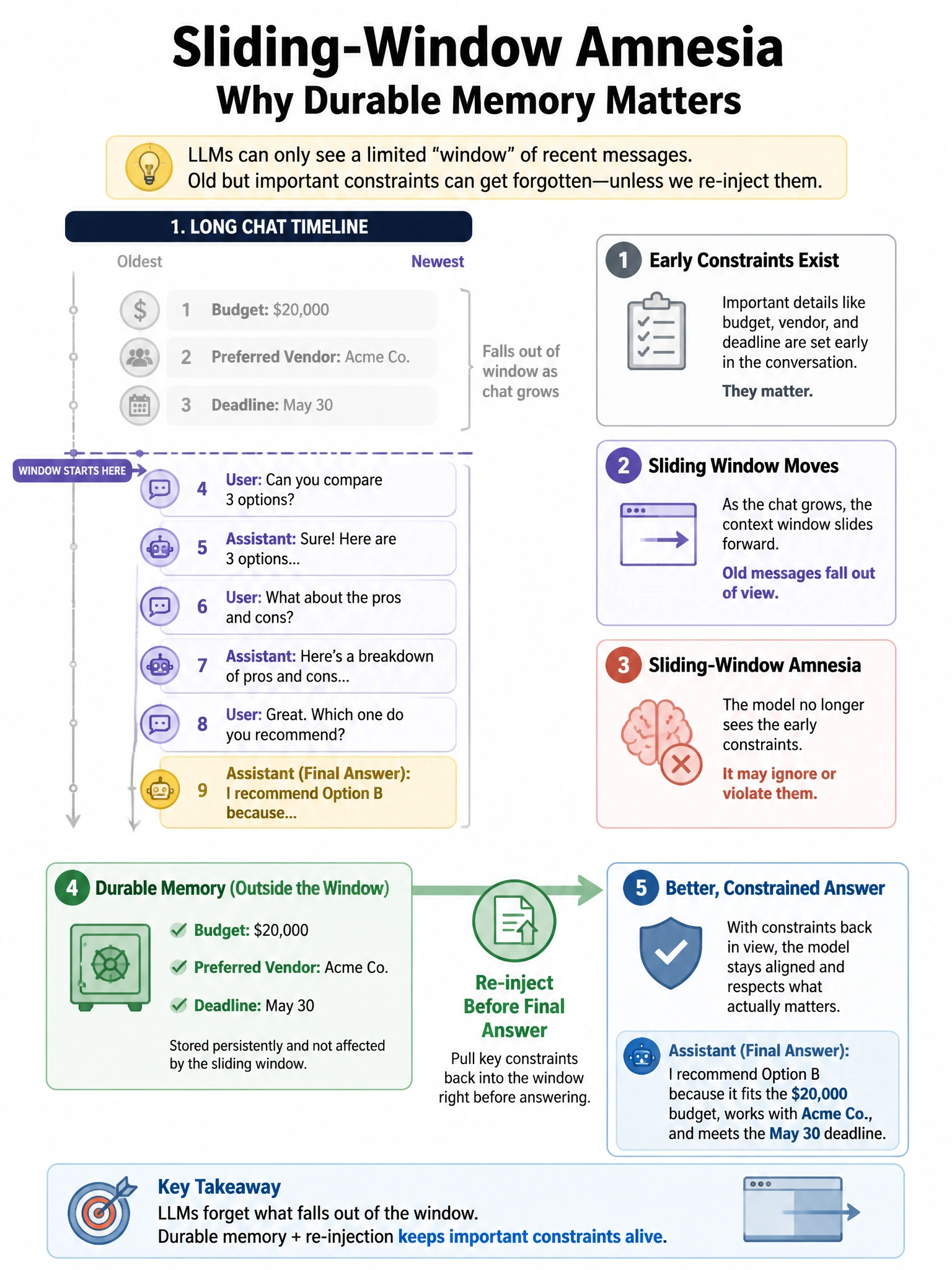
Correct answer: C. When sessions get long and token usage hugs the context limit, models drop earlier turns—classic sliding-window amnesia. Budget caps and excluded vendors that lived only in early messages vanish, so later recommendations conflict. The fix is not more GPU or Front Door DNS; it is durable constraint memory, summary/compaction strategies that preserve entities and rules, and checks that re-inject hard constraints before finalization. Storage RBAC on marketing blobs (D) is unrelated. Diagnose context loss with traces that show which turns remain in the prompt when the bad answer is produced.
Full Explanation
Sliding-window amnesia is a documented context-window failure mode: as tool results accumulate, earlier tokens fall out of the active window, causing loss of constraints and entity continuity. The scenario explicitly cites long multi-turn tool use near the model limit and invented conflicting recommendations—consistent with amnesia rather than infrastructure side issues. Option A (embedding GPU quota) would typically surface as retrieval failures, not silent constraint loss mid-session. Option B (Front Door DNS) affects reachability, not conversational memory. Option D (marketing storage RBAC) is orthogonal to agent context. Remediation includes long-term or session memory for hard constraints, careful compaction that preserves critical entities, and evaluation tests that assert constraint retention after many tool turns.