
A multi-agent investigation workflow in Microsoft Agent Framework accumulates tool outputs and intermediate reasoning until agents hit context window limits and start dropping critical entity names. Which implementation strategy best manages context across agents?
Select an answer to reveal the explanation.
Short Explanation
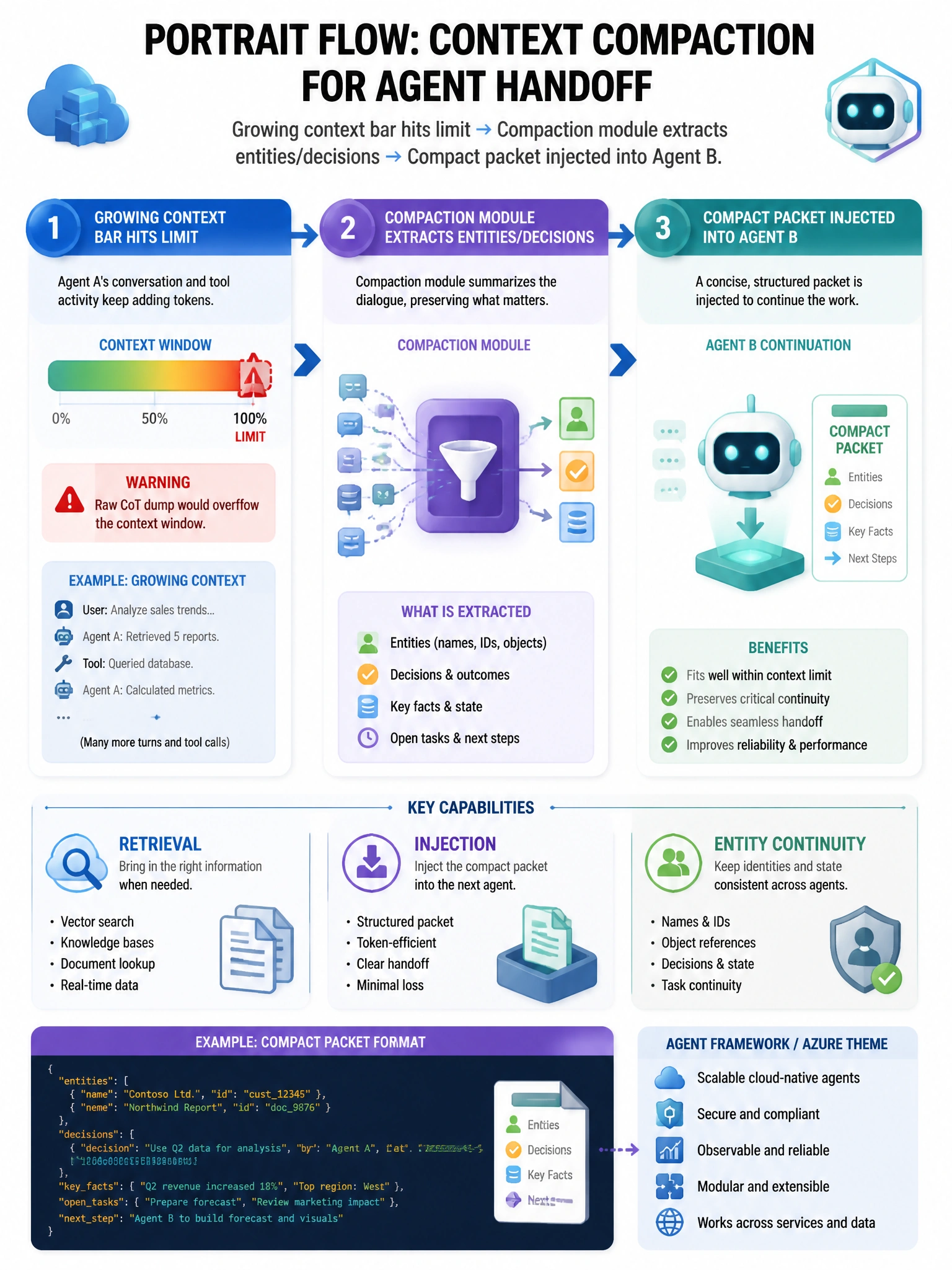
D is the right context-management pattern. You don’t shove every token forever; you accumulate deliberately, retrieve what matters, inject structured context into the next agent, and compact with care so entities and decisions survive. That fights sliding-window amnesia and entity continuity failures common in long multi-agent runs. A kills capability. B guarantees overflow and noise. C is fragile and non-enterprise. Build compaction that is loss-aware—preserve case IDs, parties, amounts, and open questions—not generic “summarize everything shorter.”
Full Explanation
D is correct because developers must implement context management for single- and multi-agent systems: accumulation, retrieval, injection, and compaction. Structured handoffs preserve signal while controlling token growth. A is incorrect: removing tools avoids growth but destroys solution value. B is incorrect: unbounded concatenation causes context overflow and dilutes attention. C is incorrect: browser-only storage is not a secure or reliable multi-agent context plane. Pair compaction with evaluations that detect summary drift and entity loss before production.