
Wide World Importers needs a multi-agent order-exception handler that spikes during holiday peaks, must recover from agent failures, and must control inference cost. Architects are selecting compute for orchestration workers and tool hosts. Which approach best balances scalability, reliability, operational efficiency, security, and cost?
Select an answer to reveal the explanation.
Short Explanation
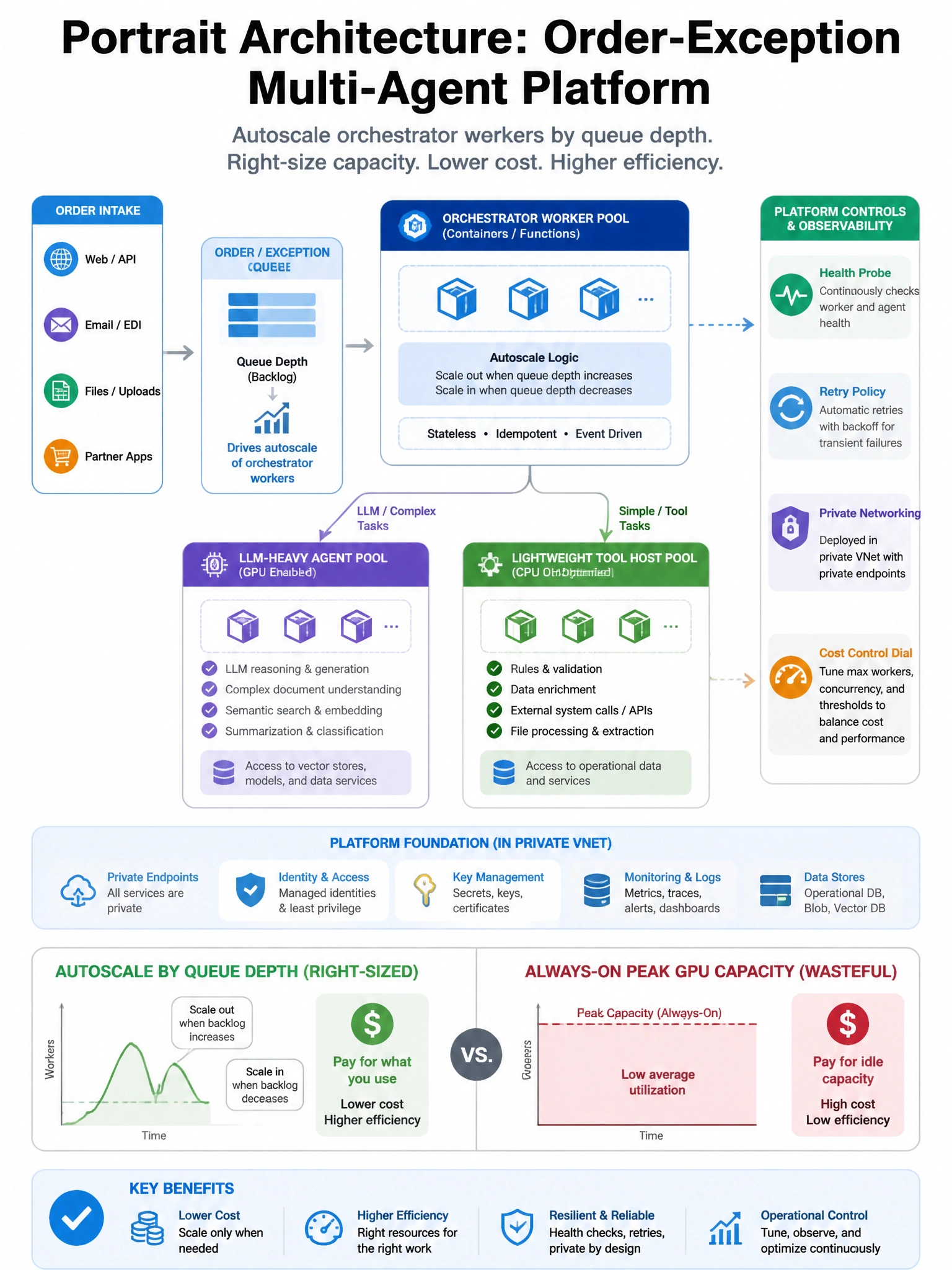
C hits the AI-500 compute-spec criteria: scalability, reliability, operational efficiency, security, and cost. Elastic containers/serverless scale with holiday load; health probes and retries handle flaky agents; private networking hardens the plane; and splitting scale policies for LLM-heavy vs tool-light work controls cost. A overpays all year and fails basic identity/ops hygiene. B is not a production architecture. D pushes secrets and orchestration into the browser—insecure and incomplete for multi-agent workflows. When sizing multi-agent platforms, design for bursty orchestration, isolate failure domains, and don’t pin expensive model capacity as if it were a static web server.
Full Explanation
C is correct because architects must specify compute components that meet scalability, reliability, operational efficiency, security, and cost requirements for multi-agent solutions. Elastic, health-checked workers with differentiated scaling for LLM versus tool workloads match spiky order-exception traffic. A is incorrect: static peak-sized GPUs waste cost and unmonitored admin sessions violate security and reliability practices. B is incorrect: a developer workstation is not a resilient control plane. D is incorrect: browser-only execution cannot safely host privileged tools, durable workflow state, or enterprise networking controls. Prefer managed identities, private endpoints, and autoscaling signals tied to workflow queues.