
Platform engineers must alert when any multi-agent workflow exceeds a token budget or repeatedly fails a critical tool stage. Which Foundry-oriented tracing implementation details are essential?
Select an answer to reveal the explanation.
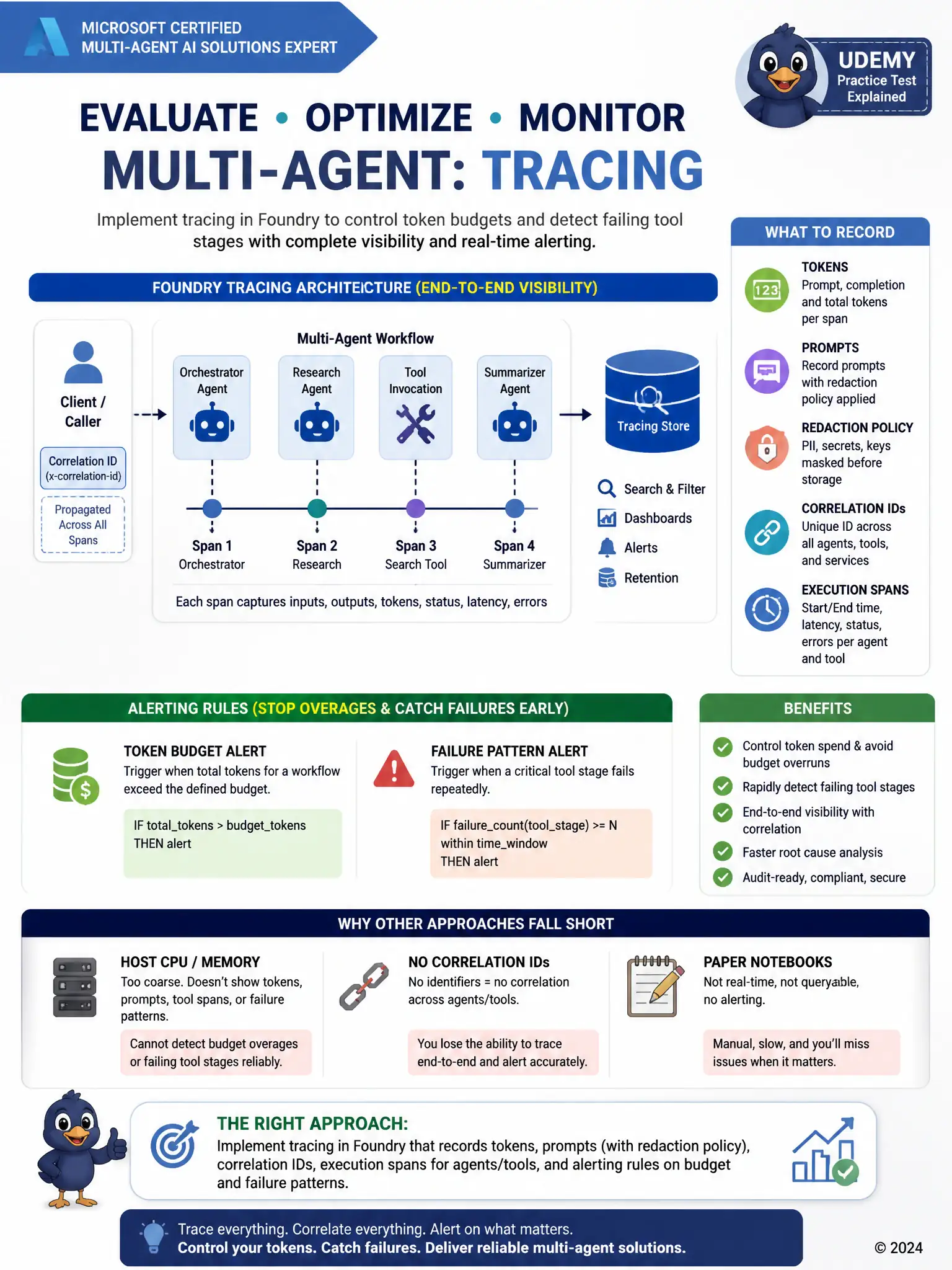
Short Explanation
You need tracing that records tokens, prompts under a redaction policy, correlation IDs, agent/tool spans, and alerts for budget overruns and repeated tool failures. That is how you catch token-budget breaches and failing stages in real time. Host CPU, no identifiers, and paper notebooks miss the point.
Full Explanation
The required implementation records token usage, prompts/responses under redaction, correlation IDs, agent/tool spans, and alerts for budget breaches and repeated tool-stage failures. This reveals which workflow or stage consumed tokens or failed, enabling remediation. Host CPU graphs are wrong because they do not identify the agent, prompt, or tool call. Logs without identifiers are wrong because missing correlation/workflow IDs collapses multi-agent debugging. Weekly paper notebooks are wrong because offline notes cannot meet real-time alerting SLAs. Apply data classification so prompt traces do not leak secrets or raw PII into general log stores.