
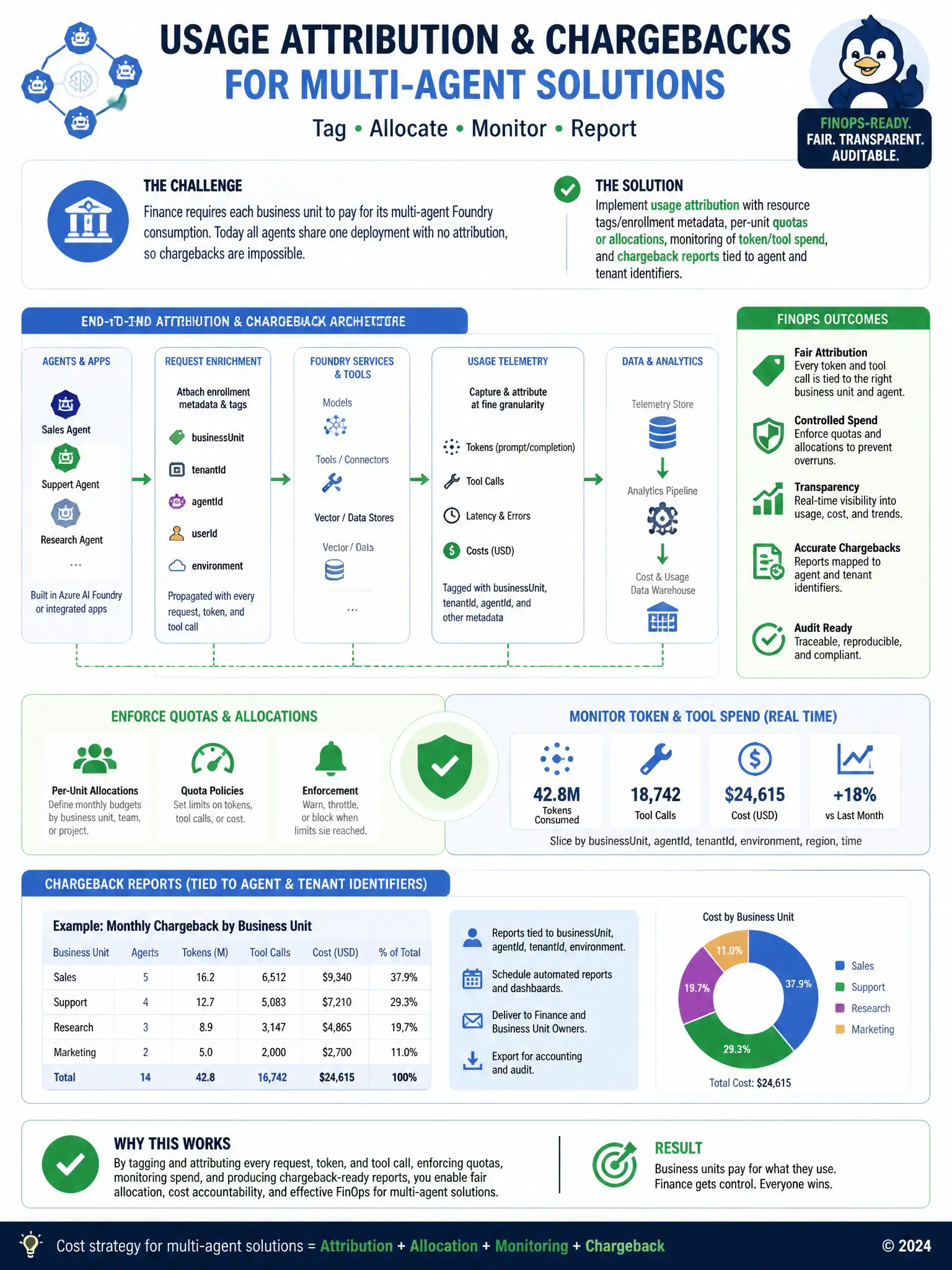
Finance requires each business unit to pay for its multi-agent Foundry consumption. Today all agents share one deployment with no attribution, so chargebacks are impossible. What monitoring and management strategy should you design?
Select an answer to reveal the explanation.
Short Explanation
You need usage attribution with tags or enrollment metadata, per-unit quotas, token and tool spend monitoring, and chargeback reports tied to agent and tenant identifiers. Shared untagged keys, deleted cost data, and unconstrained burst usage break fair chargeback and FinOps control.
Full Explanation
Use usage attribution with resource tags or enrollment metadata, per-unit quotas or allocations, monitoring of token and tool spend, and chargeback reports tied to agent and tenant identifiers. Design cost monitoring and management around usage visibility, quotas, allocations, and chargebacks. Propagate business-unit identifiers into traces and Azure cost tags; optionally isolate deployments or use Azure OpenAI/Foundry quota constructs per unit; alert on anomalies. The single shared API key with no tagging and monthly guess for each unit is incorrect because untagged shared keys make accurate chargeback impossible. Deleting cost data after each day is incorrect because retaining cost telemetry is required for finance reconciliation. Ignoring quotas and allowing unconstrained burst usage is incorrect because quotas protect budget and noisy-neighbor effects across multi-agent workloads. Align chargeback grain with how agents and tools are owned operationally.