
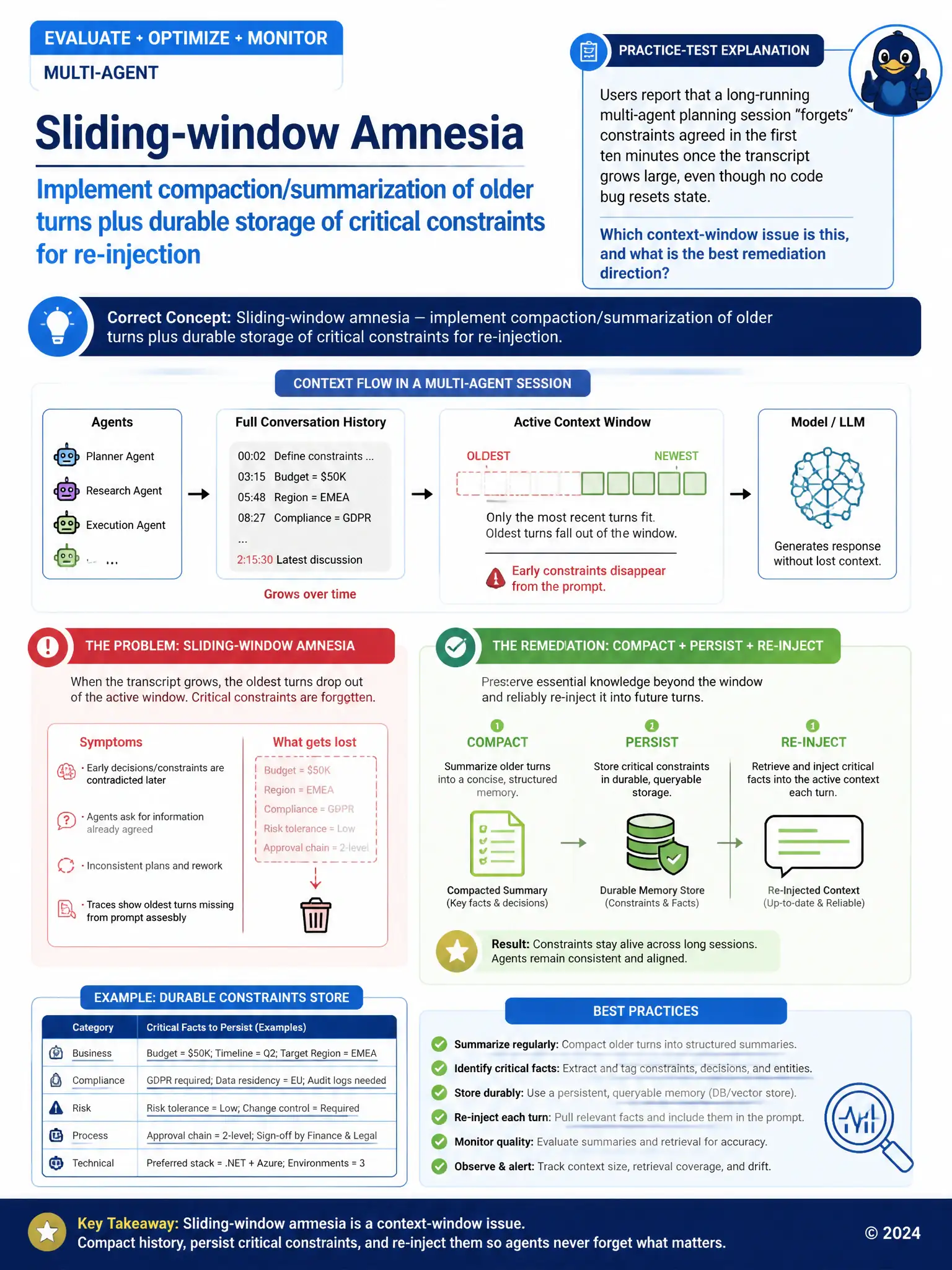
Users report that a long-running multi-agent planning session “forgets” constraints agreed in the first ten minutes once the transcript grows large, even though no code bug resets state. Traces show oldest turns disappearing from the prompt assembly. Which context-window issue is this, and what is the best remediation direction?
Select an answer to reveal the explanation.
Short Explanation
You're seeing sliding-window amnesia: the oldest turns fall out of the prompt, so early constraints disappear. Fix it by compacting older history and storing critical constraints durably so they can be re-injected.
Full Explanation
The correct issue is sliding-window amnesia, remediated by compaction or summarization of older turns plus durable storage of critical constraints for re-injection. When diagnosing context-window problems, consider sliding-window amnesia, summary drift, vector-only recall, and entity continuity problems. Sliding-window amnesia appears when prompt builders keep only the newest N tokens or turns, so early requirements silently drop from the assembled prompt. The best remediation direction is hierarchical summaries, structured constraint stores, and retrieval of “must keep” entities into each new turn.
The GPU thermal throttling option is incorrect because hardware throttling might slow responses, but it does not selectively drop early dialogue turns from prompt assembly.
The DNS cache poisoning option is incorrect because DNS issues affect connectivity, not prompt content selection.
The image resolution mismatch option is incorrect because graphics assets are irrelevant to multi-agent conversational context windows.
Also watch for summary drift if compaction itself rewrites constraints incorrectly—validate summaries against source constraints.