
Token costs for a multi-agent support system are dominated by repeated similar questions and repeated system prompts. Which caching strategy should you implement?
Select an answer to reveal the explanation.
Short Explanation
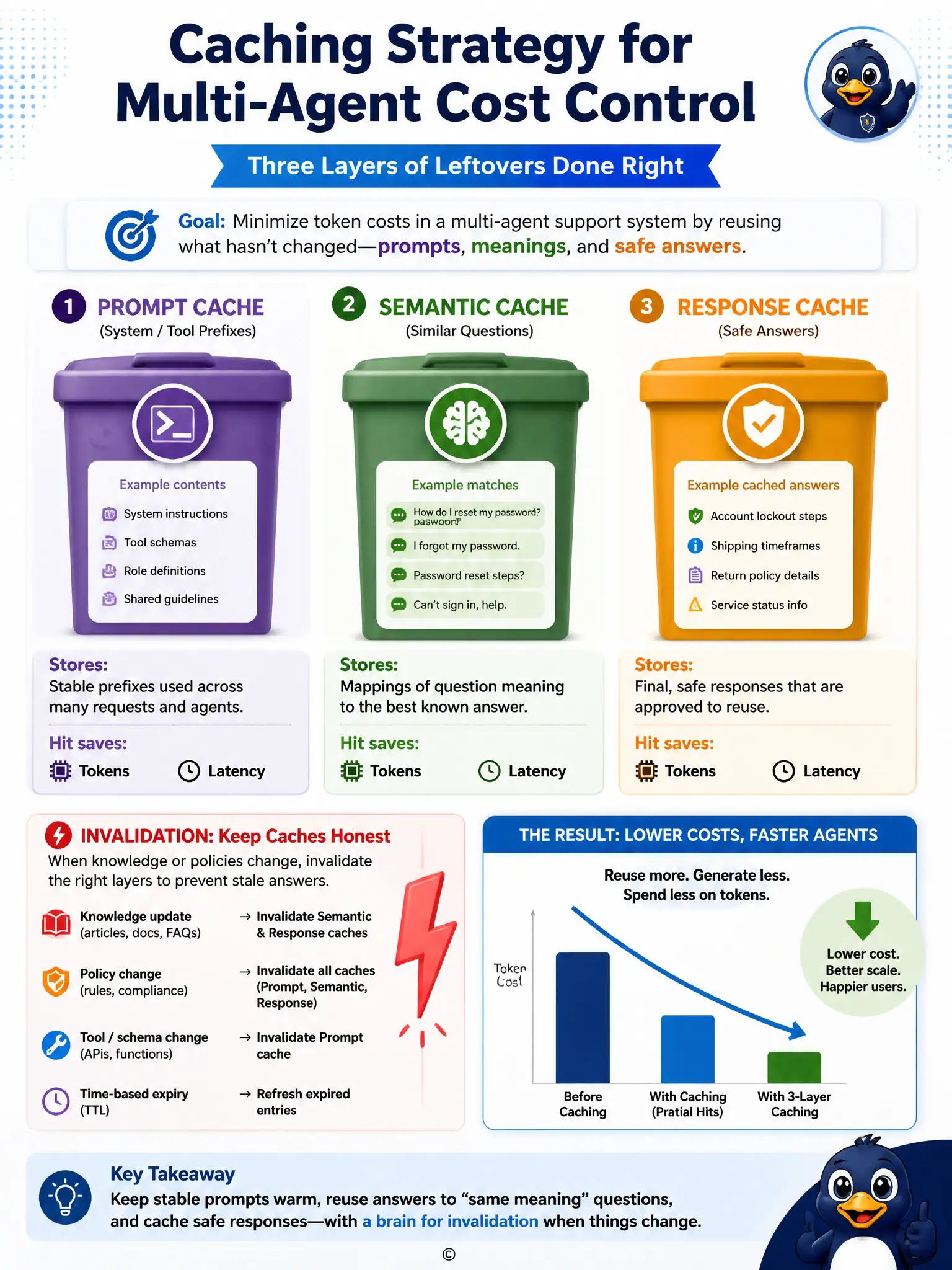
Caching for agents is three layers of leftovers done right: you keep stable system/tool prefixes warm, reuse answers to same-meaning questions, and cache safe responses—with invalidation when policy docs change.
Full Explanation
Multi-agent development includes caching strategies: prompt caching, semantic caching, and response caching. The combined approach with prompt caching for stable system/tool prefixes, semantic caching for near-duplicate questions, and response caching for safe reusable answers—with invalidation when knowledge or policies change—addresses cost and latency without serving stale policy. Disabling all caching maximizes cost unnecessarily. Caching raw TCP packets lacks semantic understanding and is not an LLM caching strategy. Storing user passwords in cache keys is a security anti-pattern and irrelevant to cost. Exam tip: memorize prompt, semantic, and response caching plus invalidation.