
You are implementing multi-agent RAG so a research agent and a compliance agent share enterprise knowledge with high retrieval precision. Which design choices are most appropriate?
Select an answer to reveal the explanation.
Short Explanation
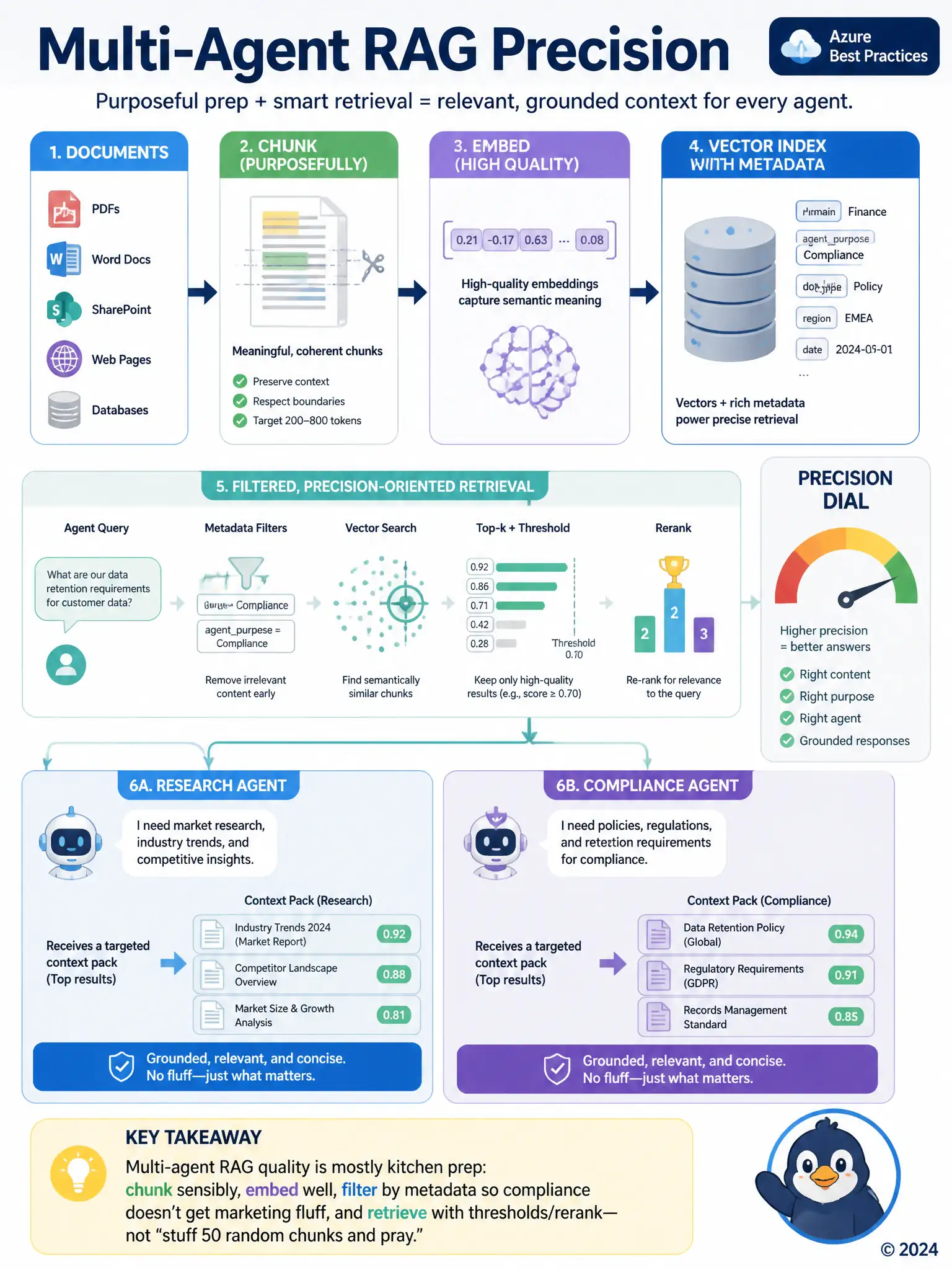
Multi-agent RAG works when you chunk sensibly, embed well, filter by metadata, and retrieve with thresholds or reranking. That keeps each agent getting relevant, grounded context instead of noisy fluff.
Full Explanation
The correct design uses purposeful chunking, high-quality embeddings, metadata filters such as domain or agent purpose, and precision-oriented retrieval with top-k thresholds or reranking so each agent receives relevant grounded context. Multi-agent RAG quality depends on chunking, embedding quality, retrieval precision, and knowledge integration for multi-agent consumption. Embedding entire multi-hundred-page PDFs as single vectors and always returning top-50 chunks regardless of relevance score yields poor embedding granularity and noisy context. Disabling embeddings and pasting random documents into the system prompt for every request is not RAG and does not scale. Training a new embedding model nightly on production user chats without evaluation is operationally risky and lacks evaluation discipline. Exam caveat: precision often includes metadata routing so each agent’s retrieval is purpose-scoped.