
Long-running multi-agent cases accumulate huge transcripts until agents hit context limits and drop critical entities. You need a strategy for context accumulation, retrieval, injection, and compaction across agents. What should you implement?
Select an answer to reveal the explanation.
Short Explanation
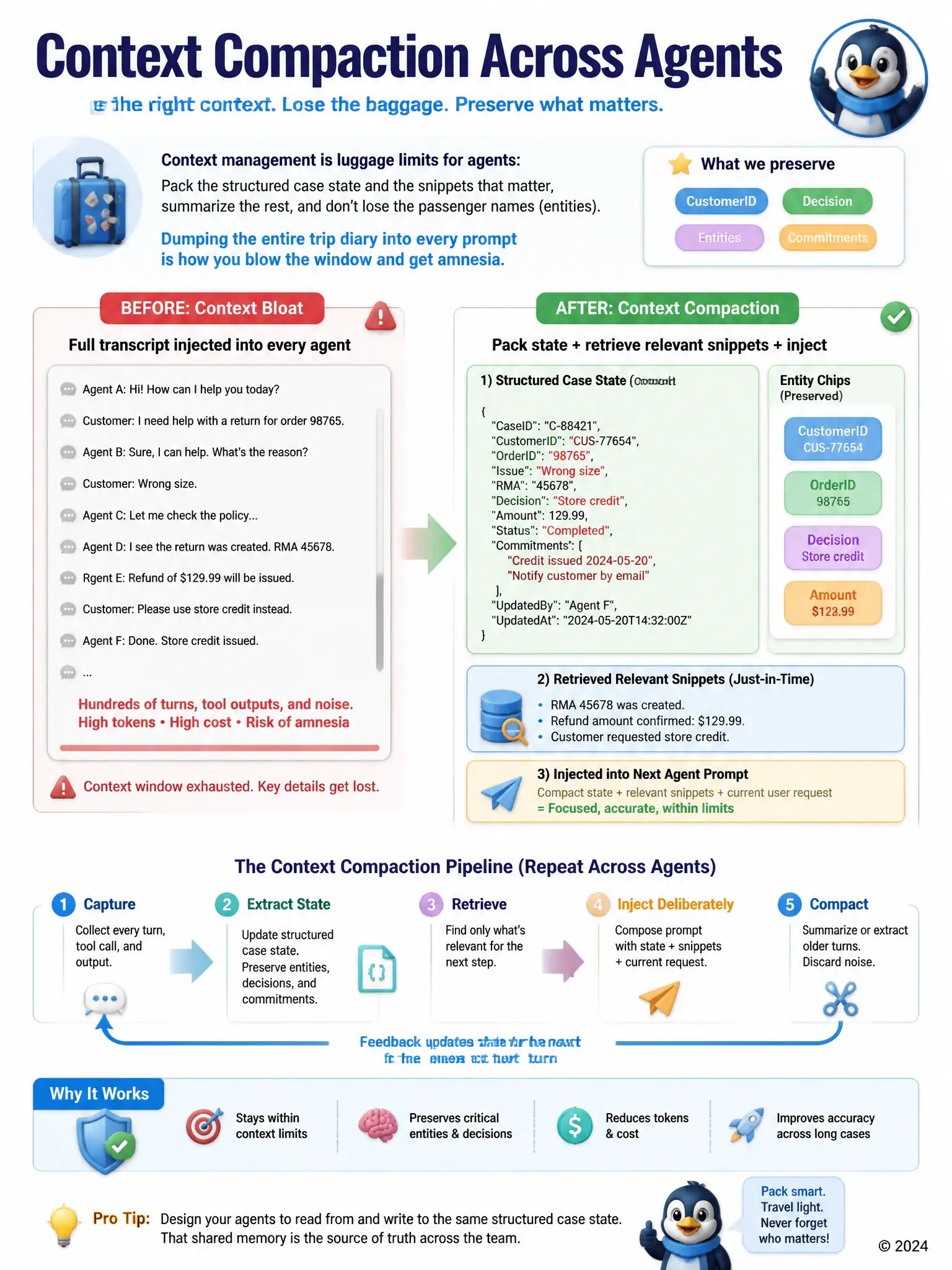
Treat context like a tight carry-on: keep the case state and key entities, pull only the snippets you need, then summarize older turns. If you dump every raw transcript into every prompt, you'll blow the window and lose the details that matter.
Full Explanation
Developers must design context management—including accumulation, retrieval, injection, and compaction—for single-agent and multi-agent systems. The correct strategy is the structured working-memory approach: maintain case state, retrieve only relevant snippets for the next step, inject them deliberately, and compact older turns through summarization or state extraction while preserving key entities and decisions. That directly addresses sliding-window failures in long-running multi-agent operations.
The full raw-history concatenation approach causes context bloat and cost or latency explosions. The stateless-delete approach destroys the continuity needed for long-running cases. The indefinite max-token increase approach is not a scalable design and eventually still hits model limits.
Exam tip: Compaction plus structured memory plus selective injection is the expected pattern for long-running multi-agent context.