
Your multi-agent design includes (1) a cheap high-volume intent classifier, (2) a reasoning-heavy planning orchestrator, and (3) a code-generation specialist. How should you match tasks to model family capacities?
Select an answer to reveal the explanation.
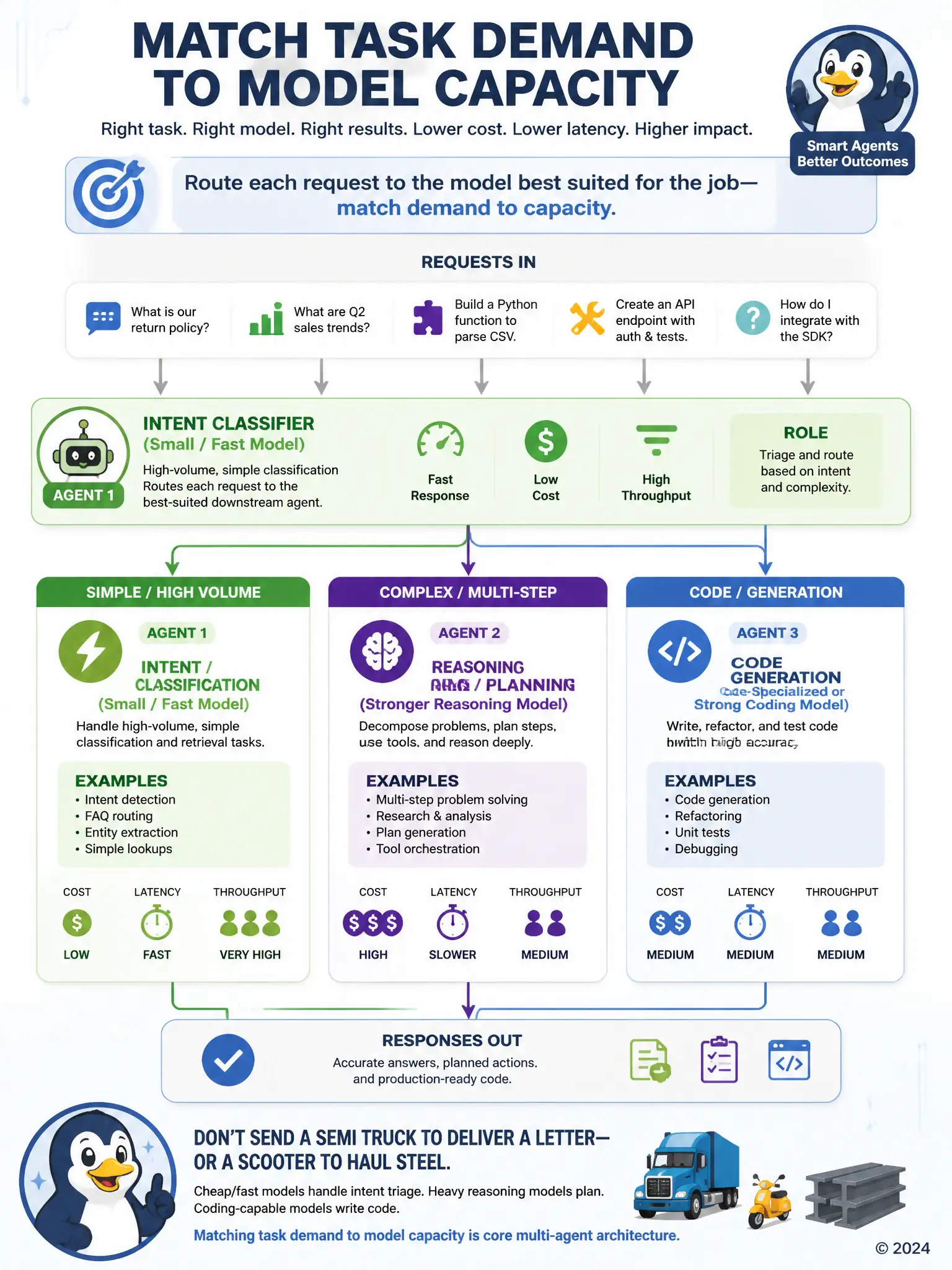
Short Explanation
You match each job to the right model: cheap fast models for intent triage, strong reasoning models for planning, and coding-capable models for code generation. Sending a semi truck to deliver a letter—or a scooter to haul steel—is wasted cost and latency. Matching task demand to model capacity is core multi-agent architecture, not an afterthought.
Full Explanation
Architects must match task demands to model family capacities. The correct approach routes high-volume simple classification to a smaller/faster model, assigns deep multi-step planning to a stronger reasoning model, and uses a code-specialized or strong coding-capable model for generation, explicitly matching demand to capacity. This balances quality, latency, and cost.
The option that uses the largest reasoning model for every step, including intent classification, is incorrect because it wastes tokens and latency on trivial classification.
The option that uses only tiny on-device models for planning and code generation to minimize spend is incorrect because undersizing planning and codegen destroys solution quality.
The option that picks a single mid-size model for all agents to keep architecture diagrams simple is incorrect because one mid-size model ignores differentiated task demands called out in the scenario.
Exam tip: Heterogeneous model routing is a feature of good multi-agent design questions.