
A legal firm wants a drafting agent that may propose contract clause language but must never send email to counterparties or accept settlement terms. Which specification elements belong in the agent’s persona and autonomy design?
Select an answer to reveal the explanation.
Short Explanation
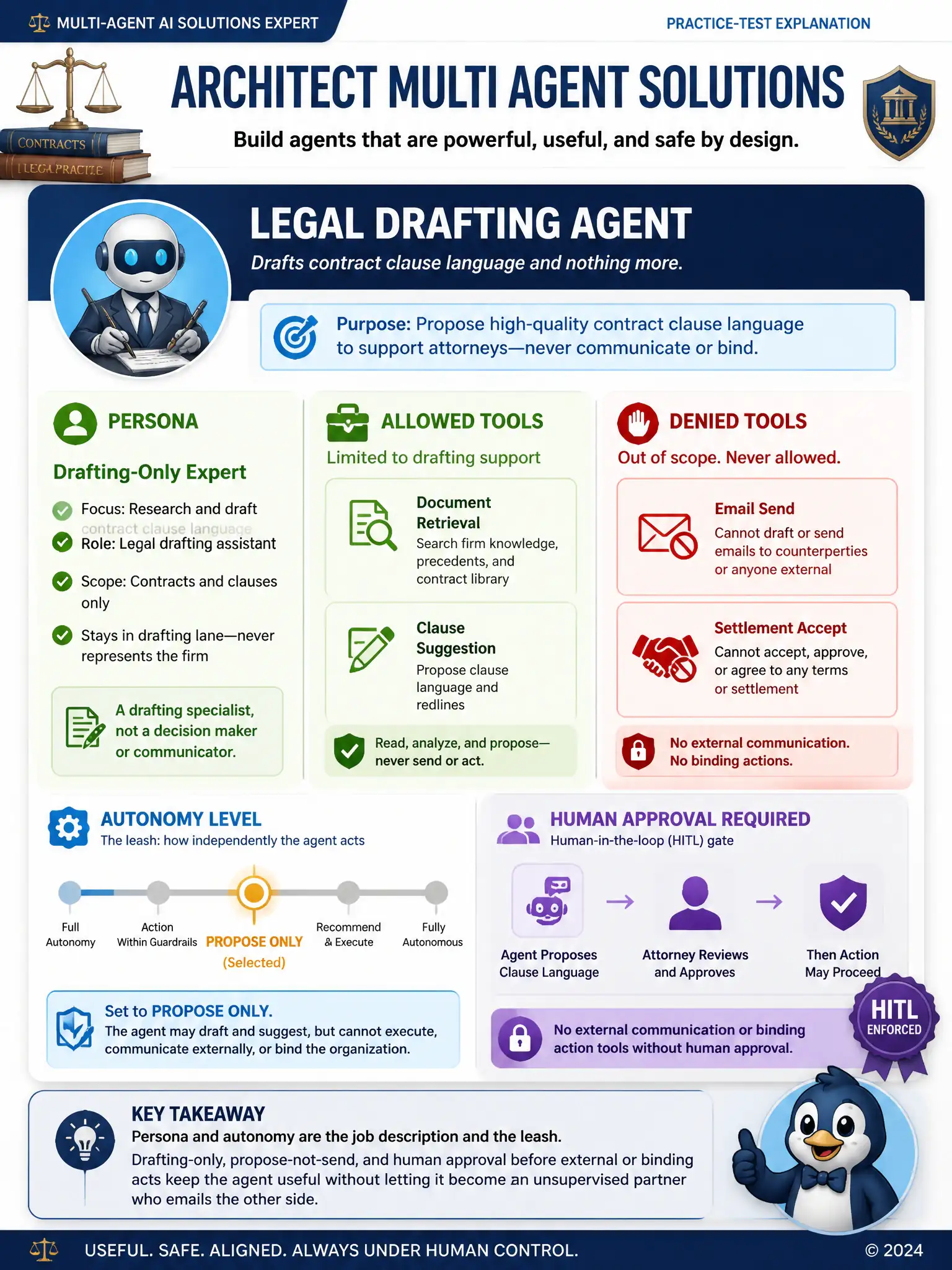
Persona and autonomy are the job description and the leash. You need a drafting-only agent that can retrieve documents and suggest clauses, but it must propose only and get human approval before any external communication or binding action. That keeps it useful without letting it become an unsupervised partner who emails the other side.
Full Explanation
Logical architecture requires specifying agent personas, scopes, boundaries, autonomy levels, behavioral guidelines, tool scopes, and permission boundaries. The correct specification limits persona and tools to drafting support, allows only document retrieval and clause suggestion, sets autonomy to propose only, and requires human approval before external or binding action tools. This matches the firm's requirement to propose clause language but never send email or accept settlement terms.
The option granting full mailbox send rights and settlement-system write tools violates the explicit never-send-email and never-accept-settlement boundaries.
The option leaving autonomy unspecified and relying on verbal reminders each session is incorrect because such reminders are not durable architecture.
The option setting temperature to 0 and assuming the model will never call unauthorized tools is incorrect because temperature does not enforce tool authorization; unauthorized tools must be absent or blocked by policy.
Exam tip: Autonomy levels should match action irreversibility—draft/propose high freedom, external side effects low freedom + HITL.