
You are selecting a communication topology for five specialist agents that must stay loosely coupled, with a single place to enforce routing policy, logging, and escalation. Peer agents should not freely call each other. Which logical architecture fits best?
Select an answer to reveal the explanation.
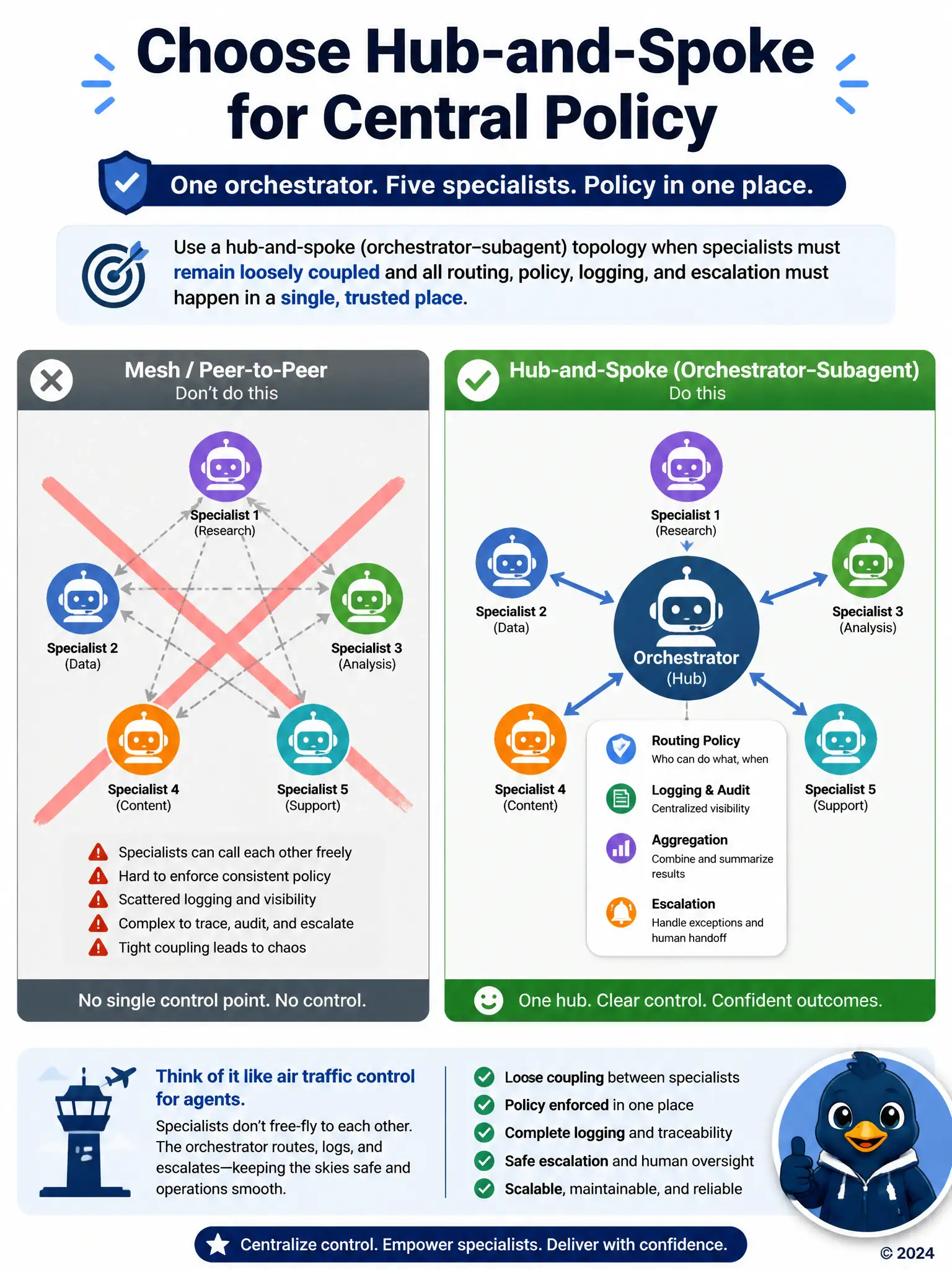
Short Explanation
You want hub-and-spoke: specialists don’t free-fly to each other; the orchestrator routes, logs, and escalates. That single choke point is exactly where you put policy when peer free-for-all would be chaos.
Full Explanation
Multi-agent architectures include hub-and-spoke, sequential, parallel, peer-to-peer, and orchestrator-subagent patterns. The hub-and-spoke (orchestrator-subagent) option is correct when you need centralized routing policy, observability, and escalation with specialists not calling each other directly—classic hub-and-spoke / orchestrator-subagent design.
The fully mesh peer-to-peer option is incorrect for this stem: full mesh peer-to-peer maximizes coupling and makes centralized policy harder.
The single sequential chain hard-coded in prompts option is incorrect: prompt-only sequential chains lack a durable policy and logging control plane.
The parallel fan-out option without aggregation is incomplete: parallel fan-out without aggregation and without a hub does not meet the single enforcement-point requirement.
Exam caveat: “Single place for policy/routing/logging” → hub-and-spoke or orchestrator-subagent; “autonomous negotiation among equals” → peer-to-peer.