
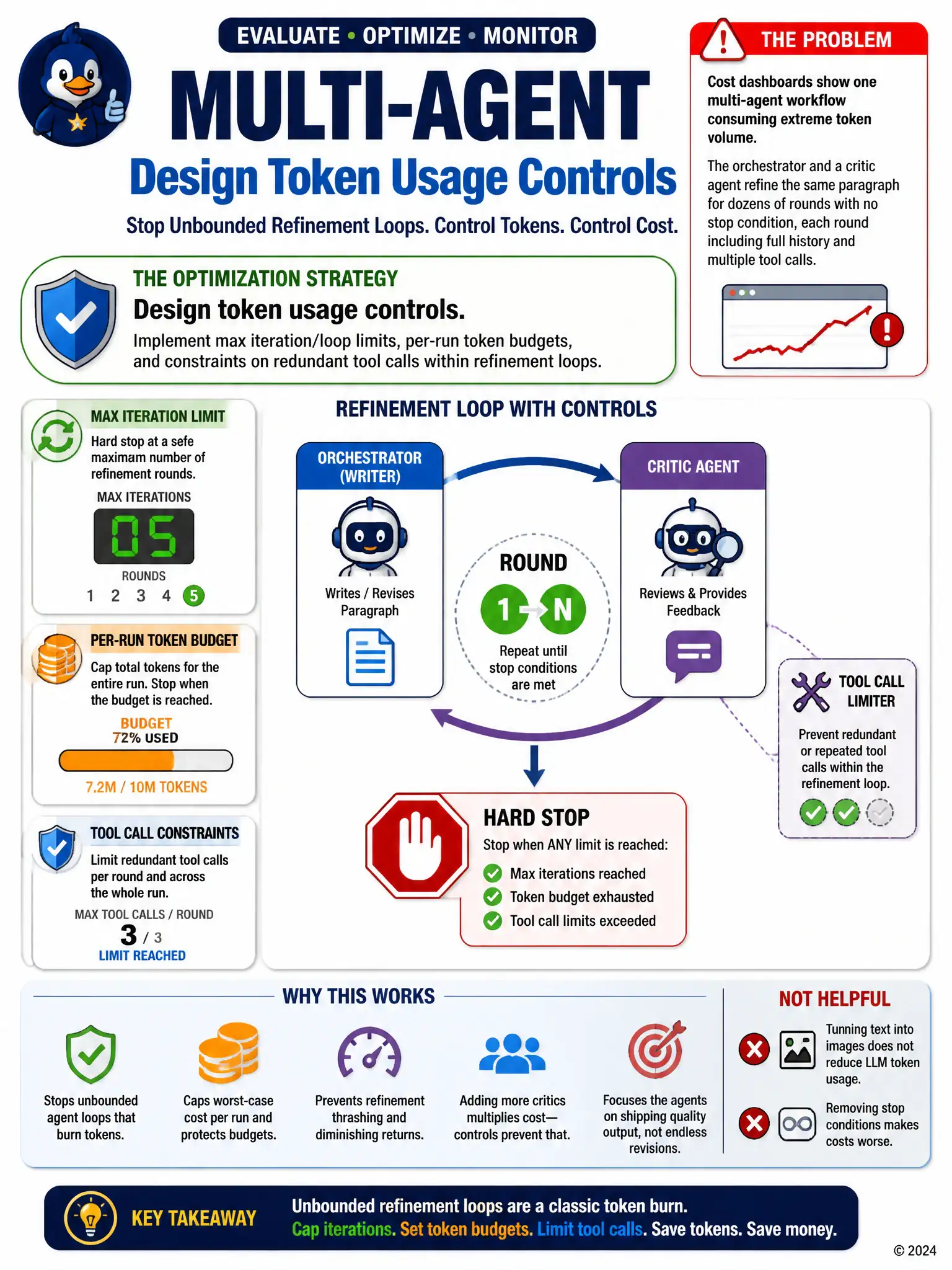
Cost dashboards show one multi-agent workflow consuming extreme token volume because the orchestrator and a critic agent refine the same paragraph for dozens of rounds with no stop condition, each round including full history and multiple tool calls. Which optimization strategy best targets this failure mode?
Select an answer to reveal the explanation.
Short Explanation
Unbounded agent loops are a classic token burn. You need to cap iterations, set per-run token budgets, and stop thrashing the same tools. That's the token optimization strategy, while adding more critics multiplies cost, image-encoded history doesn't help large language model token accounting, and removing stop conditions makes it worse.
Full Explanation
Correct strategy: design token usage controls including max iteration/loop limits, per-run token budgets, and constraints on redundant tool calls within refinement loops. Token limits, loop controls, and tool-call constraints optimize token usage. Multi-agent refinement without termination criteria or budgets creates runaway cost and latency.
Adding more critic agents to the loop so token use is shared across more identities is incorrect because adding agents to an unbounded loop increases aggregate token consumption.
Storing full conversation history in higher-resolution images instead of text is incorrect because image-encoded history is not a valid general substitute for text token control in agent reasoning pipelines.
Removing all stop conditions so refinement can continue until the process crashes is incorrect because removing stop conditions is the root cause pattern, not a fix.
Exam focus: loop controls and token budgets are first-class multi-agent cost/reliability controls.