
Users report that a long-running multi-agent planning session “forgets” goals stated at the beginning of the conversation after many turns, even though no explicit memory wipe was coded. Engineers confirm the implementation uses a simple last-N message window with no summarization of older turns. Which context-window issue is this, and what is the appropriate diagnostic framing?
Select an answer to reveal the explanation.
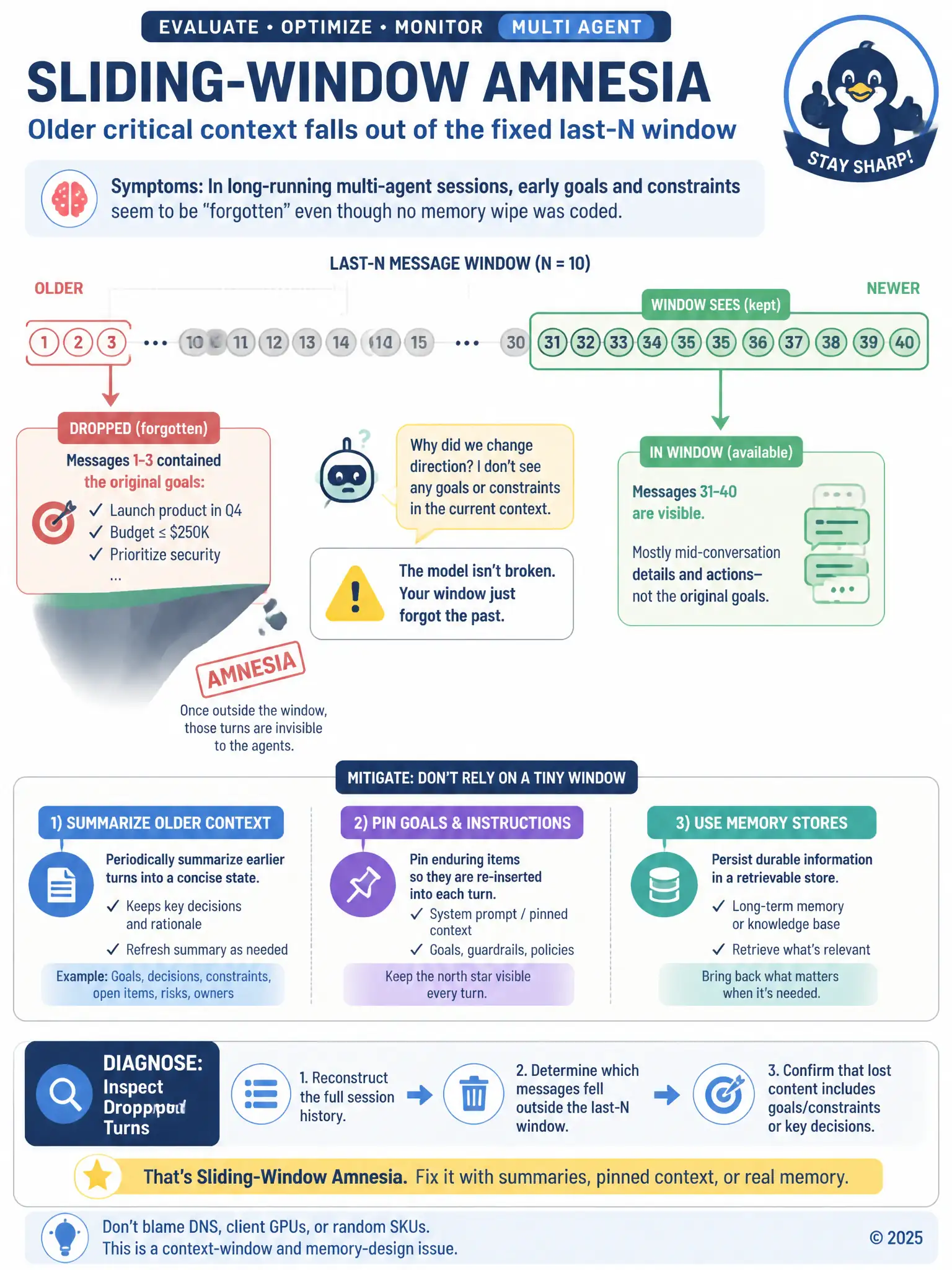
Short Explanation
If you only keep the last N messages, early goals fall off the cliff—that's sliding-window amnesia. Diagnose by seeing which turns were dropped, then fix it with summaries, pinned instructions, or real memory. Don't blame DNS, client GPUs, or random SKUs.
Full Explanation
The issue is sliding-window amnesia: older critical context falls out of the fixed last-N window; diagnose by inspecting dropped turns and mitigate with summarization, pinned goals, or memory stores. Optimizing multi-agent context requires diagnosing issues such as sliding-window amnesia, summary drift, vector-only recall limits, and entity continuity problems. A pure last-N window without summarization or durable memory will drop early goals as conversations grow. The model deployment SKU mismatch in a different Azure region unrelated to conversation history is incorrect because regional SKU choice does not explain systematic loss of early turns in a last-N window. DNS propagation delay between the browser and Azure Front Door is incorrect because DNS issues cause connectivity problems, not selective loss of early conversational goals. GPU thermal throttling on the client laptop GPU is incorrect because client GPU thermal state does not implement server-side context windowing for Azure-hosted agents. Exam focus: name context failure modes precisely—sliding-window amnesia is the last-N drop pattern.