
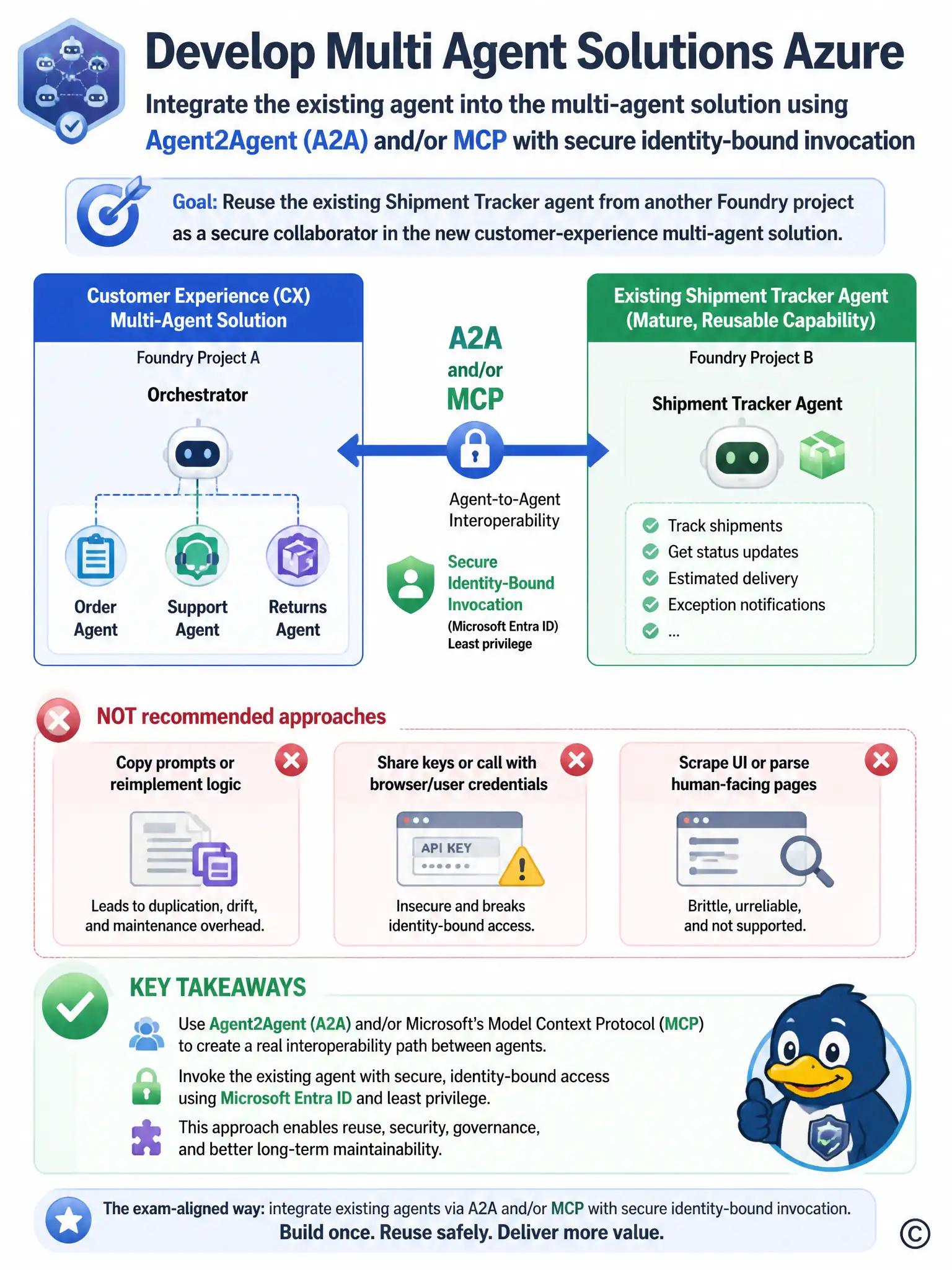
A logistics company already runs a mature “shipment tracker” agent in another business unit’s Microsoft Foundry project. A new customer-experience multi-agent solution must securely invoke that existing agent as a collaborator rather than reimplementing tracking logic, using an agent-to-agent interoperability approach. Which integration approach best matches the requirement?
Select an answer to reveal the explanation.
Short Explanation
You need a real interoperability path—A2A and/or MCP—with secure identity-bound invocation, not prompt copy-paste, leaked keys, or UI scraping. That lets you reuse the shipment tracker safely in a multi-agent solution.
Full Explanation
The correct approach is integrating the existing shipment tracker agent using Agent2Agent (A2A) and/or MCP with secure identity-bound invocation. This preserves a governed interface, authentication, and tool/agent contracts without reimplementation. Copying the shipment agent’s system prompt into a text file and pasting it weekly is incorrect because prompt copying does not provide live agent capabilities, version alignment, or secure invocation of the real agent. Exposing the shipment agent’s private model API key in client-side JavaScript for direct browser calls is incorrect because embedding private API keys in client-side code is a severe secret exposure and bypasses proper server-side identity. Scraping the shipment agent’s chat UI with a headless browser and parsing HTML for status text is incorrect because UI scraping is brittle, unsupported, and unsuitable for production agent collaboration. Exam focus: prefer A2A/MCP for secure agent reuse over informal coupling.