
A team is implementing a multi-step Azure multi-agent workflow that must checkpoint intermediate state, branch on tool outcomes, and resume after human approval without re-running completed nodes. They prefer a graph-based open-source orchestration model that natively models nodes, edges, and durable state. Which framework choice best matches these requirements?
Select an answer to reveal the explanation.
Short Explanation
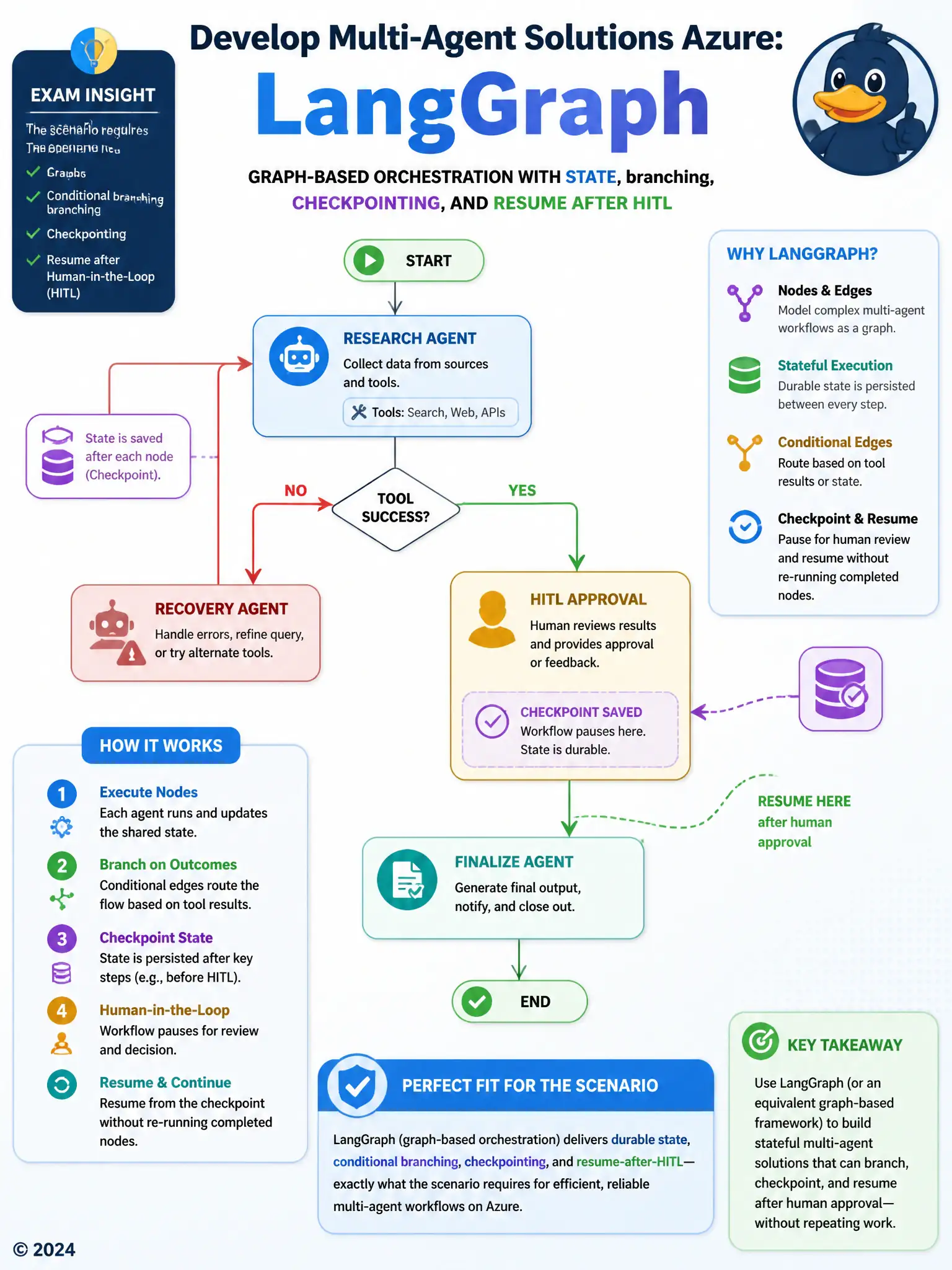
You need graphs, conditional branching, checkpoints, and resume-after-HITL, so pick LangGraph or an equivalent graph-based agent orchestration framework with stateful nodes, conditional edges, and checkpointing. A giant stateless prompt has no real checkpoints, blind cron restarts re-do completed work, and CSS animations aren’t orchestration.
Full Explanation
The best choice is LangGraph, or an equivalent graph-based agent orchestration framework, because it provides stateful nodes, conditional edges, and checkpointing for resume after human-in-the-loop approval. Implementing multi-agent orchestration frameworks includes Agent Framework, LangChain, and LangGraph. LangGraph’s graph model supports branching on tool outcomes and resuming after human approval without replaying finished steps.
A single stateless HTTP request that concatenates all agents into one prompt with no checkpoints is incorrect because it lacks durable intermediate state and controlled resume. A cron job that blindly restarts the entire workflow from step one every five minutes is incorrect because unconditional full restarts waste work and do not model graph checkpoints. A pure CSS front-end animation that visually simulates agents without backend state is incorrect because UI simulation is not backend multi-agent orchestration.
Exam focus: map durable multi-step agent workflows with HITL resume to graph-based stateful frameworks such as LangGraph.