
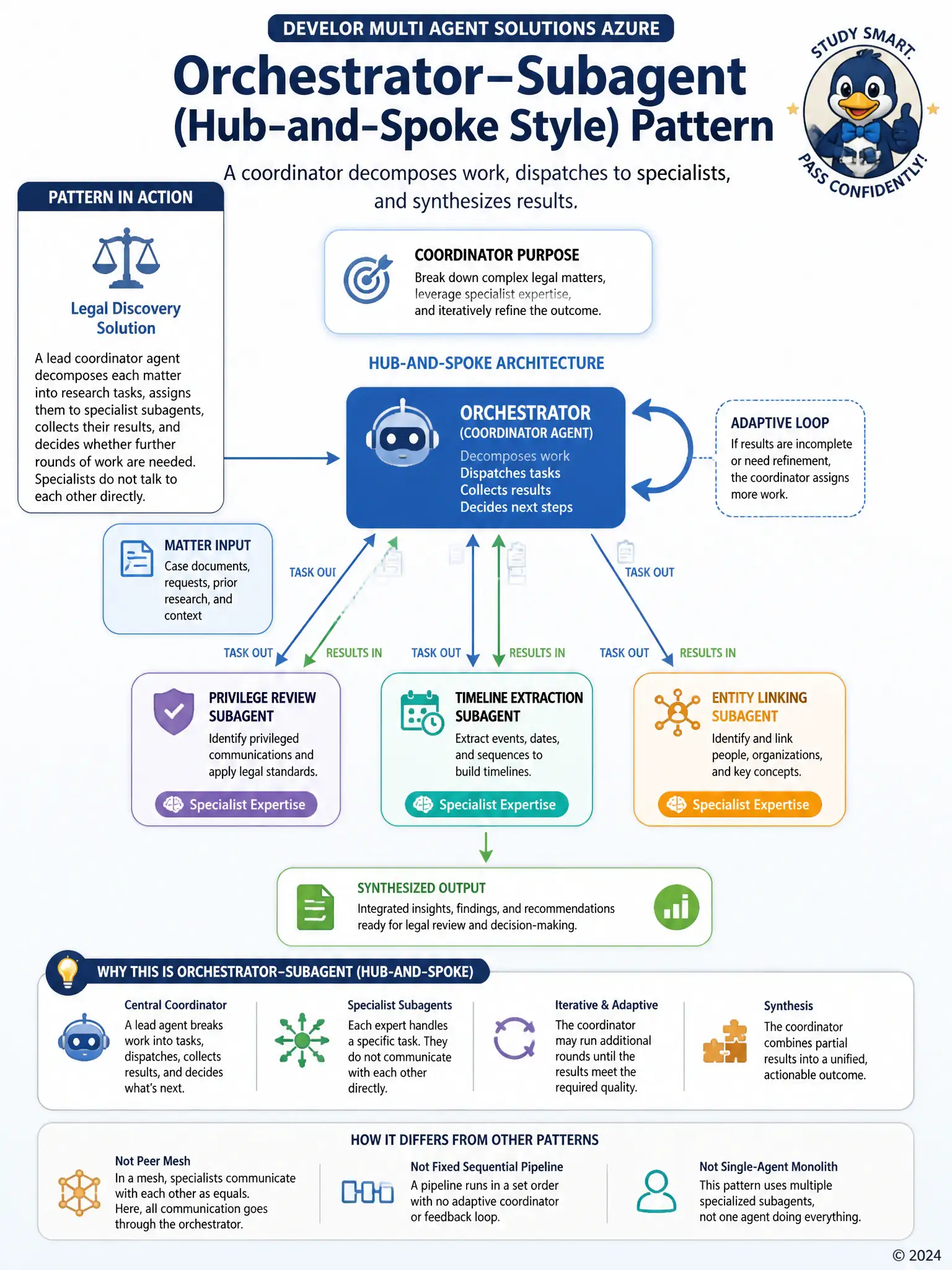
A legal-discovery solution uses a lead coordinator agent that decomposes each matter into research tasks, assigns those tasks to specialist subagents (privilege review, timeline extraction, entity linking), collects their partial results, and decides whether further rounds of work are needed. Specialists do not talk to each other directly. Which orchestration pattern is being described?
Select an answer to reveal the explanation.
Short Explanation
A lead agent that breaks work up, farms it to specialists, gathers results, and may loop again—with specialists not talking sideways—is the orchestrator-subagent, hub-and-spoke pattern. You're describing a coordinator that decomposes, dispatches, synthesizes, and decides on more rounds.
Full Explanation
The described pattern is the orchestrator-subagent, hub-and-spoke style pattern: a coordinator owns decomposition, dispatch, synthesis, and optional control loops, while specialists execute scoped tasks without requiring full peer connectivity.
A pure peer-to-peer mesh where every agent broadcasts to every other agent with equal authority is incorrect because peer-to-peer implies lateral agent communication and equal authority, which the scenario explicitly excludes.
A strict sequential pipeline where output of privilege review always feeds timeline extraction with no coordinator decisions is incorrect because a strict fixed pipeline lacks the coordinator’s adaptive multi-round assignment behavior.
A single-agent monolith that performs privilege, timeline, and entity work inside one prompt with no subagents is incorrect because a single prompt with no subagents is not multi-agent orchestration.
Exam focus: map “coordinator + specialists + synthesis + optional loops” to orchestrator-subagent.