
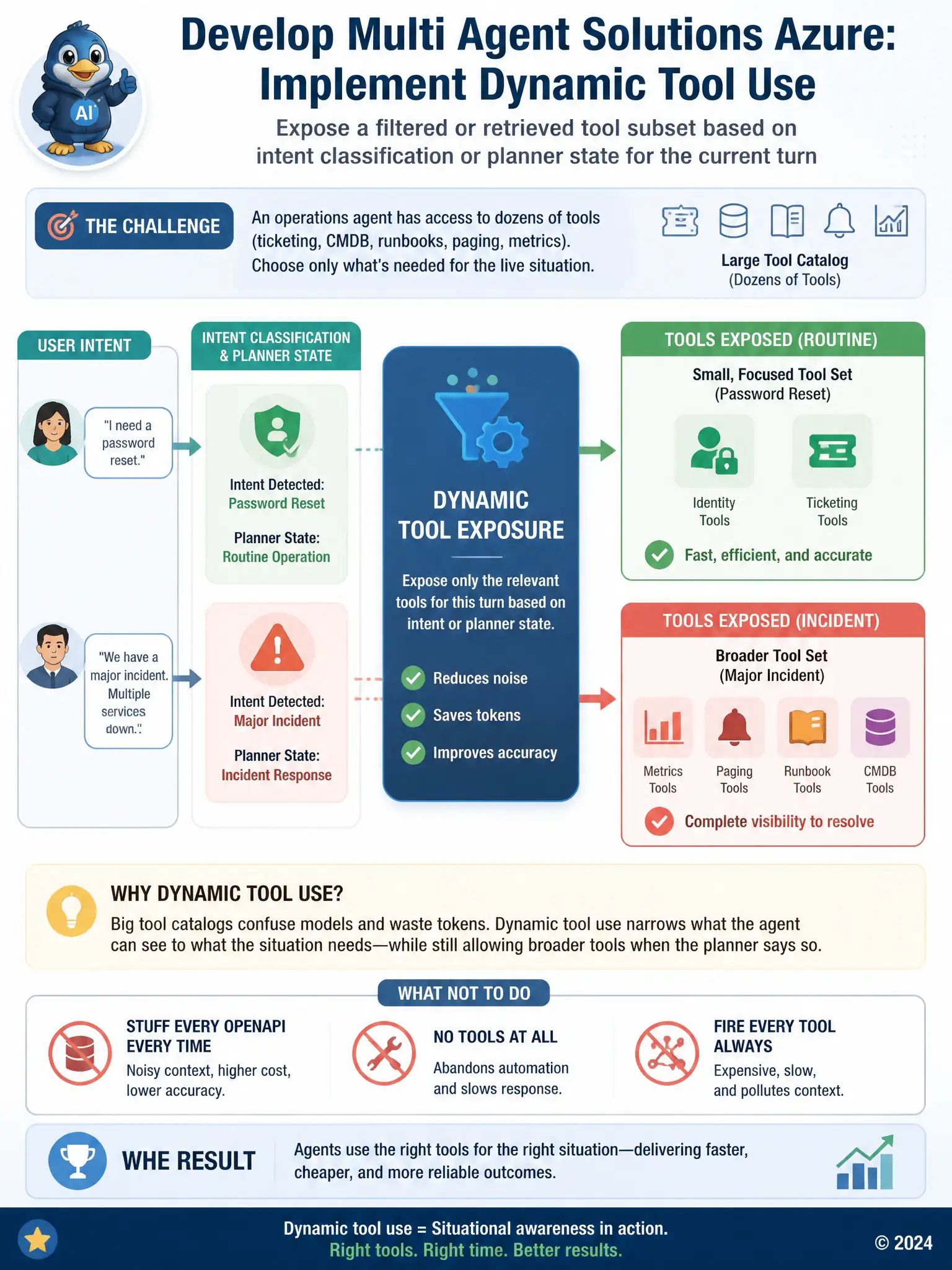
An operations agent has access to dozens of tools (ticketing, CMDB, runbooks, paging, metrics). For routine password resets it should call only the identity and ticketing tools; for major incidents it may need metrics, paging, and runbook tools. The team wants the model to choose tools based on the live situation rather than always binding the full catalog into every turn. Which approach best supports this?
Select an answer to reveal the explanation.
Short Explanation
You need the agent to see only the tools the current situation actually needs. Dynamic tool use lets the runtime filter or retrieve a smaller tool set based on intent or planner state, so password resets can use identity and ticketing tools while major incidents can also use metrics, paging, and runbook tools. Stuffing the whole catalog into every request is noisy, removing tools kills automation, and calling every tool every time is wasteful.
Full Explanation
Dynamic tool use is correct because the runtime can expose a filtered or retrieved subset of tools based on intent classification, routing, or planner state for the current turn. This matches the operational need: routine password resets can be limited to identity and ticketing tools, while major incidents can be given access to metrics, paging, and runbook tools when needed. Dynamic exposure improves precision, reduces token overhead, and lowers wrong-tool risk in large catalogs.
Embedding the complete OpenAPI of every enterprise system into every system prompt regardless of intent is incorrect because it increases prompt size and tool-selection errors. Removing all tools and requiring manual API response pasting is incorrect because it defeats agentic automation. Calling every registered tool every turn and concatenating all results is incorrect because it is costly, slow, and floods context with irrelevant data.
Exam focus: dynamic or specified tool use scales tool ecosystems without full-catalog binding each turn.